
CryoSplat: Gaussian Splatting for Cryo-EM Homogeneous Reconstruction
Abstract
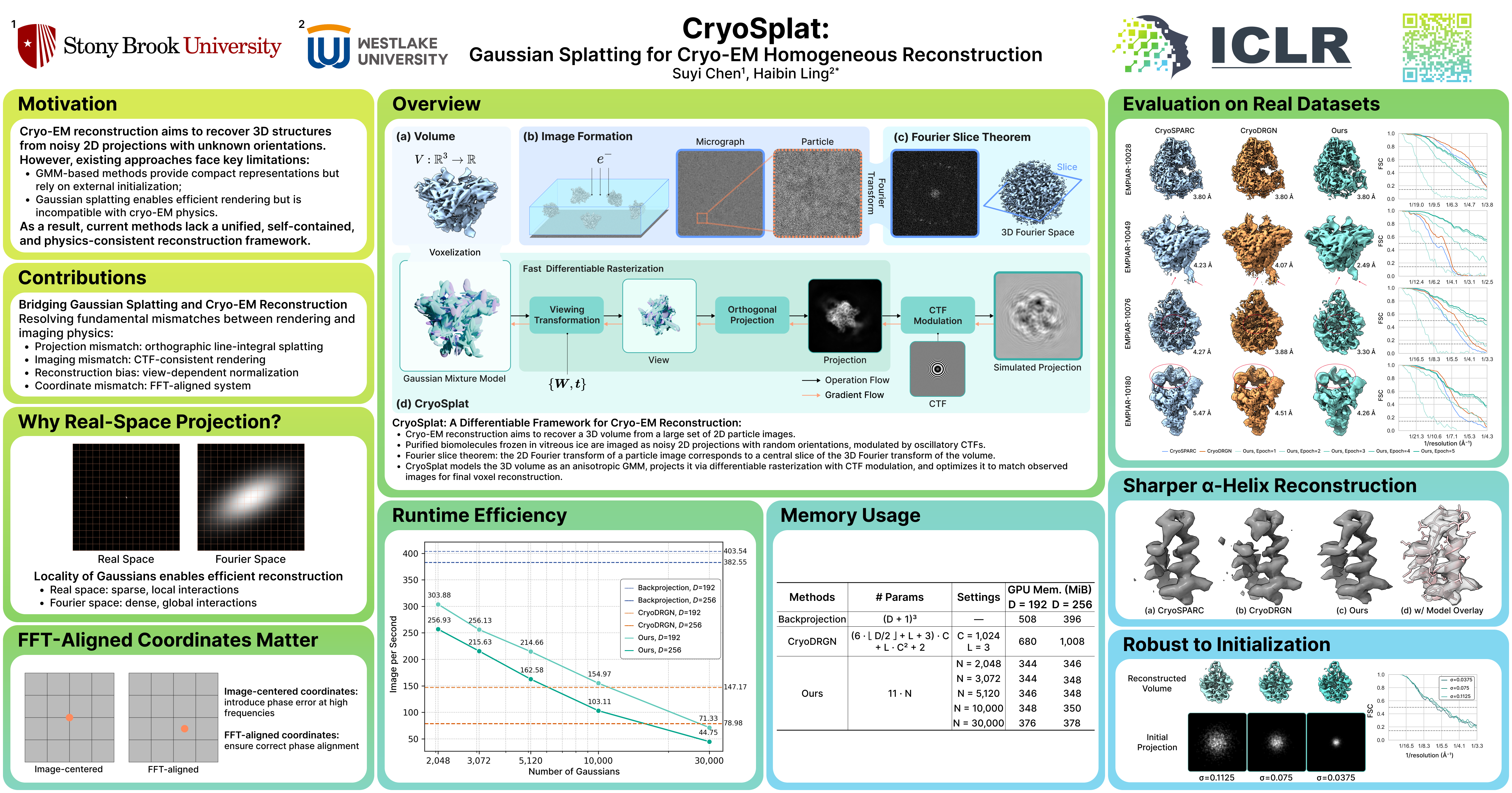
As a critical modality for structural biology, cryogenic electron microscopy (cryo-EM) facilitates the determination of macromolecular structures at near-atomic resolution. The core computational task in single-particle cryo-EM is to reconstruct the 3D electrostatic potential of a molecule from noisy 2D projections acquired at unknown orientations. Gaussian mixture models (GMMs) provide a continuous, compact, and physically interpretable representation for molecular density and have recently gained interest in cryo-EM reconstruction. However, existing methods rely on external consensus maps or atomic models for initialization, limiting their use in self-contained pipelines. In parallel, differentiable rendering techniques such as Gaussian splatting have demonstrated remarkable scalability and efficiency for volumetric representations, suggesting a natural fit for GMM-based cryo-EM reconstruction. However, off-the-shelf Gaussian splatting methods are designed for photorealistic view synthesis and remain incompatible with cryo-EM due to mismatches in the image formation physics, reconstruction objectives, and coordinate systems. Addressing these issues, we propose cryoSplat, a GMM-based method that integrates Gaussian splatting with the physics of cryo-EM image formation. In particular, we develop an orthogonal projection-aware Gaussian splatting, with adaptations such as a view-dependent normalization term and FFT-aligned coordinate system tailored for cryo-EM imaging. These innovations enable stable and efficient homogeneous reconstruction directly from raw cryo-EM particle images using random initialization. Experimental results on real datasets validate the effectiveness and robustness of cryoSplat over representative baselines. The code will be released at https://github.com/Chen-Suyi/cryosplat.