
UrbanGraph: Physics-Informed Spatio-Temporal Dynamic Heterogeneous Graphs for Urban Microclimate Prediction
Abstract
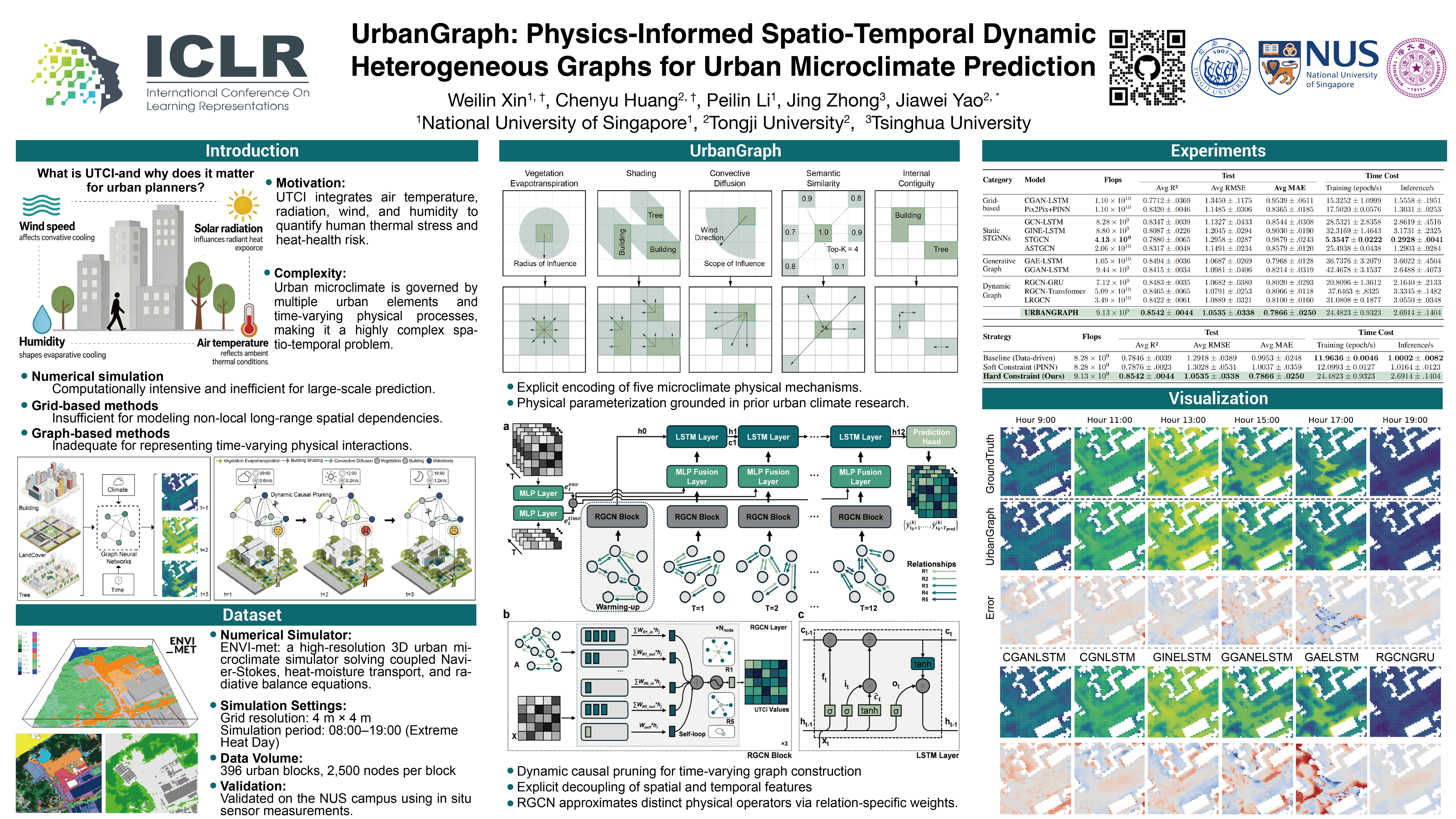
With rapid urbanization, predicting urban microclimates has become critical, as it affects building energy demand and public health risks. However, existing generative and homogeneous graph approaches fall short in capturing physical consistency, spatial dependencies, and temporal variability. \revise{To address this, we introduce UrbanGraph, a framework founded on a novel structure-based inductive bias. Unlike implicit graph learning, UrbanGraph transforms physical first principles into a dynamic causal topology, explicitly encoding time-varying causalities (e.g., shading and convection) directly into the graph structure to ensure physical consistency and data efficiency. Results show that UrbanGraph achieves state-of-the-art performance across all baselines. Specifically, the use of explicit causal pruning significantly reduces the model's floating-point operations (FLOPs) by 73.8\% and increases training speed by 21\% compared to implicit graphs. Our contribution includes the first high-resolution benchmark for spatio-temporal microclimate modeling, and a generalizable explicit topological encoding paradigm applicable to urban spatio-temporal dynamics governed by known physical equations.