
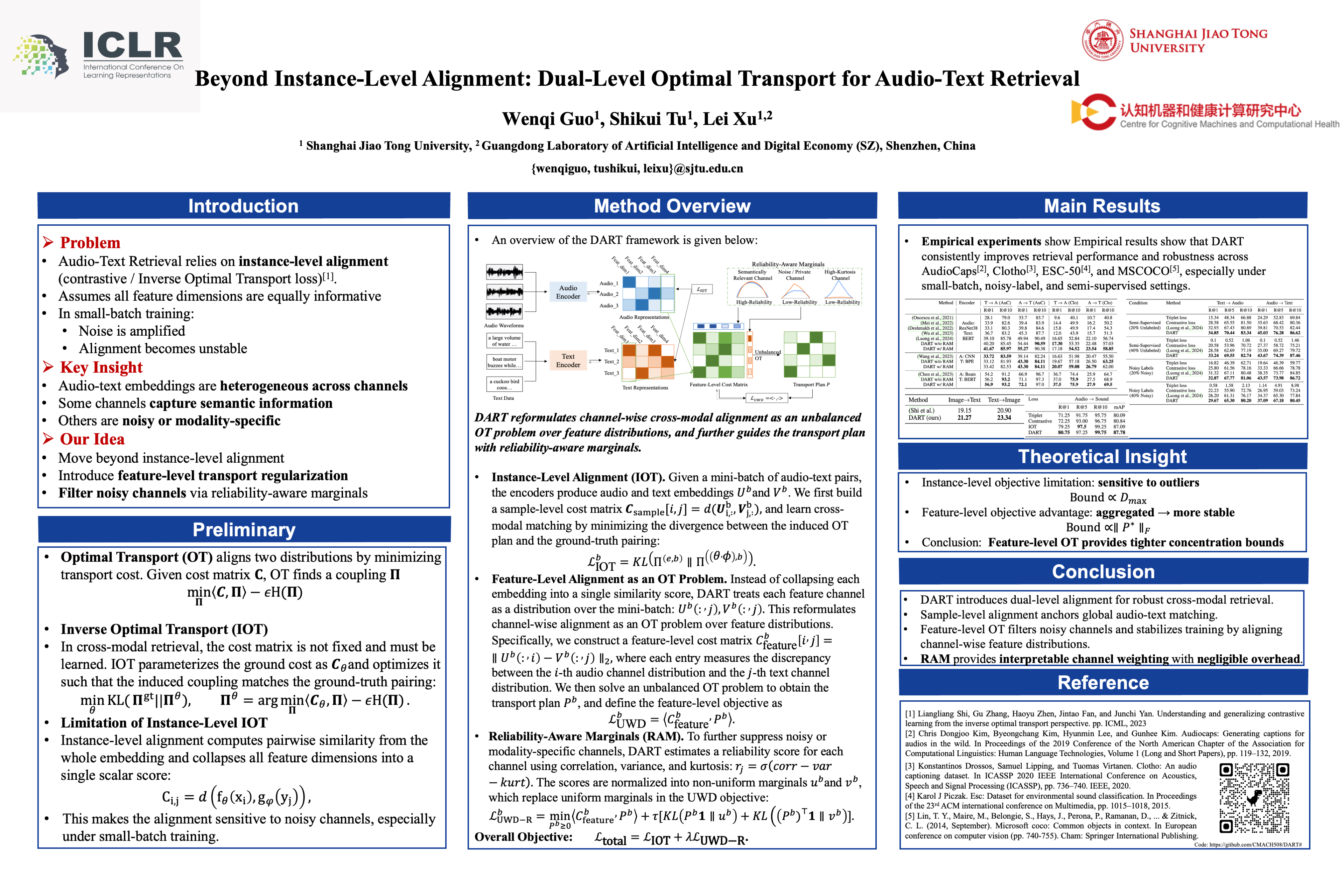
Beyond Instance-Level Alignment: Dual-Level Optimal Transport for Audio-Text Retrieval
Abstract
Cross-modal matching tasks have achieved significant progress, yet remain limited by mini-batch subsampling and scarce labelled data. Existing objectives, such as contrastive losses, focus solely on instance-level alignment and implicitly assume that all feature dimensions contribute equally. Under small batches, this assumption amplifies noise, making alignment signals unstable and biased. We propose DART (Dual-level Alignment via Robust Transport), a framework that augments instance-level alignment with feature-level regularization based on the Unbalanced Wasserstein Distance (UWD). DART constructs reliability-weighted marginals that adaptively reweight channels according to their cross-modal consistency and variance statistics, highlighting stable and informative dimensions while down-weighting noisy or modality-specific ones. From a theoretical perspective, we establish concentration bounds showing that instance-level objectives scale with the maximum distance across presumed aligned pairs, while feature-level objectives are governed by the Frobenius norm of the transport plan. By suppressing unmatched mass and sparsifying the transport plan, DART reduces the effective transport diameter and tightens the bound, yielding greater robustness under small batches. Empirically, DART achieves state-of-the-art retrieval performance on three audio-text benchmarks, with particularly strong gains under scarce labels and small batch sizes.