
TriQDef: Disrupting Semantic and Gradient Alignment to Prevent Adversarial Patch Transferability in Quantized Neural Networks
Abstract
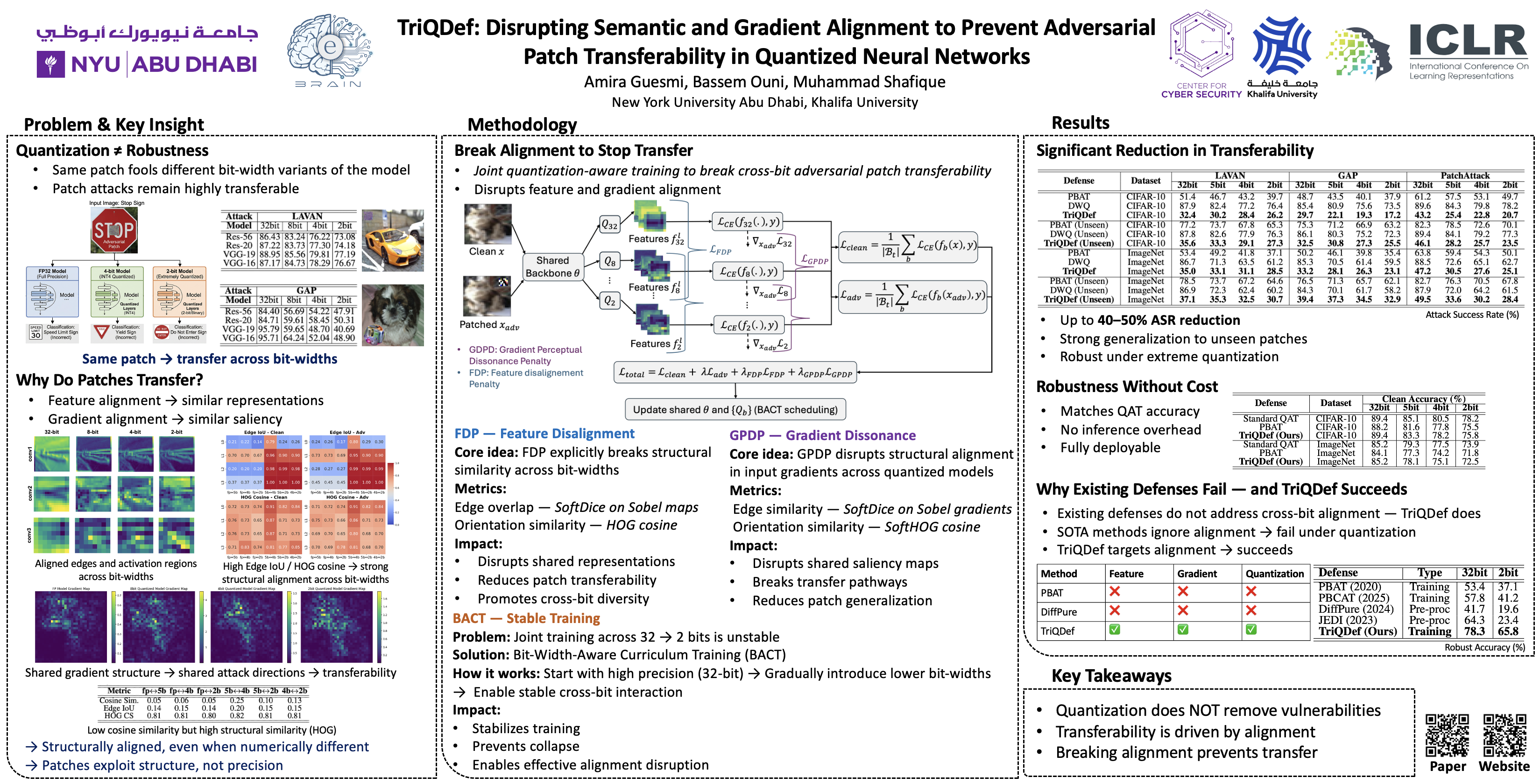
Quantized Neural Networks (QNNs) are widely deployed in edge and resource-constrained environments for their efficiency in computation and memory. While quantization distorts gradient landscapes and weakens pixel-level attacks, it offers limited robustness against patch-based adversarial attacks—localized, high-saliency perturbations that remain highly transferable across bit-widths. Existing defenses either overfit to specific quantization settings or fail to address this cross-bit vulnerability. We propose \textbf{TriQDef}, a tri-level quantization-aware defense framework that disrupts the transferability of patch-based attacks across QNNs. TriQDef integrates: (1) a \emph{Feature Disalignment Penalty (FDP)} that enforces semantic inconsistency by penalizing perceptual similarity in intermediate features; (2) a \emph{Gradient Perceptual Dissonance Penalty (GPDP)} that misaligns input gradients across quantization levels using structural metrics such as Edge IoU and HOG Cosine; and (3) a \emph{Joint Quantization-Aware Training Protocol} that applies these penalties within a \emph{shared backbone} jointly optimized across multiple quantizers. Extensive experiments on CIFAR-10 and ImageNet show that TriQDef lowers Attack Success Rates (ASR) by over 40\% on unseen patch and quantization combinations while preserving high clean accuracy. These results highlight the importance of disrupting both semantic and perceptual gradient alignment to mitigate patch transferability in QNNs.