
Pretraining with Re-parametrized Self-Attention: Unlocking Generalizationin SNN-Based Neural Decoding Across Time, Brains, and Tasks
Abstract
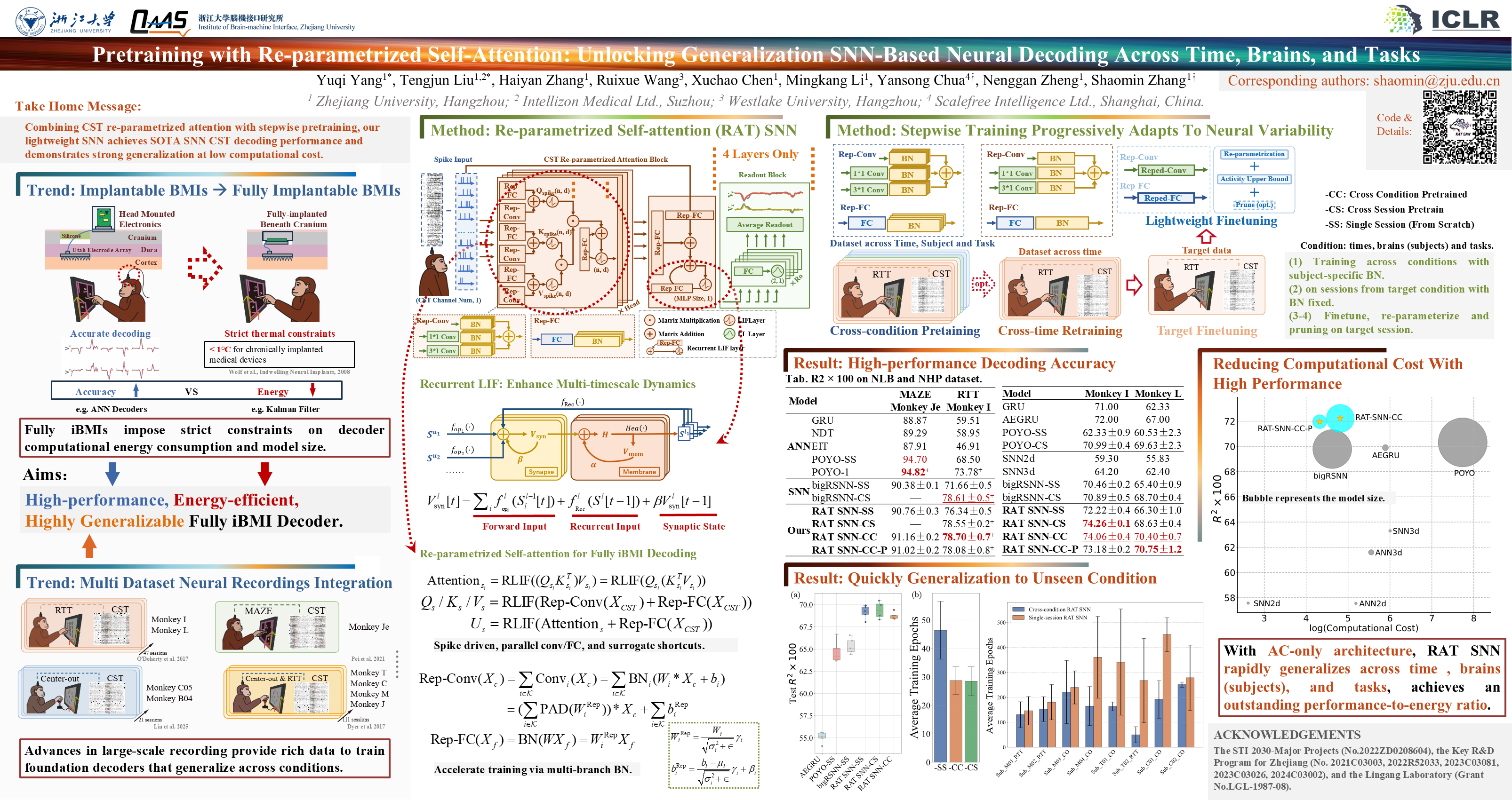
The emergence of large-scale neural activity datasets provides new opportunities to enhance the generalization of neural decoding models. However, it remains a practical challenge to design neural decoders for fully implantable brain-machine interfaces (iBMIs) that achieve high accuracy, strong generalization, and low computational cost, which are essential for reliable, long-term deployment under strict power and hardware constraints. To address this, we propose the Re-parametrized self-Attention Spiking Neural Network (RAT SNN) with a cross-condition pretraining framework to integrate neural variability and adapt to stringent computational constraints. Specifically, our approach introduces multi-timescale dynamic spiking neurons to capture the complex temporal variability of neural activity. We refine spike-driven attention within a lightweight, re-parameterized architecture that enables accumulate-only operations between spiking neurons without sacrificing decoding accuracy. Furthermore, we develop a stepwise training pipeline to systematically integrate neural variability across conditions, including neural temporal drift, subjects and tasks. Building on these advances, we construct a pretrained model capable of rapid generalization to unseen conditions with high performance. We demonstrate that RAT SNN consistently outperforms leading SNN baselines and matches the accuracy of state-of-the-art artificial neural network (ANN) models with much lower computational cost under both seen and unseen conditions across various datasets. Collectively, pretrained-RAT SNN represents a high-performance, highly generalizable, and energy-efficient prototype of an SNN foundation model for fully iBMI. Code is available at RAT SNN GitHub.