
Healthcare Insurance Fraud Detection via Continual Fiedler Vector Graph Model
Abstract
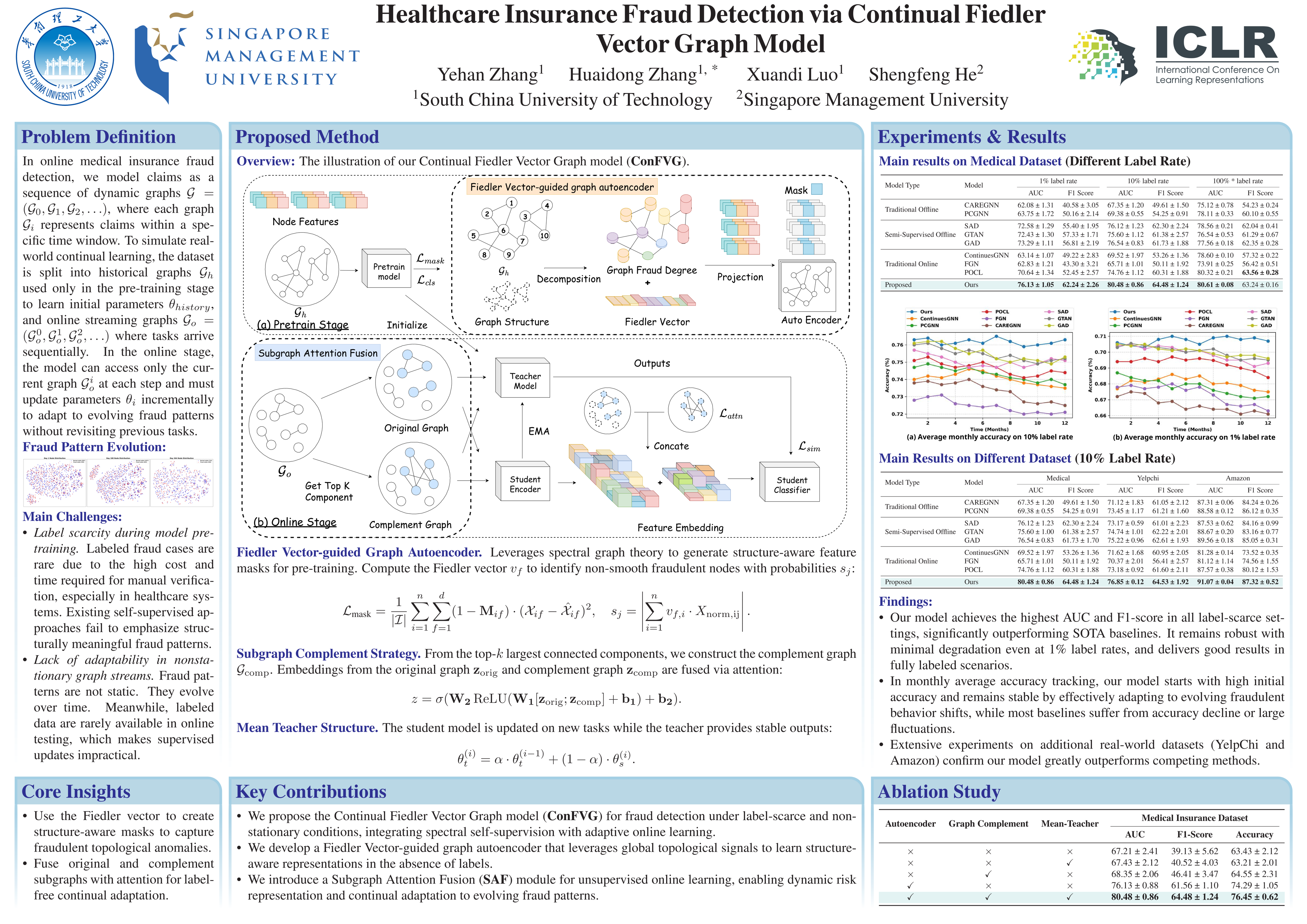
Healthcare insurance fraud detection presents unique machine learning challenges: labeled data are scarce due to delayed verification processes, and fraudulent behaviors evolve rapidly, often manifesting in complex, graph-structured interactions. Existing methods struggle in such settings. Pretraining routines typically overlook structural anomalies under limited supervision, while online models often fail to adapt to changing fraud patterns without labeled updates. To address these issues, we propose the Continual Fiedler Vector Graph model (ConFVG), a fraud detection framework designed for label-scarce and non-stationary environments. The framework comprises two key components. To mitigate label scarcity, we develop a Fiedler Vector-guided graph autoencoder that leverages spectral graph properties to learn structure-aware node representations. The Fiedler Vector, derived from the second smallest eigenvalue of the graph Laplacian, captures global topological signals such as community boundaries and connectivity bottlenecks, which are patterns frequently associated with collusive fraud. This enables the model to identify structurally anomalous nodes without relying on labels. To handle evolving graph streams, we propose a Subgraph Attention Fusion (SAF) module that constructs neighborhood subgraphs and applies attention-based reweighting to emphasize emerging high-risk structures. This design allows the model to adapt to new fraud patterns in real time. A Mean Teacher mechanism further stabilizes online updates and prevents forgetting of previously acquired knowledge. Experiments on real-world medical fraud datasets demonstrate that the Continual Fiedler Vector Graph model outperforms state-of-the-art baselines in both low-label and distribution-shift scenarios, offering a scalable and structure-sensitive solution for real-time fraud detection.