
Topological Anomaly Quantification for Semi-supervised Graph Anomaly Detection
Abstract
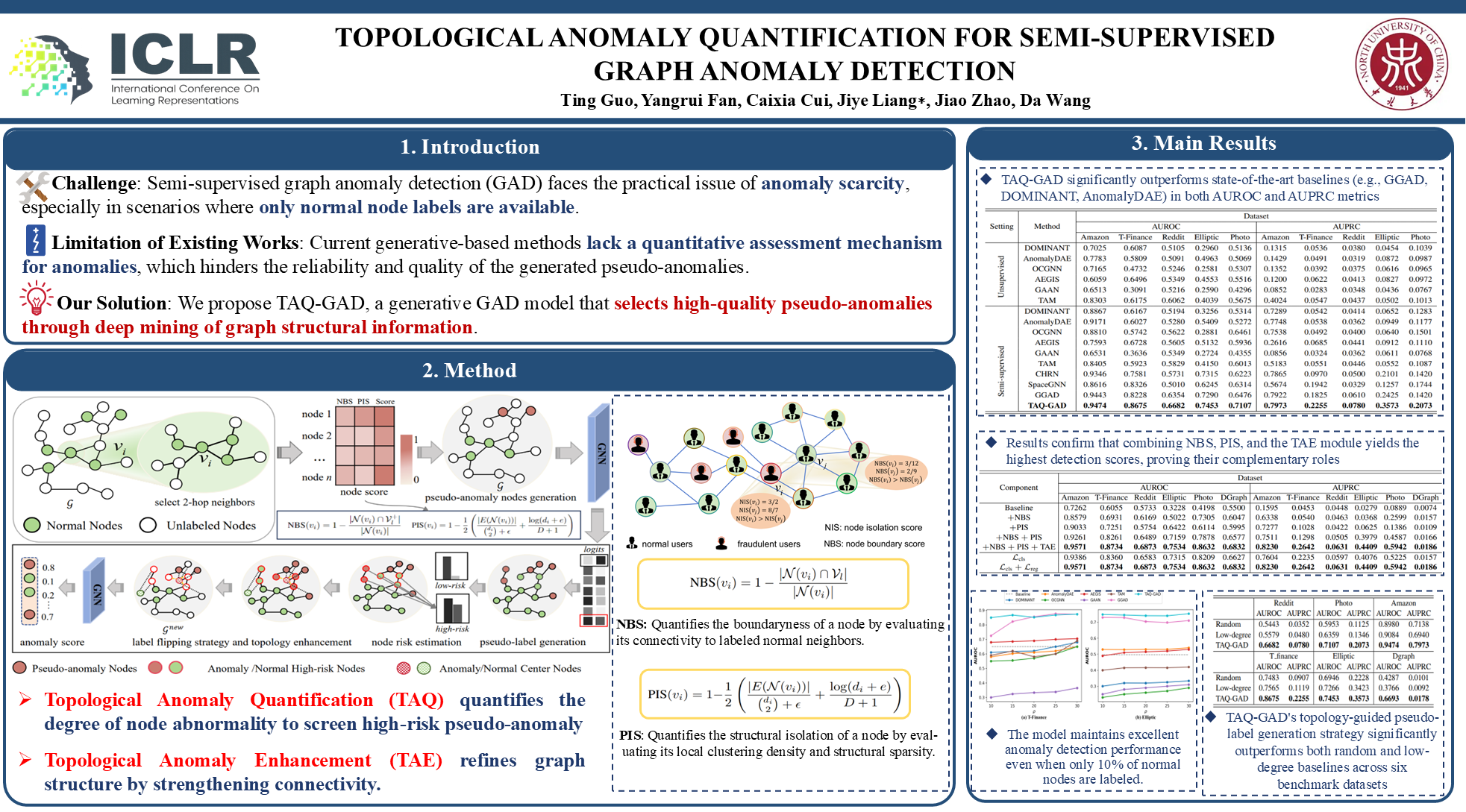
Semi-supervised graph anomaly detection identifies nodes deviating from normal patterns using a limited set of labeled nodes. This paper specifically addresses the challenging scenario where only normal node labels are available. To address the challenge of anomaly scarcity in real-world graphs, generative-based methods synthesize anomalies by linear/non-linear interpolation or random noise perturbation. However, these methods lack a quantitative assessment of anomalies, hindering the reliability of the generated ones. To overcome this limitation, we propose a generative graph anomaly detection model based on topological anomaly quantification (TAQ-GAD). First, we design a topological anomaly quantification module (TAQ), which quantifies node abnormality through two topological metrics: The node boundary score (NBS) quantifies the boundaryness of a node by evaluating its connectivity to labeled normal neighbors. The node isolation score (NIS) assesses the structural isolation of a node by evaluating its connection strength to other nodes within the same category. This anomaly measurement module dynamically screens nodes with high anomaly scores as pseudo-anomaly nodes. Subsequently, the topological anomaly enhancement (TAE) module generates virtual anomaly center nodes and constructs their topological relationships with other nodes. Finally, the method integrates normal and pseudo-anomaly nodes on the enhanced graph for model training. Extensive experiments on benchmark datasets demonstrate TAQ-GAD’s superiority over state-of-the-art methods and effectively improve anomaly detection performance.