
AtC: Aggregate-then-Calibrate for Human-centered Assessment
Zejun Xie ⋅ Xintong Li ⋅ Guang Wang ⋅ Desheng Zhang
Abstract
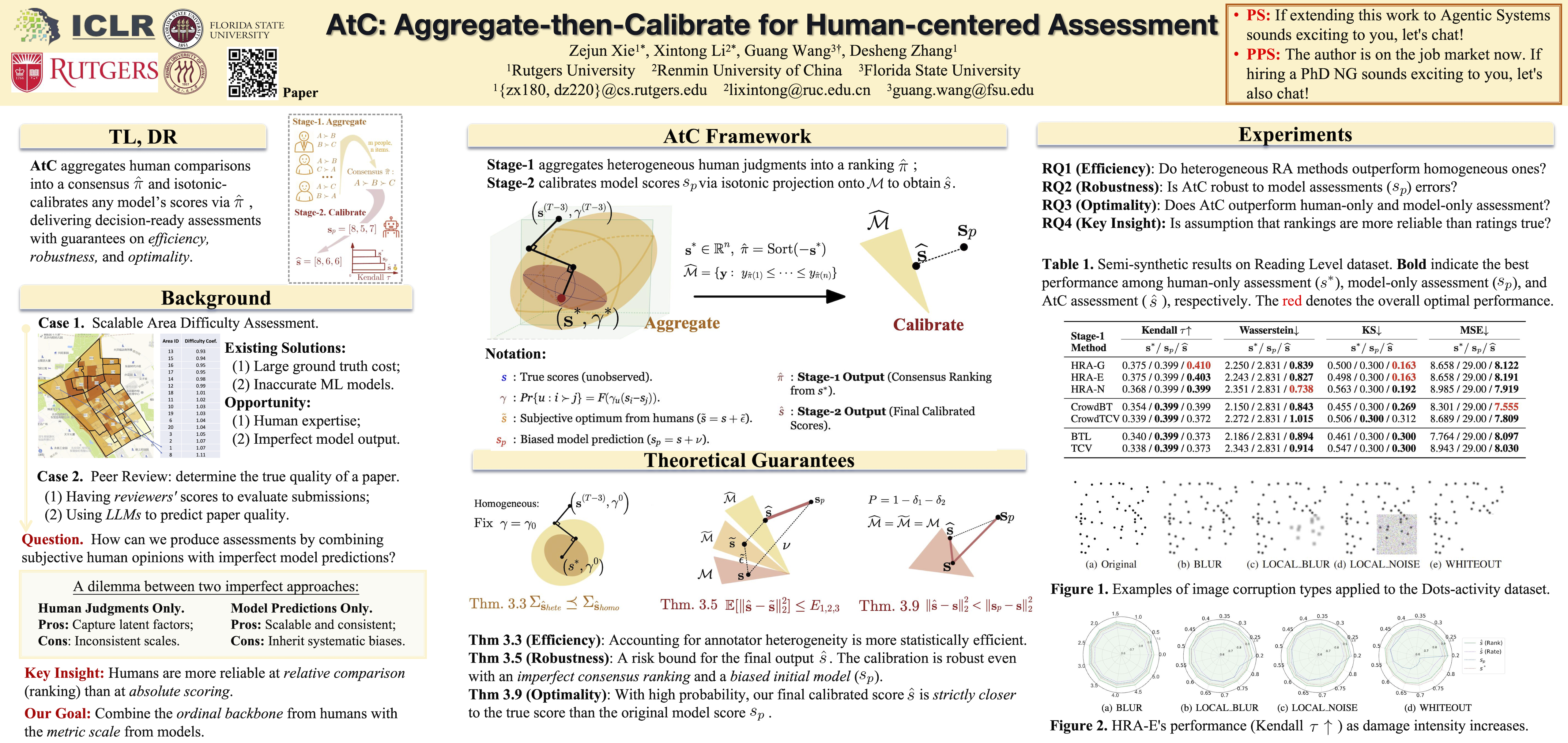
Human-centered assessment tasks, which are essential for systematic decision-making, rely heavily on human judgment and typically lack verifiable ground truth. Existing approaches face a dilemma: methods using only human judgments suffer from heterogeneous expertise and inconsistent rating scales, while methods using only model-generated scores must learn from imperfect proxies or incomplete features. We propose Aggregate-then-Calibrate (AtC), a two-stage framework that combines these complementary sources. Stage-1 aggregates heterogeneous comparative judgments into a consensus ranking $\hat{\pi}$ using a rank-aggregation model that accounts for annotator reliability. Stage-2 calibrates any predictive model’s scores by an isotonic projection onto the order $\hat{\pi}$, enforcing ordinal consistency while preserving as much of the model’s quantitative information as possible. Theoretically, we show: (1) modeling annotator heterogeneity yields strictly more efficient consensus estimation than homogeneity; (2) isotonic calibration enjoys risk bounds even when the consensus ranking is misspecified; and (3) AtC asymptotically outperforms model-only assessment. Across semi-synthetic and real-world datasets, AtC consistently improves accuracy and robustness over human-only or model-only assessments. Our results bridge judgment aggregation with model-free calibration, providing a principled recipe for human-centered assessment when ground truth is costly, scarce, or unverifiable.
Video
Chat is not available.
Successful Page Load