
Fair Graph Machine Learning under Adversarial Missingness Processes
Abstract
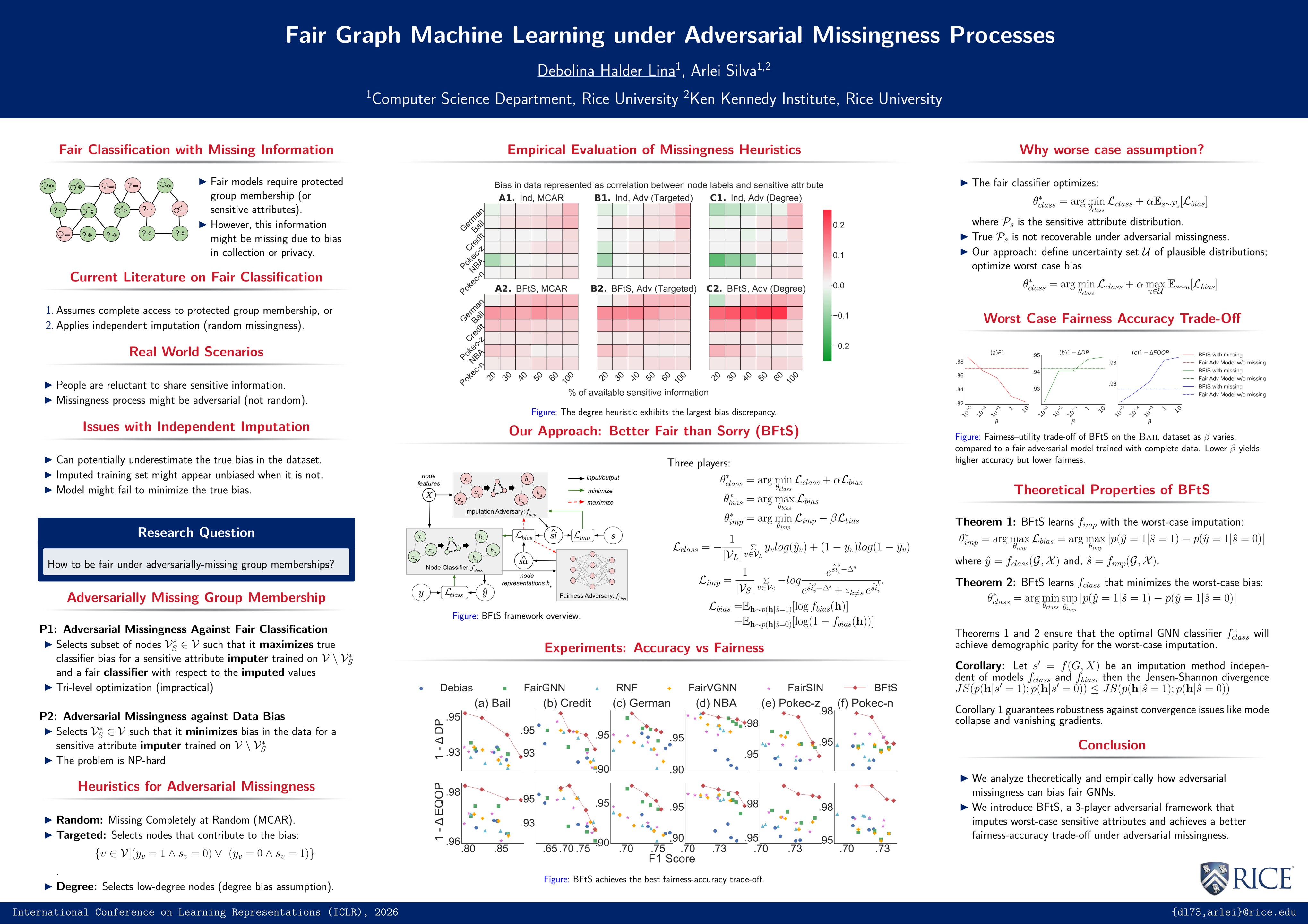
Graph Neural Networks (GNNs) have achieved state-of-the-art results in many relevant tasks where decisions might disproportionately impact specific communities. However, existing work on fair GNNs often assumes that either sensitive attributes are fully observed or they are missing completely at random. We show that an adversarial missingness process can inadvertently disguise a fair model through the imputation, leading the model to overestimate the fairness of its predictions. We address this challenge by proposing Better Fair than Sorry (BFtS), a fair missing data imputation model for sensitive attributes. The key principle behind BFtS is that imputations should approximate the worst-case scenario for fairness---i.e. when optimizing fairness is the hardest. We implement this idea using a 3-player adversarial scheme where two adversaries collaborate against a GNN classifier, and the classifier minimizes the maximum bias. Experiments using synthetic and real datasets show that BFtS often achieves a better fairness x accuracy trade-off than existing alternatives under an adversarial missingness process.