
BOLT: Decision‑Aligned Distillation and Budget-Aware Routing for Constrained Multimodal QA on Robots
Abstract
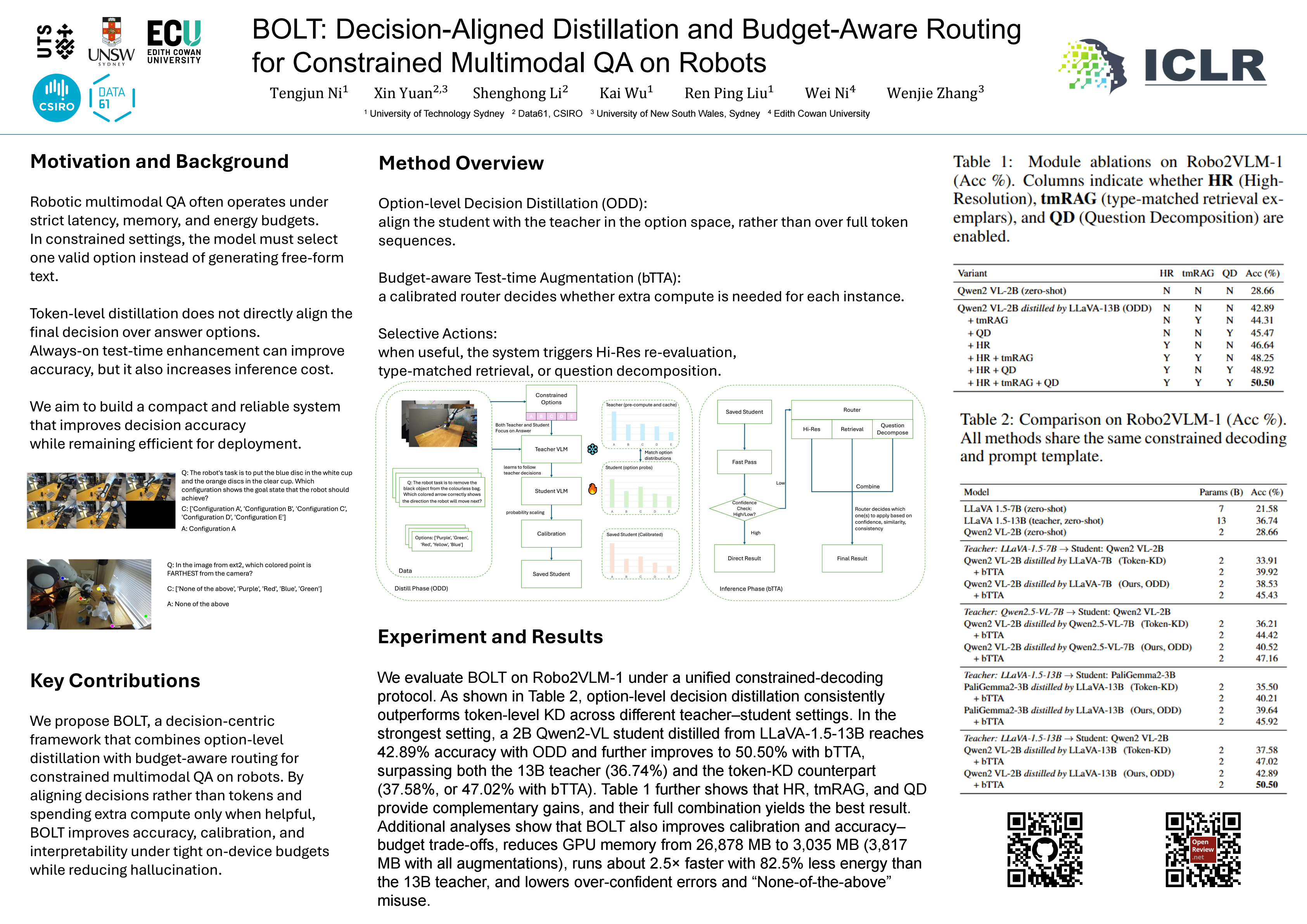
Robotic systems can require multimodal reasoning under stringent constraints of latency, memory, and energy. Standard instruction tuning and token-level distillation fail to deliver decision quality, reliability, and interpretability under these constraints. We introduce BOLT, a decision-aligned distillation and budget-aware routing framework that treats multi-choice prediction as a decision surface to be aligned during training and selectively refined at inference. During training, BOLT introduces Option-level Decision Distillation to align student models directly on the decision surface of multi-choice answers, thereby eliminating prompt artifacts, improving calibration, and optimizing the exact output space. At inference, BOLT activates Budget-aware Test-time Augmentation, a calibrated router that uses low-cost signals such as confidence, margin, entropy, retrieval affinity, and agreement across short question decompositions to trigger high-resolution reevaluation, type-matched retrieval exemplars, or question decomposition only when their expected benefit outweighs cost. On Robo2VLM-1, a 2B BOLT student distilled from LLaVA-1.5-13B improves accuracy from 28.66 in zero-shot to 42.89 with decision distillation and to 50.50 with budgeted routing, surpassing the 13B teacher at 36.74. It lowers expected calibration error, strengthens the risk-coverage frontier, and slashes GPU memory from 26,878 MB for the teacher to 3,035 MB for the distilled student, and 3,817 MB with all augmentations enabled. By constraining outputs to valid options while exposing retrieved evidence and decomposition traces, BOLT reduces hallucination and provides transparent decision-making, enabling large-model quality on edge robots.