
Compositional Generalization from Learned Skills via CoT Training: A Theoretical and Structural Analysis for Reasoning
Abstract
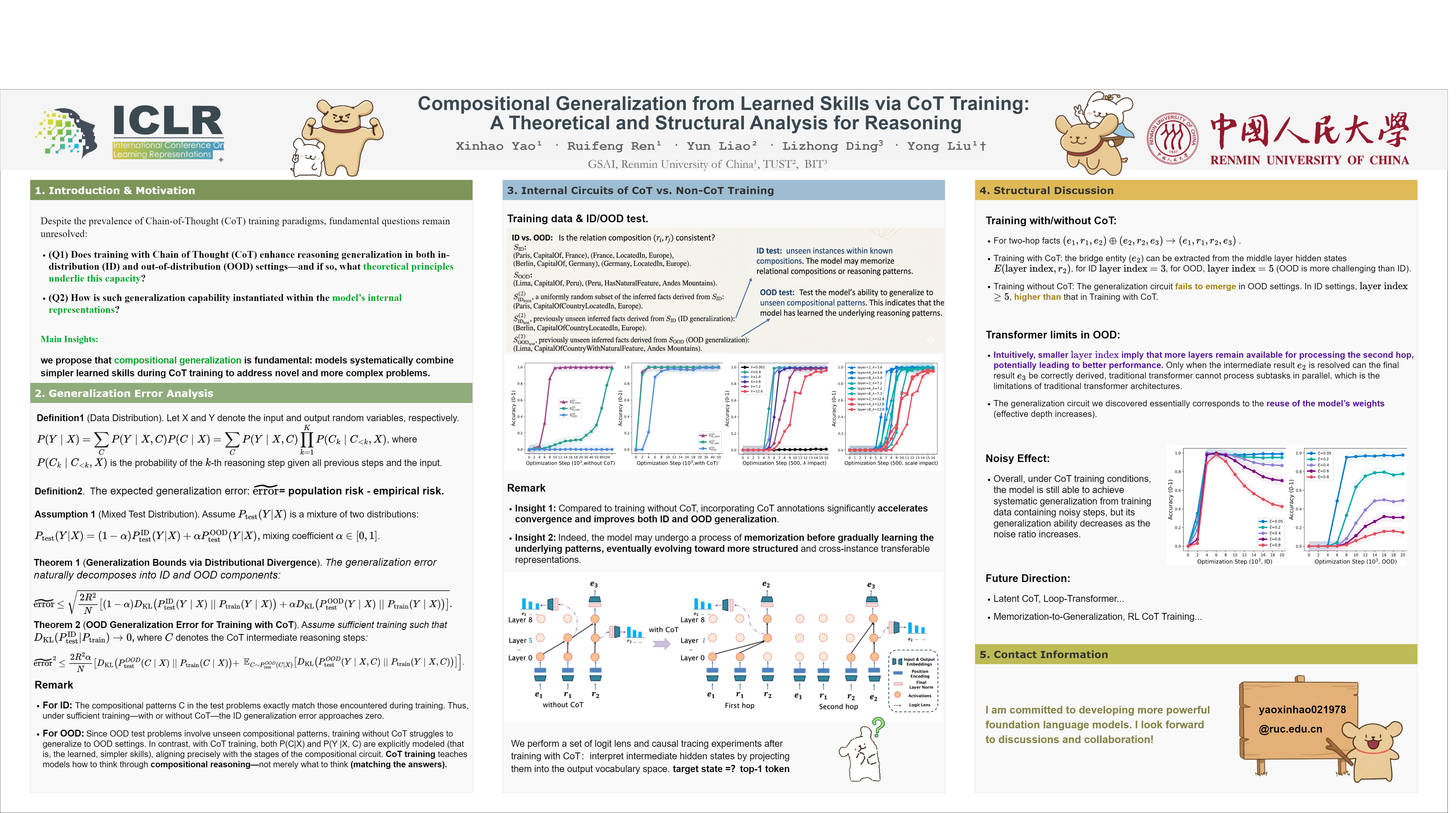
Chain-of-Thought (CoT) training has markedly advanced the reasoning capabilities of large language models (LLMs), yet the mechanisms by which CoT training enhances generalization remain inadequately understood. In this work, we demonstrate that compositional generalization is fundamental: models systematically combine simpler learned skills during CoT training to address novel and more complex problems. Through a theoretical and structural analysis, we formalize this process: 1) Theoretically, the information-theoretic generalization bounds through distributional divergence can be decomposed into in-distribution (ID) and out-of-distribution (OOD) components. Specifically, the non-CoT models fail on OOD tasks due to unseen compositional patterns, whereas CoT-trained models achieve strong generalization by composing previously learned skills. In addition, controlled experiments and real-world validation confirm that CoT training accelerates convergence and enhances generalization from ID to both ID and OOD scenarios while maintaining robust performance even with tolerable noise. 2) Structurally, CoT training internalizes reasoning into a two-stage compositional circuit, where the number of stages corresponds to the explicit reasoning steps during training. Notably, CoT-trained models resolve intermediate results at shallower layers compared to non-CoT counterparts, freeing up deeper layers to specialize in subsequent reasoning steps. A key insight is that CoT training teaches models how to think—by fostering compositional reasoning—rather than merely what to think, through the provision of correct answers alone. This paper offers valuable insights for designing CoT strategies to enhance LLMs' reasoning robustness.