
On Measuring Influence in Avoiding Undesired Future
Abstract
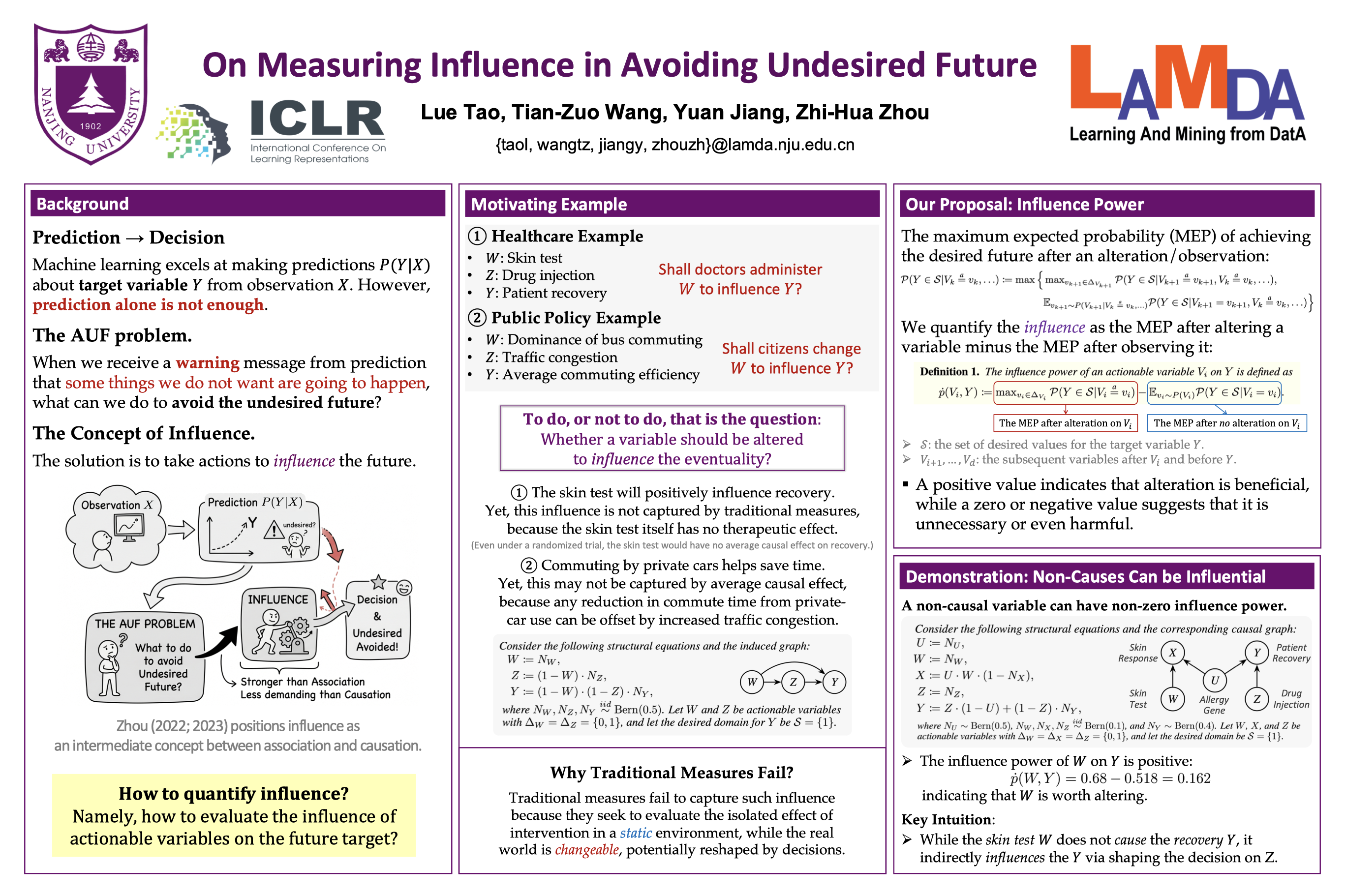
When a predictive model anticipates an undesired future event, a question arises: What can we do to avoid it? Resolving this forward-looking challenge requires determining the variables that positively influence the future, moving beyond the statistical association typically exploited for prediction. In this paper, we introduce a novel measure for evaluating the influence of actionable variables in successfully avoiding the undesired future. We quantify influence as the degree to which the success probability can be increased by altering variables under the principle of maximum expected utility. Our analysis demonstrates a counterintuitive insight: while related to causality, influential variables may not necessarily be those with strong intrinsic causal effects on the target event. In fact, it can be highly beneficial to alter a weak causal factor, or even a variable that is not an intrinsic factor at all. We provide a practical implementation for estimating the proposed measure and validate its utility through experiments on synthetic and real-world tasks.