
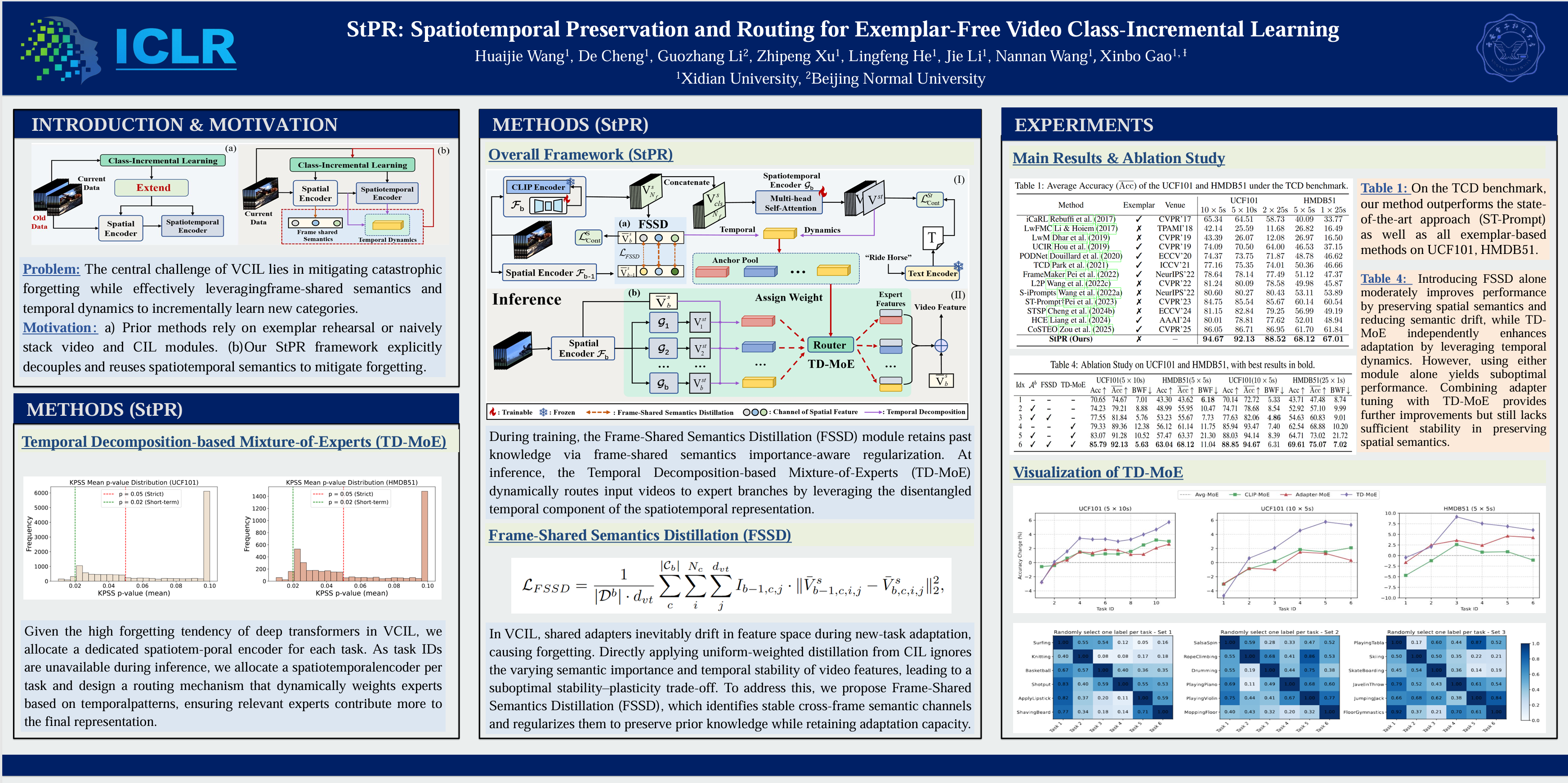
StPR: Spatiotemporal Preservation and Routing for Exemplar-Free Video Class-Incremental Learning
Abstract
Video Class-Incremental Learning (VCIL) seeks to develop models that continuously learn new action categories over time without forgetting previously acquired knowledge. Unlike traditional Class-Incremental Learning (CIL), VCIL introduces the added complexity of spatiotemporal structures, making it particularly challenging to mitigate catastrophic forgetting while effectively capturing both frame-shared semantics and temporal dynamics. Existing approaches either rely on exemplar rehearsal, raising concerns over memory and privacy, or adapt static image-based methods that neglect temporal modeling. To address these limitations, we propose Spatiotemporal Preservation and Routing (StPR), a unified and exemplar-free VCIL framework that explicitly disentangles and preserves spatiotemporal information. We begin by introducing Frame-Shared Semantics Distillation (FSSD), which identifies semantically stable and meaningful channels by jointly considering channel-wise sensitivity and classification contribution. By selectively regularizing these important semantic channels, FSSD preserves prior knowledge while allowing for adaptation. Building on this preserved semantic space, we further design a Temporal Decomposition-based Mixture-of-Experts (TD-MoE), which dynamically routes task-specific experts according to temporal dynamics, thereby enabling inference without task IDs or stored exemplars. Through the synergy of FSSD and TD-MoE, StPR progressively leverages spatial semantics and temporal dynamics, culminating in a unified, exemplar-free VCIL framework. Extensive experiments on UCF101, HMDB51, SSv2 and Kinetics400 show that our method outperforms existing baselines while offering improved interpretability and efficiency in VCIL.