
Tucker-FNO: Tensor Tucker-Fourier Neural Operator and its Universal Approximation Theory
Abstract
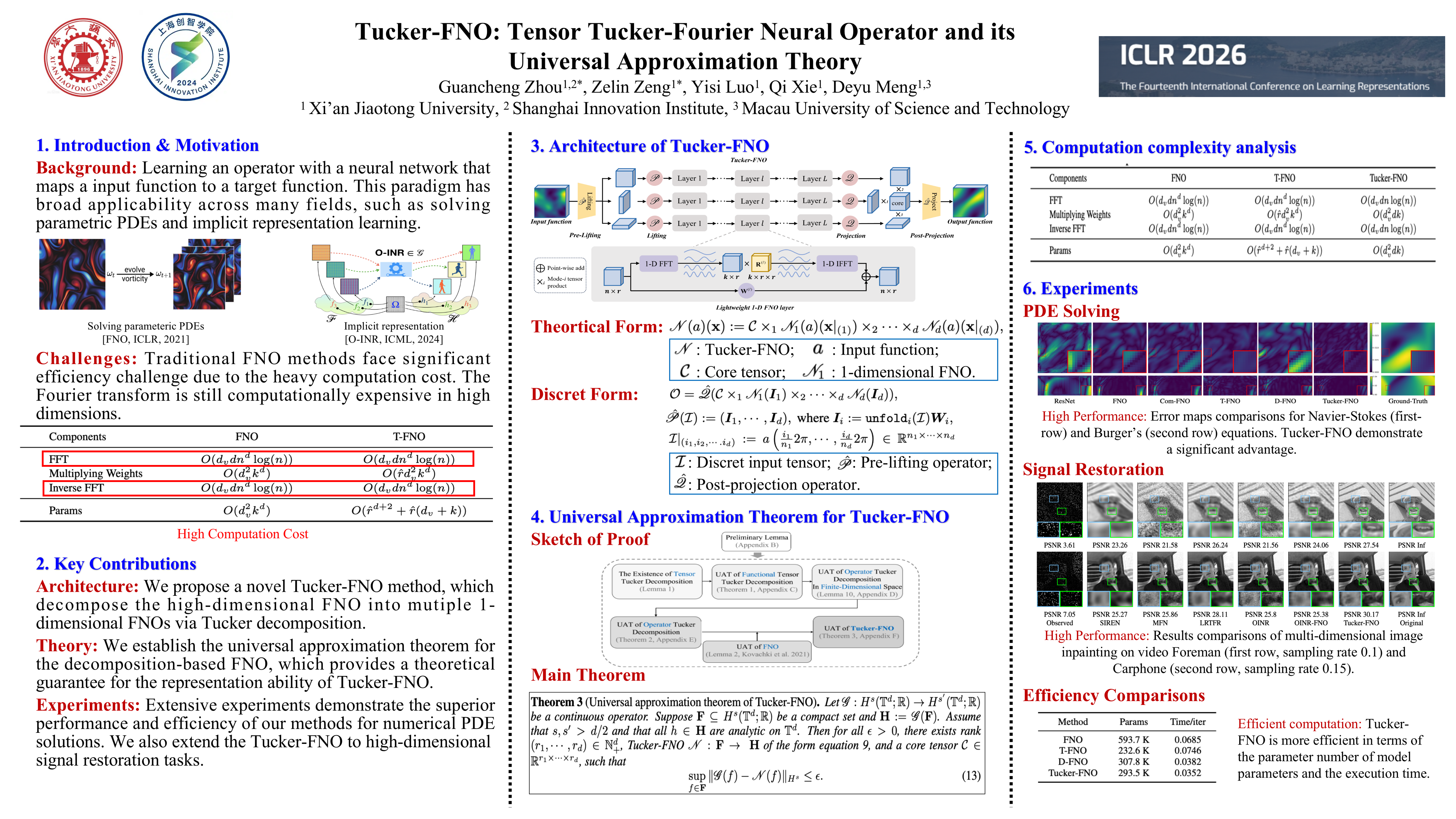
Fourier neural operator (FNO) has demonstrated substantial potential in learning mappings between function spaces, such as numerical partial differential equations (PDEs). However, FNO may suffer from inefficiencies when applied to large-scale, high-dimensional function spaces due to the computational overhead associated with high-dimensional Fourier and convolution operators. In this work, we introduce the Tucker-FNO, an efficient neural operator that decomposes the high-dimensional FNO into a series of 1-dimensional FNOs through Tucker decomposition, thereby significantly reducing computational complexity while maintaining expressiveness. Especially, by using the theoretical tools of functional decomposition in Sobolev space, we rigorously establish the universal approximation theorem of Tucker-FNO. Experiments on high-dimensional numerical PDEs such as Navier-Stokes, Plasticity, and Burger's equations show that Tucker-FNO achieves substantial improvement in execution time and performance over FNO. Moreover, by virtue of the compact Tucker decomposition, Tucker-FNO generalizes seamlessly to high-dimensional visual signals by learning mappings from the positional encoding space to the signal's implicit neural representations (INRs). Under this operator INR framework, Tucker-FNO gains consistent improvements on continuous signal restoration over traditional INR methods in terms of efficiency and accuracy.