
D2E: Scaling Vision-Action Pretraining on Desktop Data for Transfer to Embodied AI
Suhwan Choi ⋅ Jaeyoon Jung ⋅ Haebin Seong ⋅ Minchan Kim ⋅ Minyeong Kim ⋅ Yongjun Cho ⋅ Yoonshik Kim ⋅ Yu Park ⋅ Youngjae Yu ⋅ Yunsung Lee
Abstract
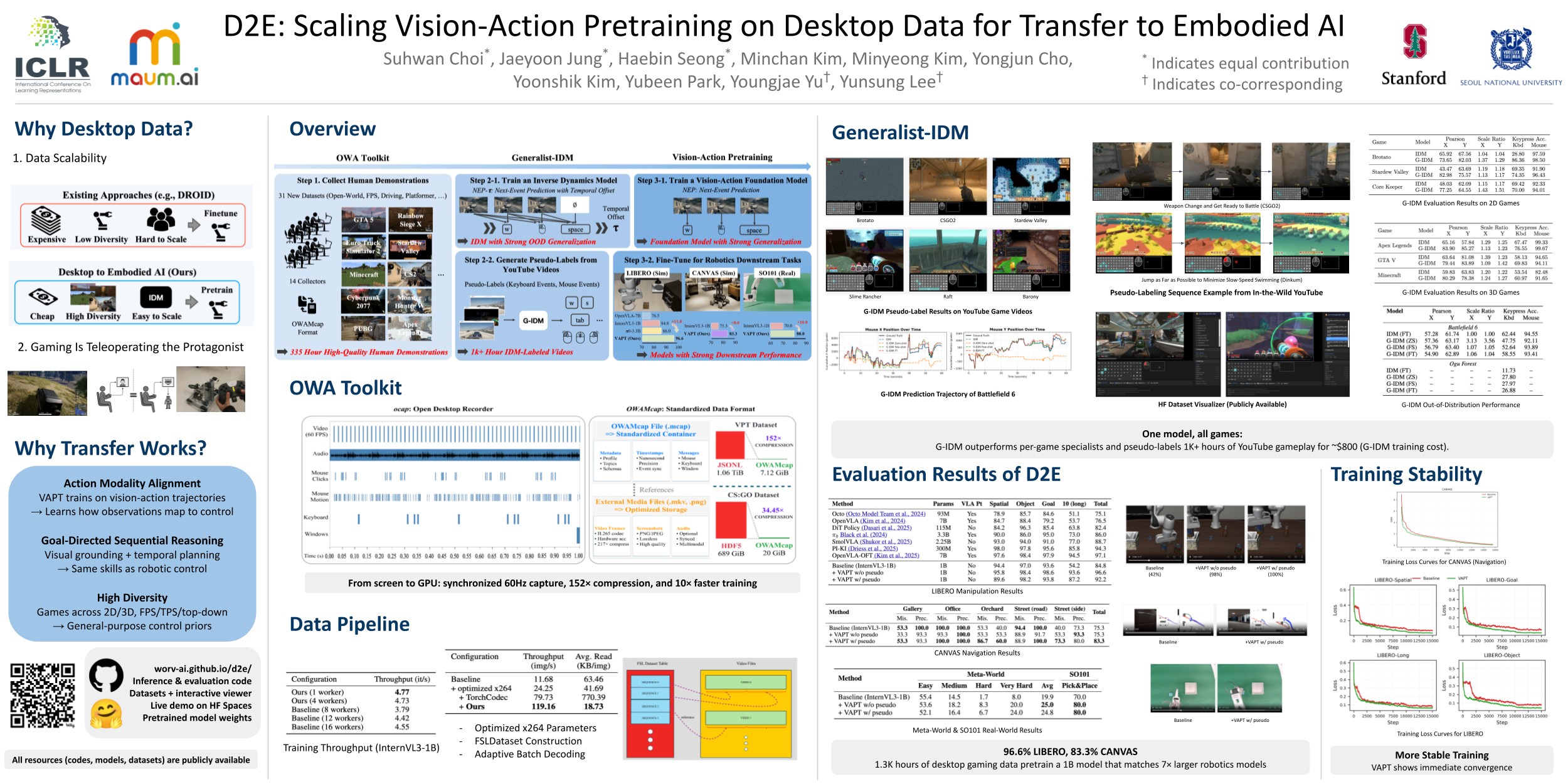
Large language models leverage internet-scale text data, yet embodied AI remains constrained by the prohibitive costs of physical trajectory collection. Desktop environments---particularly gaming---offer a compelling alternative: they provide rich sensorimotor interactions at scale while maintaining the structured observation-action coupling essential for embodied learning. We present D2E (Desktop to Embodied AI), a framework that demonstrates desktop interactions can serve as an effective pretraining substrate for robotics embodied AI tasks. Unlike prior work that remained domain-specific (e.g., VPT for Minecraft) or kept data proprietary (e.g., SIMA), D2E establishes a complete pipeline from scalable desktop data collection to verified transfer in embodied domains. Our framework comprises three components: (1) the OWA Toolkit that unifies diverse desktop interactions into a standardized format with 152× compression, (2) the Generalist-IDM that achieves strong zero-shot generalization across unseen games through timestamp-based event prediction, enabling internet-scale pseudo-labeling, and (3) VAPT that transfers desktop-pretrained representations to physical manipulation and navigation. Using 1.3K+ hours of data (259 hours of human demonstrations and 1K+ hours of pseudo-labeled gameplay), our 1B-parameter model achieves 96.6\% success on LIBERO manipulation and 83.3\% on CANVAS navigation, matching or surpassing models up to 7$\times$ larger, such as $\pi_0$ (3.3B) and OpenVLA (7B). These results demonstrate that sensorimotor primitives learned from digital interactions transfer effectively to real-world physical tasks, establishing desktop pretraining as a practical paradigm for embodied AI. All resources are publicly available at https://worv-ai.github.io/d2e.
Video
Chat is not available.
Successful Page Load