
Scenethesis: A Language and Vision Agentic Framework for 3D Scene Generation
Abstract
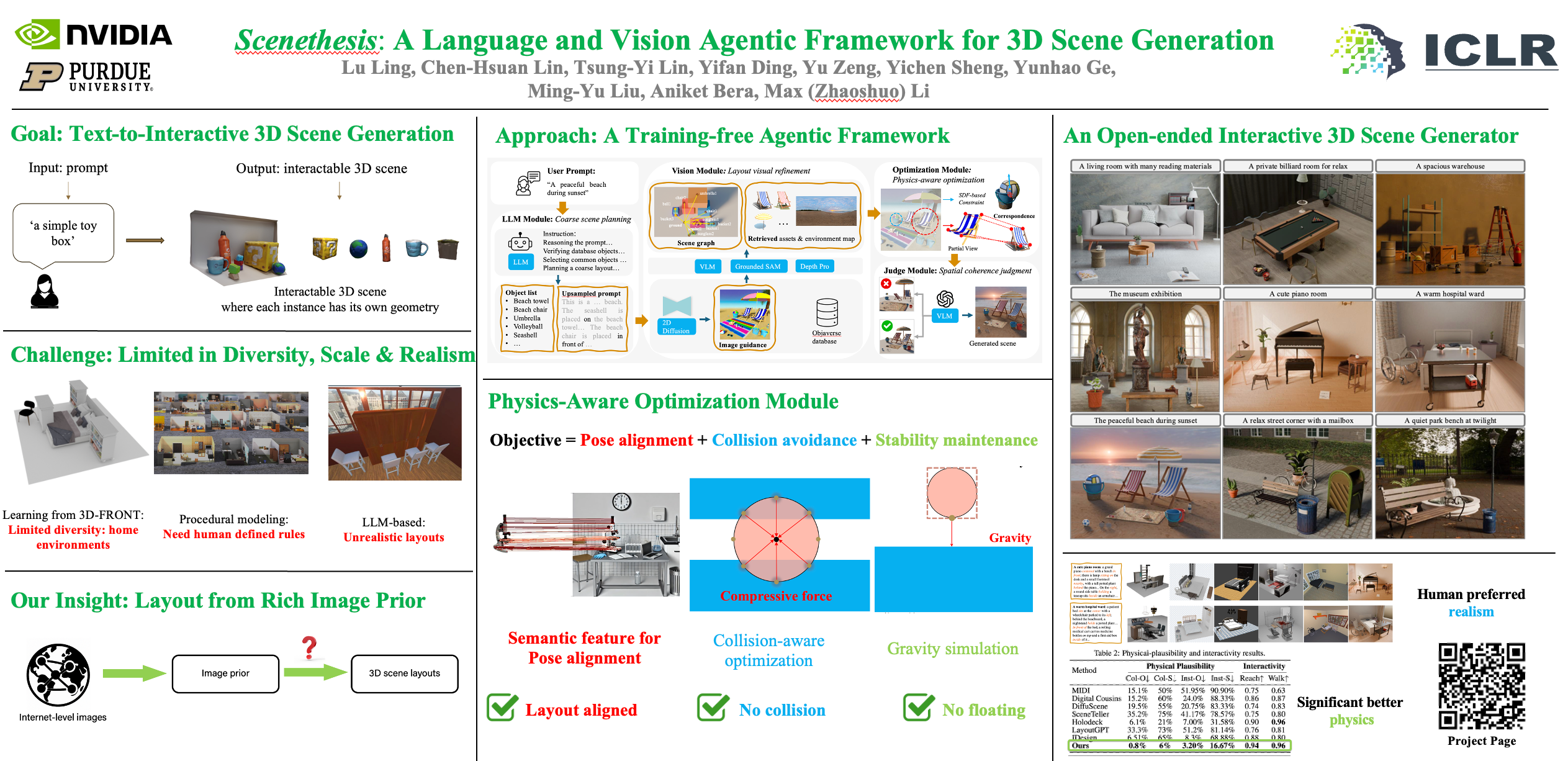
Generating interactive 3D scenes from text requires not only synthesizing assets but arranging them with spatial intelligence—support, affordances, and plausibility. However, training data for interactive scenes is dominated by a few indoor datasets, so learning-based methods overfit to in-distribution layouts and struggle to compose diverse arrangements (e.g., outdoor settings and small-on-large relations). Meanwhile, LLM-based layout planners can propose diverse arrangements, but the lack of visual grounding often yields implausible placements that violate commonsense physics. We propose Scenethesis, a training-free, agentic framework that couples LLM-based scene planning with vision-guided layout refinement. Given a text prompt, Scenethesis first drafts a coarse layout with an LLM; a vision module refines the layout and extracts scene structure to capture inter-object relations. A novel optimization stage enforces pose alignment and physical plausibility, and a final judge verifies spatial coherence and triggers targeted repair when needed. Across indoor and outdoor prompts, Scenethesis produces realistic, relation-rich, and physically plausible 3D interactive scenes, reducing collisions and stability failures compared to SOTA methods, making it practical for virtual content creation, simulation, and embodied AI.