
Math Blind: Failures in Diagram Understanding Undermine Reasoning in MLLMs
Yanpeng Sun ⋅ Shan Zhang ⋅ Wei Tang ⋅ Aotian Chen ⋅ Piotr Koniusz ⋅ Kai Zou ⋅ Yuan Xue ⋅ Anton Hengel
Abstract
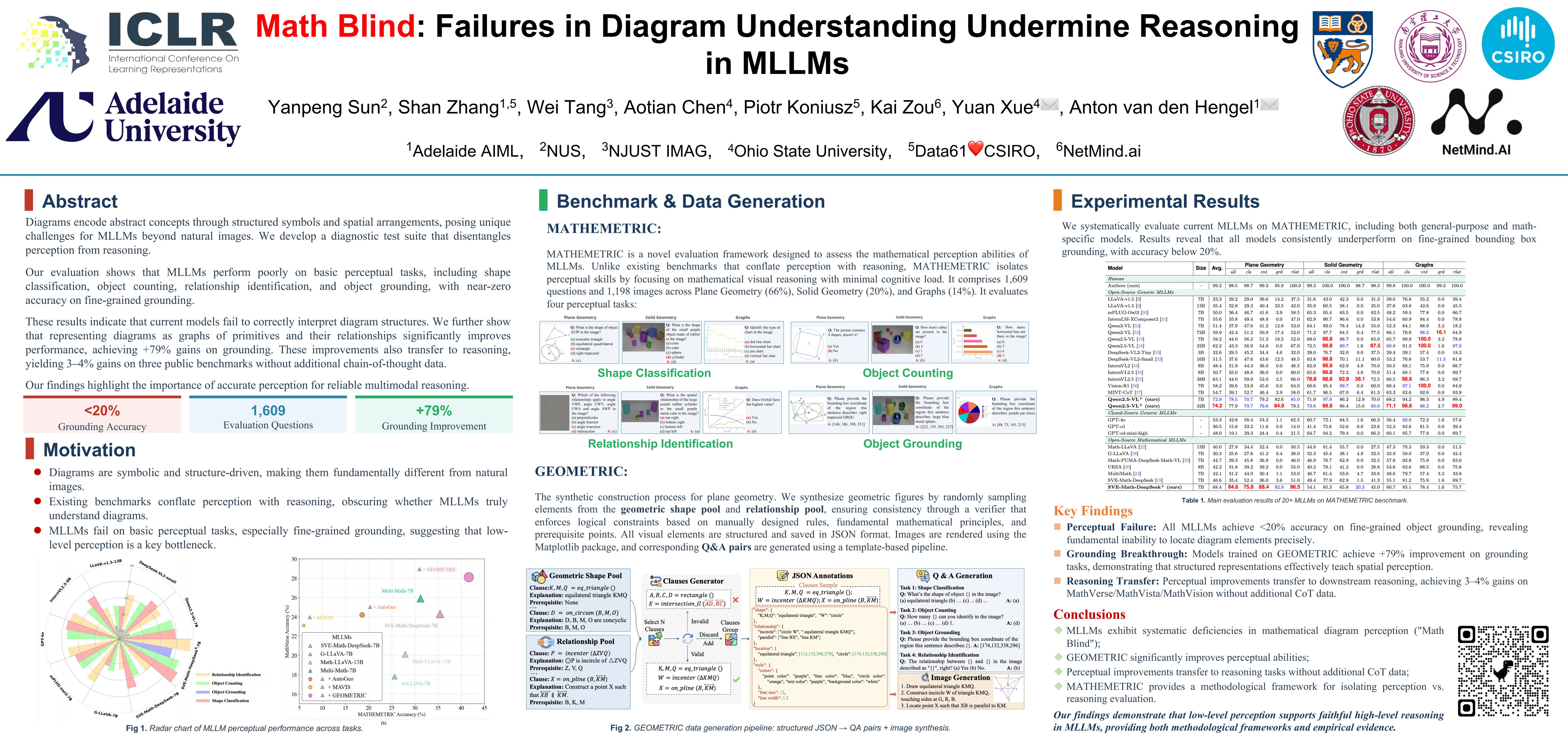
Diagrams represent a form of visual language that encodes abstract concepts and relationships through structured symbols and their spatial arrangements. Unlike natural images, they are inherently symbolic, and entirely artificial. They thus pose unique challenges for Multimodal Large Language Models (MLLMs) distinct from natural image processing. Recent studies have shown that MLLMs often exhibit flawed reasoning and hallucinations when handling diagram inputs. We investigate here whether these limitations stem from shortcomings in the models' ability to interpret diagrams themselves. To this end, we develop a diagnostic test suite that isolates perception from reasoning. Our systematic evaluation reveals that MLLMs perform poorly on basic perceptual tasks, e.g., shape classification, object counting, relationship identification, and object grounding, with near-zero accuracy on fine-grained grounding. Further analysis shows that weak diagram perception leads to ``blind faith in text", where models rely on textual shortcuts rather than visual understanding (that is, they are $\textit{Math Blind}$). We hypothesize that enabling models to capture the inherent structural properties of diagrams, represented as graphs of primitives and their interrelationships, is essential for improving diagram understanding. Experiments with 7B and 32B MLLMs validate this assumption, with models trained on such representations achieving a +79\% gain on the grounding task. Crucially, these gains transfer to reasoning, achieving 3–4\% cross-suite improvements on four public benchmarks even without additional chain-of-thought reasoning data. Our findings demonstrate that low-level perception supports faithful high-level reasoning in mathematical MLLMs. We provide both methodological frameworks and empirical evidence to guide future research in this direction. Our project page is at \href{https://vi-ocean.github.io/projects/MATHEMETRIC/index.html}{\color{blue}{viocean/\ourMethod}}.
Video
Chat is not available.
Successful Page Load