
Score Distillation Beyond Acceleration: Generative Modeling from Corrupted Data
Yasi Zhang ⋅ Tianyu Chen ⋅ Zhendong Wang ⋅ Yingnian Wu ⋅ Mingyuan Zhou ⋅ Oscar Leong
Abstract
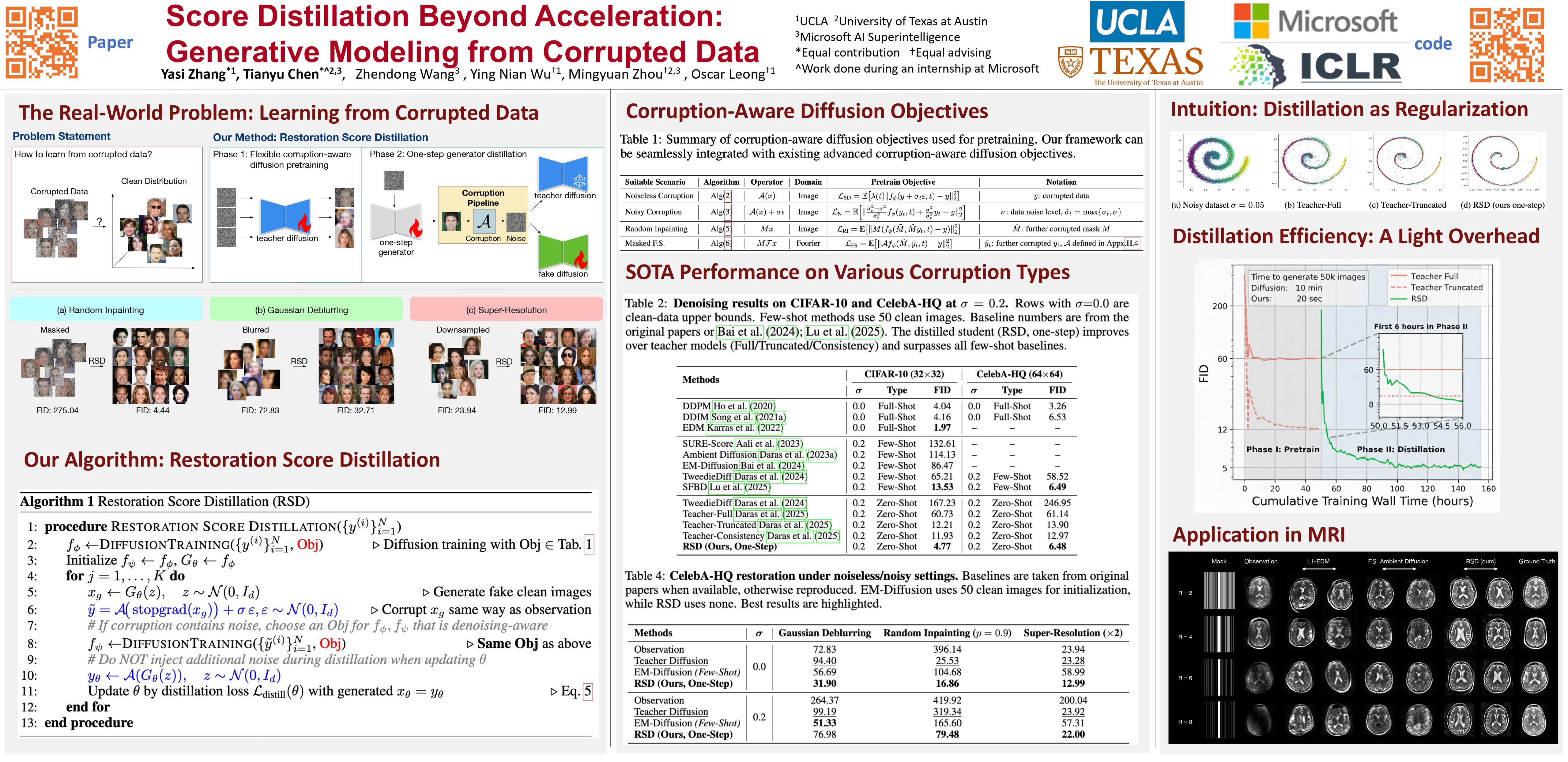
Learning generative models directly from corrupted observations is a long-standing challenge across natural and scientific domains. We introduce **Restoration Score Distillation (RSD)**, a unified framework for learning high-fidelity, one-step generative models using **only** degraded data of the form $ y = \mathcal{A}(x) + \sigma \varepsilon, x\sim p_X,\ \varepsilon\sim \mathcal{N}(0,I_m), $ where the mapping $\mathcal{A}$ may be the identity or a non-invertible corruption operator (e.g., blur, masking, subsampling, Fourier acquisition). RSD first pretrains a corruption-aware diffusion teacher on the observed measurements, then *distills* it into an efficient one-step generator whose samples are statistically closer to the clean distribution $p_X$. The framework subsumes identity corruption (denoising task) as a special case of our general formulation. Empirically, RSD consistently reduces Fr\'echet Inception Distance (FID) relative to corruption-aware diffusion teachers across noisy generation (CIFAR-10, FFHQ, CelebA-HQ, AFHQ-v2), image restoration (Gaussian deblurring, random inpainting, super-resolution, and mixtures with additive noise), and multi-coil MRI—*without access to any clean images*. The distilled generator inherits one-step sampling efficiency, yielding up to $30\times$ speedups over multi-step diffusion while surpassing the teachers after substantially fewer training iterations. These results establish score distillation as a practical tool for generative modeling from corrupted data, *not merely for acceleration*. We provide theoretical support for the use of distillation in enhancing generation quality in the Appendix. The code is available at https://github.com/TianyuCodings/RSD.
Video
Chat is not available.
Successful Page Load