
Scaling Linear Attention Capacity with Sparse State Expansion
Yuqi Pan ⋅ Yongqi An ⋅ Zheng Li ⋅ Yuhong Chou ⋅ Rui-Jie Zhu ⋅ Xiaohui Wang ⋅ Mingxuan Wang ⋅ Jinqiao Wang ⋅ Guoqi Li
Abstract
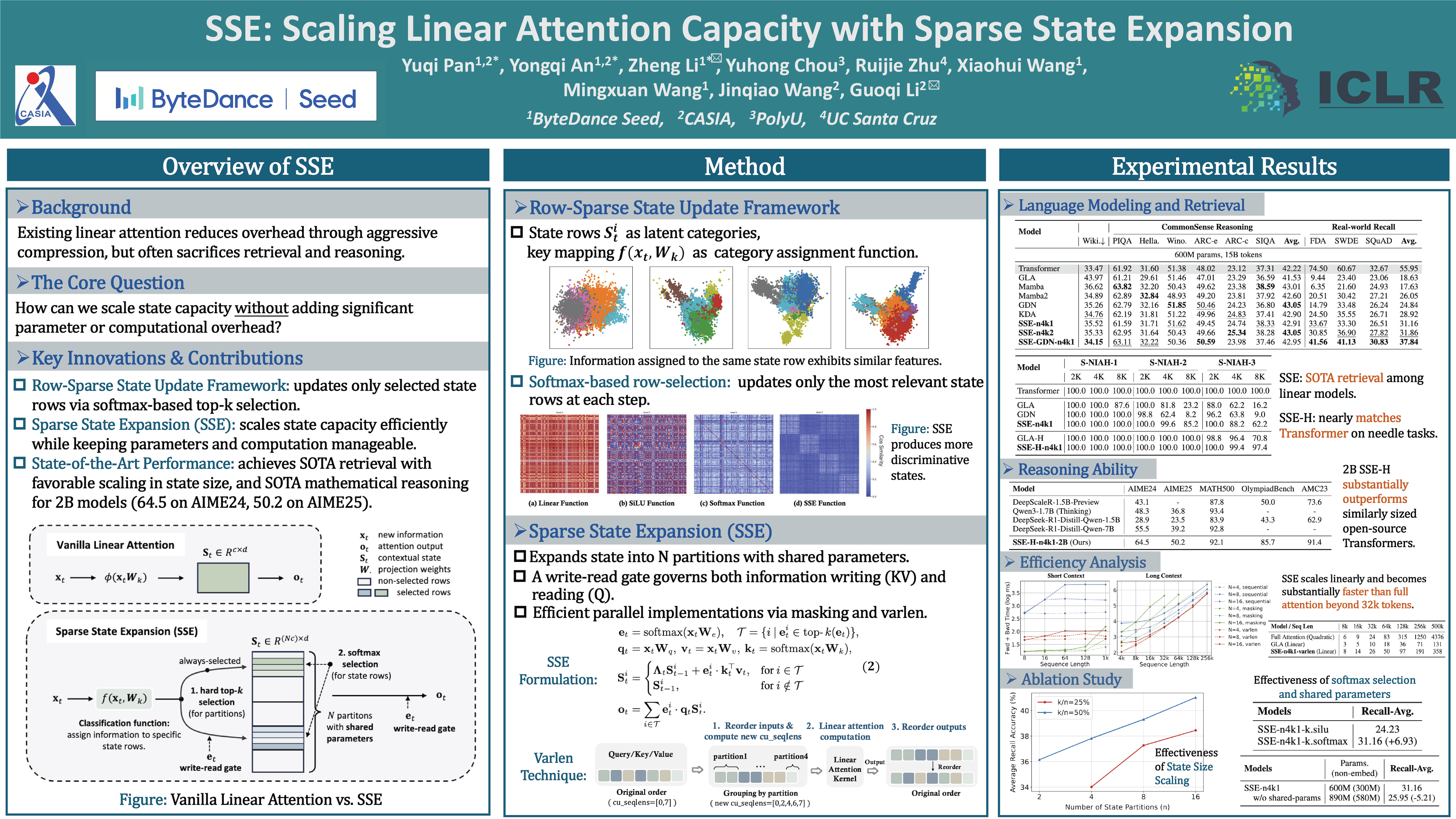
The Transformer architecture, despite its widespread success, struggles with long-context scenarios due to quadratic computation and linear memory growth. While various linear attention variants mitigate these efficiency constraints by compressing context into fixed-size states, they often degrade performance in tasks such as in-context retrieval and reasoning. To address this limitation and achieve more effective context compression, we propose two key innovations. First, we introduce a row-sparse update formulation for linear attention by conceptualizing state updating as information categorization. This enables sparse state updates via softmax-based top-$k$ row selection, thereby extending receptive fields and reducing information interference. Second, we present Sparse State Expansion (SSE) within the sparse framework, which expands the contextual state into multiple partitions, effectively decoupling parameter size from state capacity while maintaining the sparse row-selection paradigm. Supported by efficient parallelized implementations, our design achieves highly discriminative state representations. We extensively validate SSE in both pure linear and hybrid (SSE-H) architectures across language modeling, in-context retrieval, and mathematical reasoning benchmarks. SSE demonstrates strong retrieval performance and scales favorably with state size. Moreover, after reinforcement learning (RL) training, our 2B SSE-H model achieves state-of-the-art mathematical reasoning performance among small reasoning models, scoring 64.5 on AIME24 and 50.2 on AIME25, significantly outperforming similarly sized open-source Transformers. These results highlight SSE as a promising and efficient architecture for long-context modeling.
Video
Chat is not available.
Successful Page Load