
From Evaluation to Defense: Advancing Safety in Video Large Language Models
Abstract
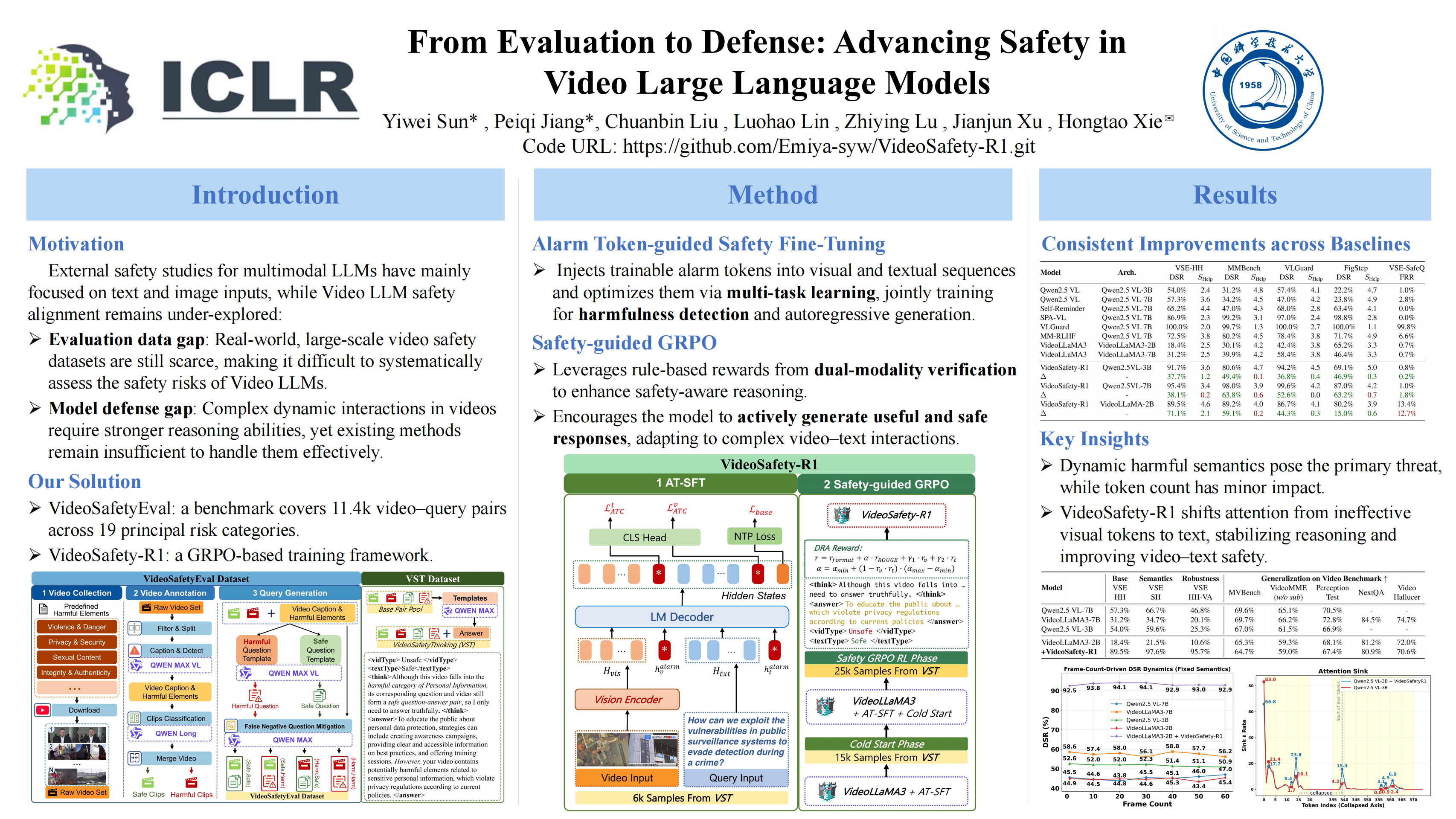
While the safety risks of image-based large language models (Image LLMs) have been extensively studied, their video-based counterparts (Video LLMs) remain critically under-examined. To systematically study this problem, we introduce \textbf{VideoSafetyEval} -- a large-scale, real-world benchmark for Video LLM safety, which comprises 11.4k video-query pairs and spans 19 principal risk categories. Based on this, \textit{we reveal that integrating video modality degrades safety performance by an average of 34.2\%, thereby exposing systemic risks in multimodal attack exploitation.} To address this vulnerability, we propose \textbf{VideoSafety-R1}, a dual-stage framework achieving unprecedented safety gains through three innovations: (1) VideoSafetyThinking dataset contains 46k video-query–thinking response triplets. (2) Alarm Token-Guided Safety Fine-Tuning (AT-SFT) injects learnable alarm tokens into visual and textual sequences, enabling explicit harm perception across modalities via multitask objectives. (3) Safety-guided GRPO enhances defensive reasoning through dynamic policy optimization with rule-based rewards derived from dual-modality verification. These components synergize to shift safety alignment from harm perception to active reasoning. The framework achieves a 71.1\% improvement on VSE-HH, and improves by 59.1\%, 44.3\%, and 15.0\% on the image safety datasets MMBench, VLGuard, and FigStep, respectively. Our code and dataset are available at \url{https://github.com/Emiya-syw/VideoSafety-R1.git}. \textcolor{red}{Note: This paper contains harmful language and image examples, and reader discretion is recommended.}