
Expressive Power of Implicit Models: Rich Equilibria and Test-Time Scaling
Abstract
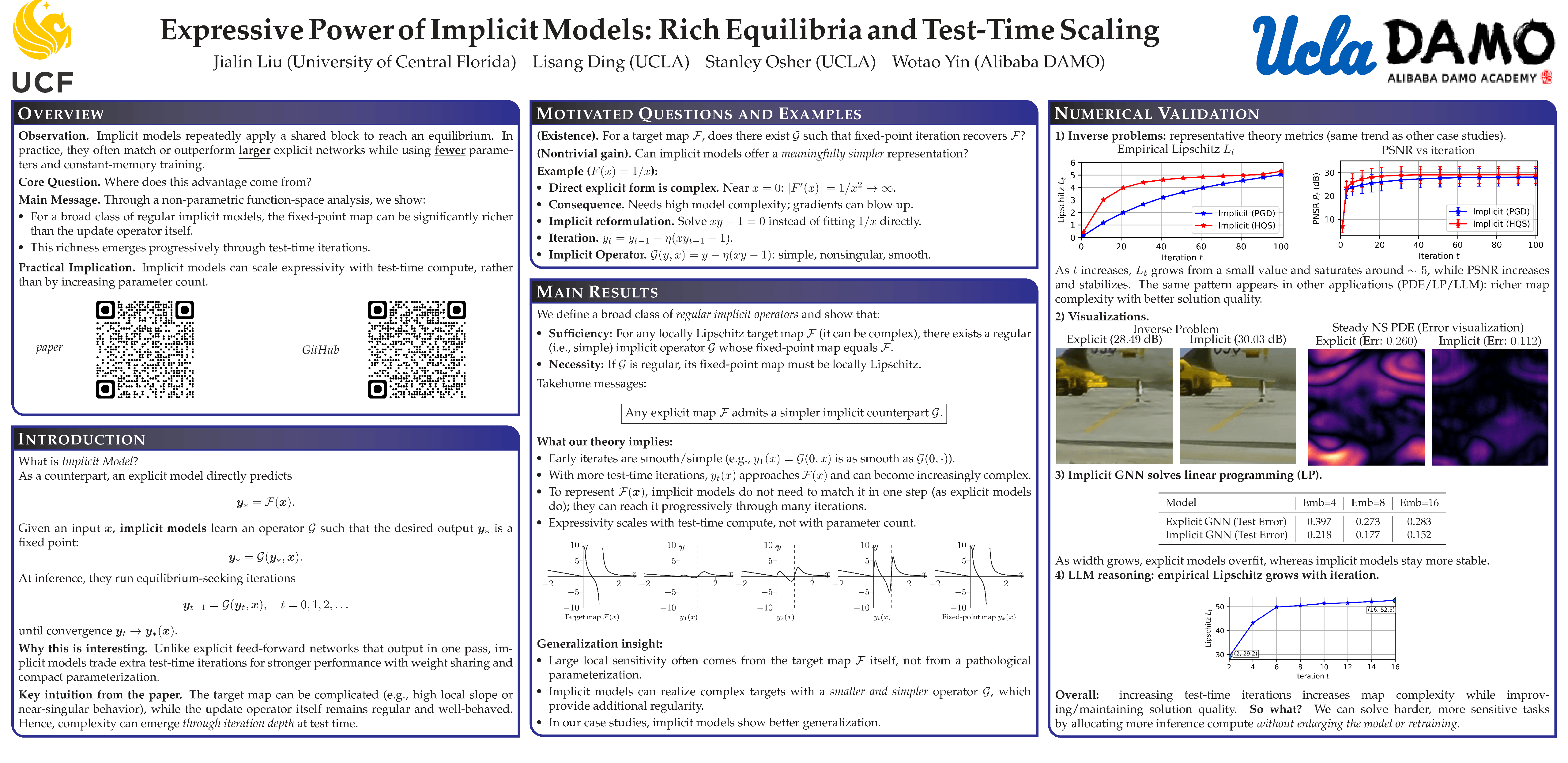
Implicit models, an emerging model class, compute outputs by iterating a single parameter block to a fixed point. This architecture realizes an infinite-depth, weight-tied network that trains with constant memory, significantly reducing memory needs for the same level of performance compared to explicit models. While it is empirically known that these compact models can often match or even exceed the accuracy of larger explicit networks by allocating more test-time compute, the underlying reasons are not yet well understood. We study this gap through a non-parametric analysis of expressive power. We provide a strict mathematical characterization, showing that a simple and regular implicit operator can, through iteration, progressively express more complex mappings. We prove that for a broad class of implicit models, this process allows the model's expressive power to grow with test-time compute, ultimately matching a much richer function class. The theory is validated across four domains: imaging, scientific computing, operations research, and LLM reasoning, demonstrating that as test-time iterations increase, the complexity of the learned mapping rises, while the solution quality simultaneously improves and stabilizes.