
Unified Vision-Language-Action Model
Abstract
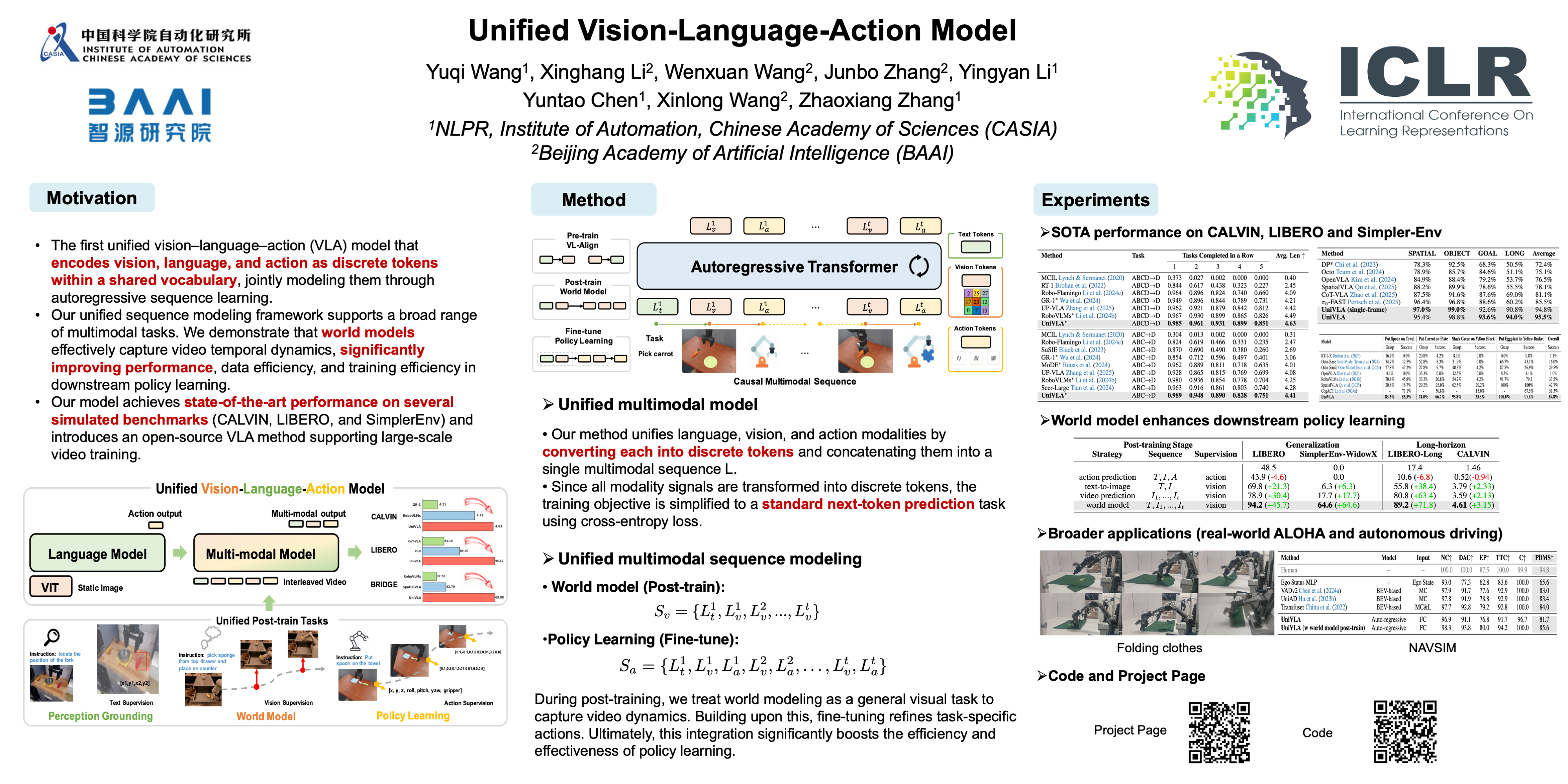
Vision-language-action models (VLAs) have garnered significant attention for their potential in advancing robotic manipulation. However, previous approaches predominantly rely on the general comprehension capabilities of vision-language models (VLMs) to generate action signals, often overlooking the rich temporal and causal structure embedded in visual observations. In this paper, we present UniVLA, a unified and native multimodal VLA model that autoregressively models vision, language, and action signals as discrete token sequences. This tokenized formulation naturally supports flexible multimodal task learning, particularly from large-scale video data, and further demonstrates that generative vision supervision can significantly enhance visual understanding. By incorporating world modeling during post-training, UniVLA captures causal dynamics from videos, facilitating effective transfer to downstream policy learning—especially for long-horizon tasks. Our approach sets new state-of-the-art results across several widely used simulation benchmarks, including CALVIN, LIBERO, and Simplenv-Bridge, substantially outperforming prior methods. For example, UniVLA achieves 95.5% average success rate on LIBERO benchmark, surpassing π₀-FAST's 85.5%. We further demonstrate its broad applicability through experiments on real-world ALOHA manipulation tasks and autonomous driving scenarios.