
SeRI: Gradient-Free Sensitive Region Identification in Decision-Based Black-Box Attacks
Abstract
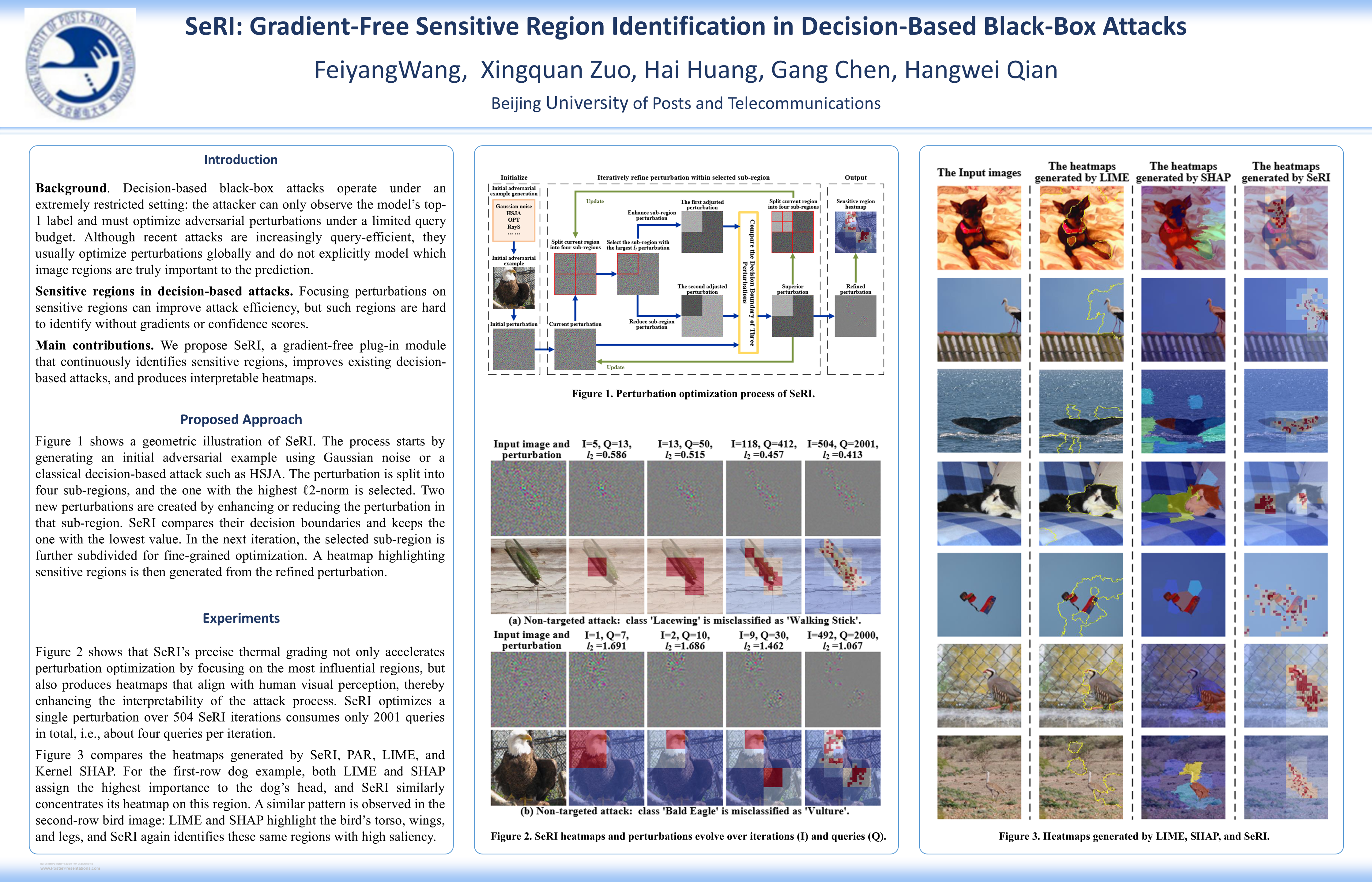
Deep neural networks (DNNs) are highly vulnerable to adversarial attacks, where small, carefully crafted perturbations are added to input images to cause misclassification. These perturbations are particularly effective when concentrated in sensitive regions of an image that strongly influence the model’s prediction. However, in decision-based black-box settings, where only the top-1 predicted label is observable and query budgets are strictly limited, identifying sensitive regions becomes extremely challenging. This issue is critical because without accurate region information, decision-based attacks cannot refine adversarial examples effectively, limiting both their efficiency and accuracy. We propose Sensitive Region Identification, SeRI, the first decision-based method that assigns a continuous sensitivity score to each image pixel. It enables fine-grained region discovery and substantially improves the efficiency of adversarial attacks, all without access to gradients, confidence scores, or surrogate models. SeRI progressively partitions the image into finer sub-regions and refines a continuous sensitivity score to capture their true importance. At each iteration, it generates two perturbation variants of the selected region by scaling its magnitude up or down, and compares their decision boundaries to derive an accurate, continuous characterization of pixel sensitivity. SeRI further divides selected region into smaller sub-regions, recursively refining the search for sensitive areas. This recursive refinement process enables more precise sensitivity estimation through fine-grained analysis, distinguishing SeRI from prior binary or one-shot region selection approaches. Experiments on two benchmark datasets show that SeRI significantly enhances state-of-the-art decision-based attacks in both targeted and non-targeted attack scenarios. Additionally, SeRI generates precise heatmaps that identify sensitive image regions. The code is available at https://github.com/BUPTAIOC/SeRI.