
Markovian Transformers for Informative Language Modeling
Scott Viteri ⋅ Max Lamparth ⋅ Peter Chatain ⋅ Clark Barrett
Abstract
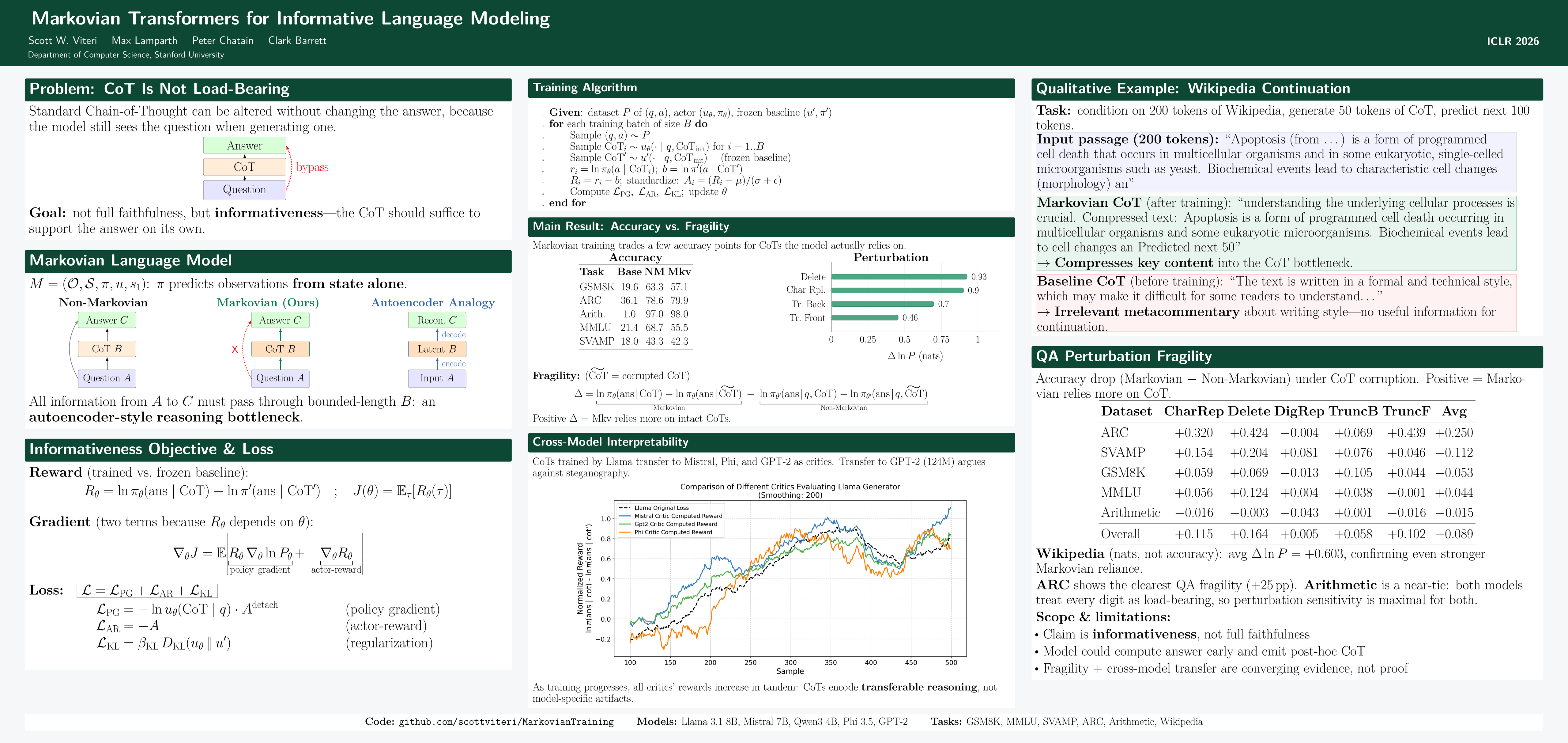
Chain-of-Thought (CoT) reasoning often fails to faithfully reflect a language model's underlying decision process. We address this by introducing a *Markovian* language model framework with an autoencoder-style *reasoning bottleneck*: all information flowing from question to answer must pass through a bounded-length CoT, creating a bandwidth bottleneck analogous to the latent layer of an autoencoder. In practice, the KL penalty toward the pretrained distribution and the inductive biases of gradient descent discourage steganographic encoding, so the model learns to express its reasoning in natural-language steps from which the answer can be derived. We train this system with a GRPO-style policy gradient algorithm using parallel sampling, a frozen baseline CoT$'$, within-batch standardized advantages, and actor-reward (chain-rule) gradients. On QA tasks, Markovian training recovers most of the gains of a Non-Markovian GRPO variant while forcing the model to answer from the CoT alone (e.g., GSM8K: 19.6\% $\to$ 57.1\%; ARC-Challenge: 36.1\% $\to$ 79.9\%; on average within $\approx$3--4 pp of a Non-Markovian variant). Perturbation analyses across types and severities show that Markovian models incur systematically larger log-probability drops under CoT corruption than matched Non-Markovian baselines, indicating stronger causal reliance on the CoT. Cross-model evaluation confirms that learned CoTs generalize across architectures, suggesting they encode transferable reasoning steps rather than model-specific artifacts.
Video
Chat is not available.
Successful Page Load