
HGNet: Scalable Foundation Model for Automated Knowledge Graph Generation from Scientific Literature
Abstract
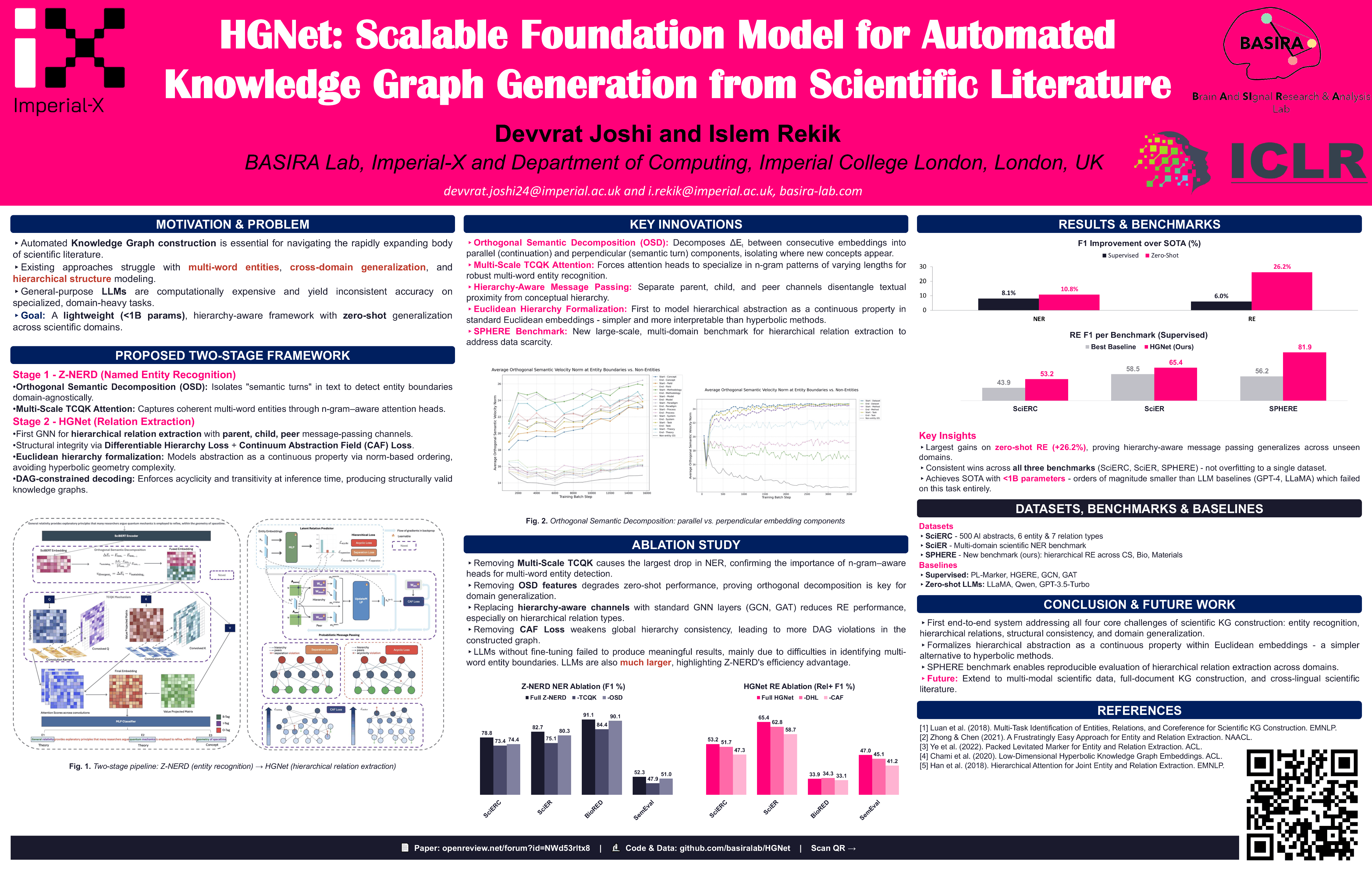
Automated knowledge graph (KG) construction is essential for navigating the rapidly expanding body of scientific literature. However, existing approaches face persistent challenges: they struggle to recognize long multi-word entities, often fail to generalize across domains, and typically overlook the hierarchical and logically constrained nature of scientific knowledge. While general-purpose large language models (LLMs) offer some adaptability, they are computationally expensive and yield inconsistent accuracy on specialized, domain-heavy tasks such as scientific knowledge graph construction. As a result, current KGs are shallow and inconsistent, limiting their utility for exploration and synthesis. We propose a two-stage framework for scalable, zero-shot scientific KG construction. The first stage, Z-NERD, introduces (i) Orthogonal Semantic Decomposition (OSD), which promotes domain-agnostic entity recognition by isolating semantic “turns” in text, and (ii) a Multi-Scale TCQK attention mechanism that captures coherent multi-word entities through n-gram–aware attention heads. The second stage, HGNet, performs relation extraction with hierarchy-aware message passing, explicitly modeling parent, child, and peer relations. To enforce global consistency, we introduce two complementary objectives: a Differentiable Hierarchy Loss to discourage cycles and shortcut edges, and a Continuum Abstraction Field (CAF) Loss that embeds abstraction levels along a learnable axis in Euclidean space. To the best of our knowledge, this is the first approach to formalize hierarchical abstraction as a continuous property within standard Euclidean embeddings, offering a simpler and more interpretable alternative to hyperbolic methods. To address data scarcity, we also release SPHERE, a large-scale, multi-domain benchmark for hierarchical relation extraction. Our framework establishes a new state of the art on benchmarks such as SciERC, SciER and SPHERE benchmarks, improving named entity recognition (NER) by 8.08\% and relation extraction (RE) by 5.99\% on the official out-of-distrubtion test sets. In zero-shot settings, the gains are even more pronounced, with improvements of 10.76\% for NER and 26.2\% for RE, marking a significant step toward reliable and scalable scientific knowledge graph construction.