
Stochastic Optimal Control for Continuous-Time fMRI Representation Learning
Abstract
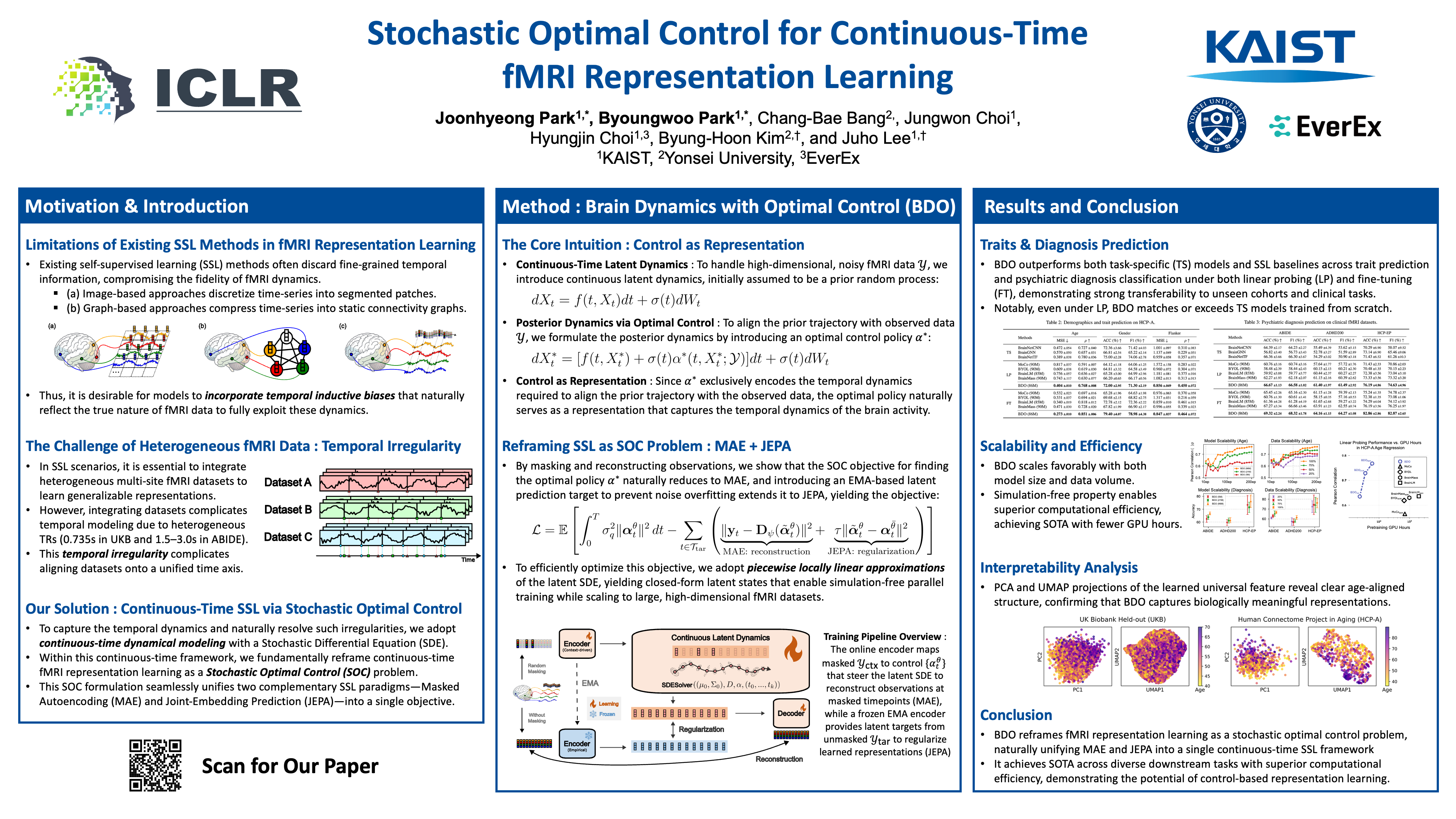
Learning robust representations from functional magnetic resonance imaging (fMRI) is fundamentally challenged by the temporal irregularity and noise inherent in data from heterogeneous sources. Existing self-supervised learning (SSL) methods often discard critical temporal information by discretizing or averaging fMRI signals. To address this, we introduce a novel framework that reframes SSL as a Stochastic Optimal Control (SOC) problem. Our approach models brain activity as continuous-time latent dynamics, learning a robust representation of brain dynamics by optimizing a control policy that is agnostic to the temporal irregularity. This SOC framework naturally unifies masked autoencoding (MAE) and joint-embedding prediction (JEPA) to extract compact, control-derived representations. Furthermore, a simulation-free inference strategy ensures computational efficiency and scalability for large-scale fMRI datasets. Our model demonstrates state-of-the-art performance across diverse downstream applications, highlighting the potential of the SOC-based continuous-time representation learning framework.