
Spike-based Digital Brain: a novel fundamental model for brain activity analysis
Abstract
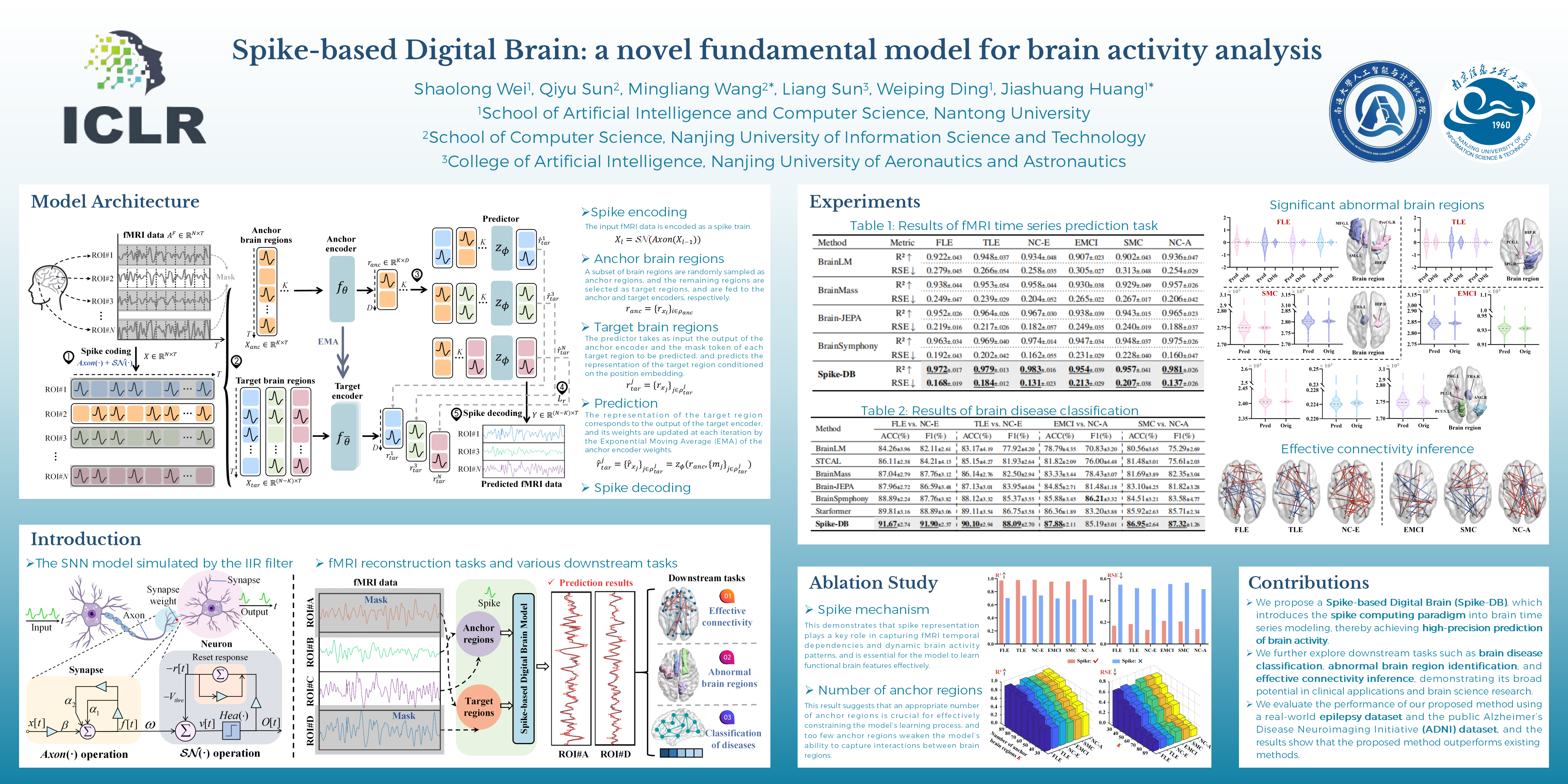
Modeling the temporal dynamics of the human brain remains a core challenge in computational neuroscience and artificial intelligence. Traditional methods often ignore the biological spike characteristics of brain activity and find it difficult to reveal the dynamic dependencies and causal interactions between brain regions, limiting their effectiveness in brain function research and clinical applications. To address this issue, we propose a Spike-based Digital Brain (Spike-DB), a novel fundamental model that introduces the spike computing paradigm into brain time series modeling. Spike-DB encodes fMRI signals as spike trains and learns the temporal driving relationships between anchor and target regions to achieve high-precision prediction of brain activity and reveal underlying causal dependencies and dynamic relationship characteristics. Based on Spike-DB, we further conducted downstream tasks including brain disease classification, abnormal brain region identification, and effective connectivity inference. Experimental results on real-world epilepsy datasets and the Alzheimer's Disease Neuroimaging Initiative (ADNI) dataset show that Spike-DB outperforms existing mainstream methods in both prediction accuracy and downstream tasks, demonstrating its broad potential in clinical applications and brain science research. Our code is available at https://github.com/UAIBC-Brain/Spike-DB.