
Unleashing LLMs in Bayesian Optimization: Preference-Guided Framework for Scientific Discovery
Abstract
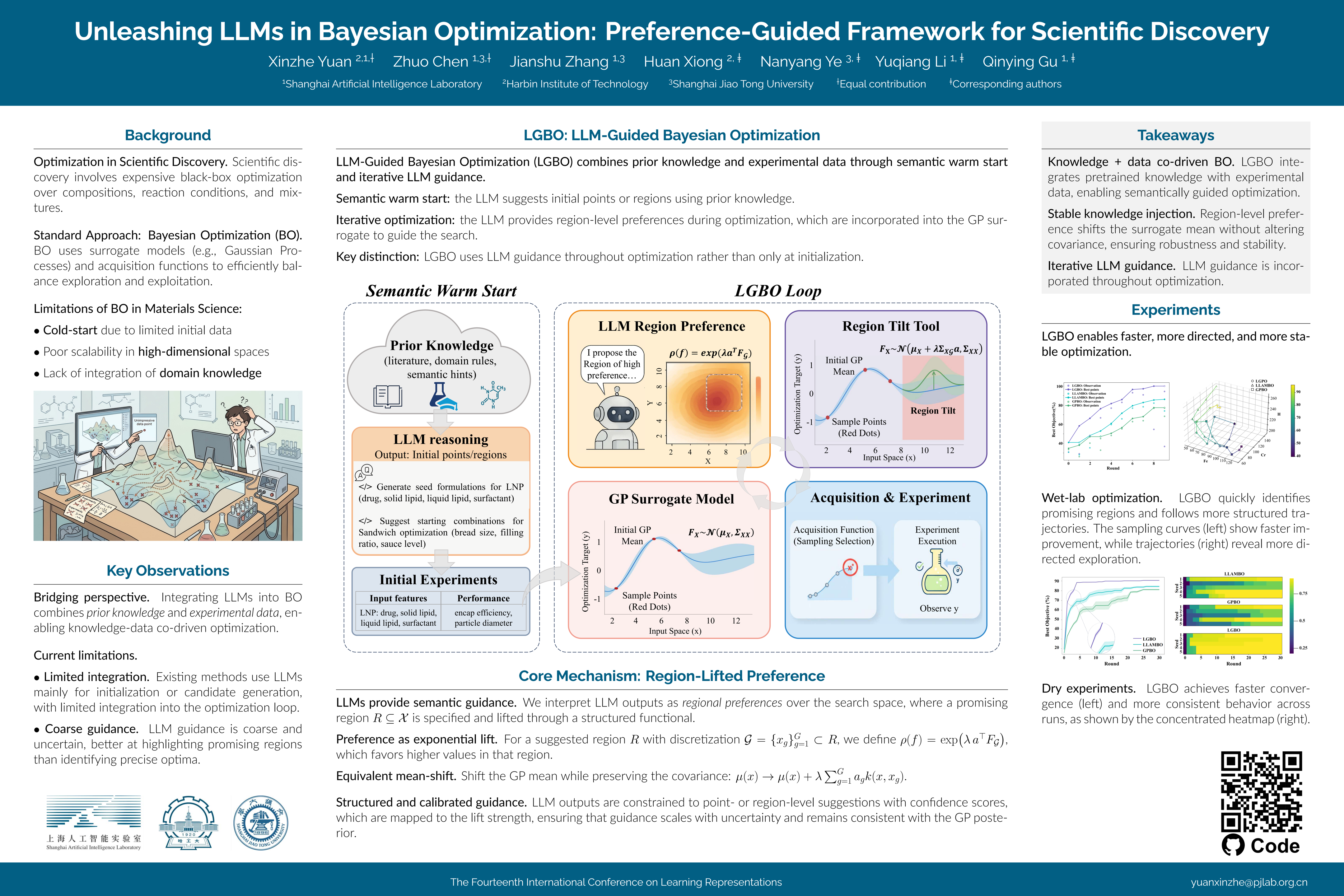
Scientific discovery is increasingly constrained by costly experiments and limited budgets, making efficient optimization essential for AI for science. Bayesian Optimization (BO), while widely adopted for balancing exploration and exploitation, suffers from slow cold-start performance and poor scalability in high-dimensional settings, limiting its effectiveness in real-world scientific applications. To address these challenges, we propose LLM-Guided Bayesian Optimization (LGBO), the first LLM preference-guided BO framework that continuously integrates the semantic reasoning of large language models (LLMs) into the optimization loop. Unlike prior works that use LLMs only for warm-start initialization or candidate generation, LGBO introduces a region-lifted preference mechanism that embeds LLM-driven preferences into every iteration, shifting the surrogate mean in a stable and controllable way. Theoretically, we prove that LGBO is not perform significantly worse than standard BO in the worst case, while achieving significantly faster convergence when preferences align with the objective. Empirically, LGBO achieves consistent improvements across diverse dry benchmarks in physics, chemistry, biology, and materials science. Most notably, in a new wet-lab optimization of Fe–Cr battery electrolytes, LGBO reaches \textbf{90\% of the best observed value within 6 iterations}, whereas standard BO and existing LLM-augmented baselines require more than 10 iterations. Together, the results suggest that LGBO offers a promising direction for integrating LLMs into scientific optimization workflows.