
Plan then Act: Bi-level CAD Command Sequence Generation
Abstract
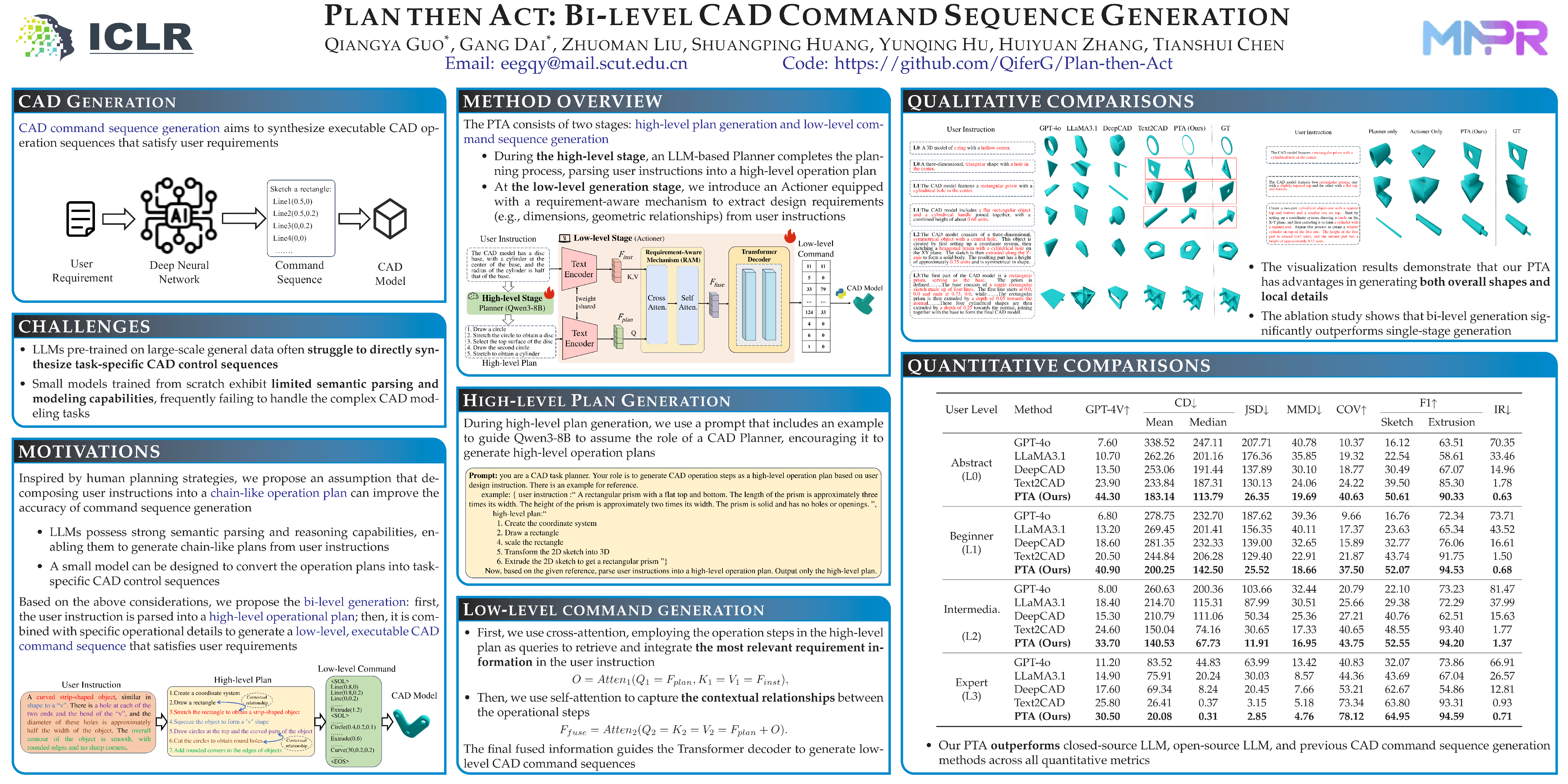
Computer-Aided Design (CAD), renowned for its flexibility and precision, serves as the foundation of digital design. Recently, some efforts adopt Large Language Models (LLMs) for generating parametric CAD command sequences from text instructions. However, our study reveals that LLMs pre-trained on large-scale general data are not proficient at directly outputting task-specific CAD sequences. Instead of relying on direct generation, we introduce a Plan then Act process where user instructions are first parsed into a chain-like operational plan via an LLM, which is then used to generate accurate command sequences. Specifically, we propose PTA, a new bi-level CAD command sequence generation method. The PTA consists of two critical stages: high-level plan generation and low-level command generation. During the high-level stage, an LLM-based Planner completes the planning process, parsing user instructions into a high-level operation plan. Following this, at the low-level generation stage, we introduce an Actioner equipped with a requirement-aware mechanism to extract design requirements (e.g., dimensions, geometric relationships) from user instructions. This extracted information is used to guide the low-level command sequence generation, improving the alignment of the generated sequences with user requirements. Experimental results demonstrate that our PTA outperforms existing methods in both quantitative and qualitative evaluations. Code is available at https://github.com/QiferG/Plan-then-Act.