
Reducing Class-Wise Performance Disparity via Margin Regularization
Beier Zhu ⋅ Kesen Zhao ⋅ Jiequan Cui ⋅ Qianru Sun ⋅ Yuan Zhou ⋅ Xun Yang ⋅ Hanwang Zhang
Abstract
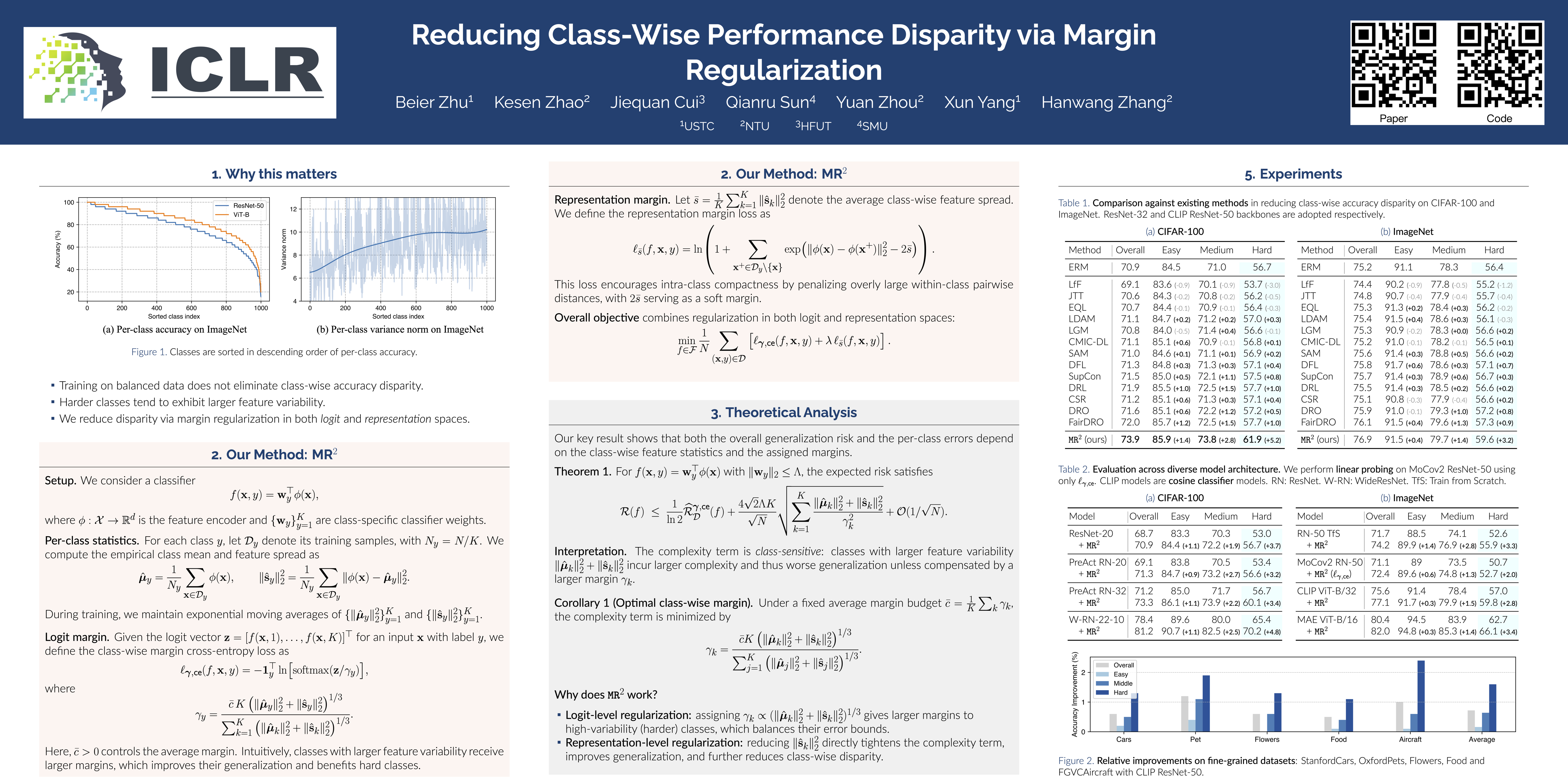
Deep neural networks often exhibit substantial disparities in class-wise accuracy, even when trained on class-balanced data—posing concerns for reliable deployment. While prior efforts have explored empirical remedies, a theoretical understanding of such performance disparities in classification remains limited. In this work, we present Margin Regularization for performance disparity Reduction ( $MR^2$ ), a theoretically principled regularization for classification by dynamically adjusting margins in both the logit and representation spaces. Our analysis establishes a novel margin-based, class-sensitive generalization bound that reveals how per-class feature variability contributes to error, motivating the use of larger margins for ''hard'' classes. Guided by this insight,$MR^2$ optimizes per-class logit margins proportional to feature spread and penalizes excessive representation margins to enhance intra-class compactness. Experiments on seven datasets—including ImageNet—and diverse pre-trained backbones (MAE, MoCov2, CLIP) demonstrate demonstrate that our $MR^2$ not only improves overall accuracy but also significantly boosts ''hard'' class performance without trading off ''easy'' classes, thus reducing the performance disparities. Codes are available in https://github.com/BeierZhu/MR2.
Video
Chat is not available.
Successful Page Load