
Structured Flow Autoencoders: Learning Structured Probabilistic Representations with Flow Matching
Abstract
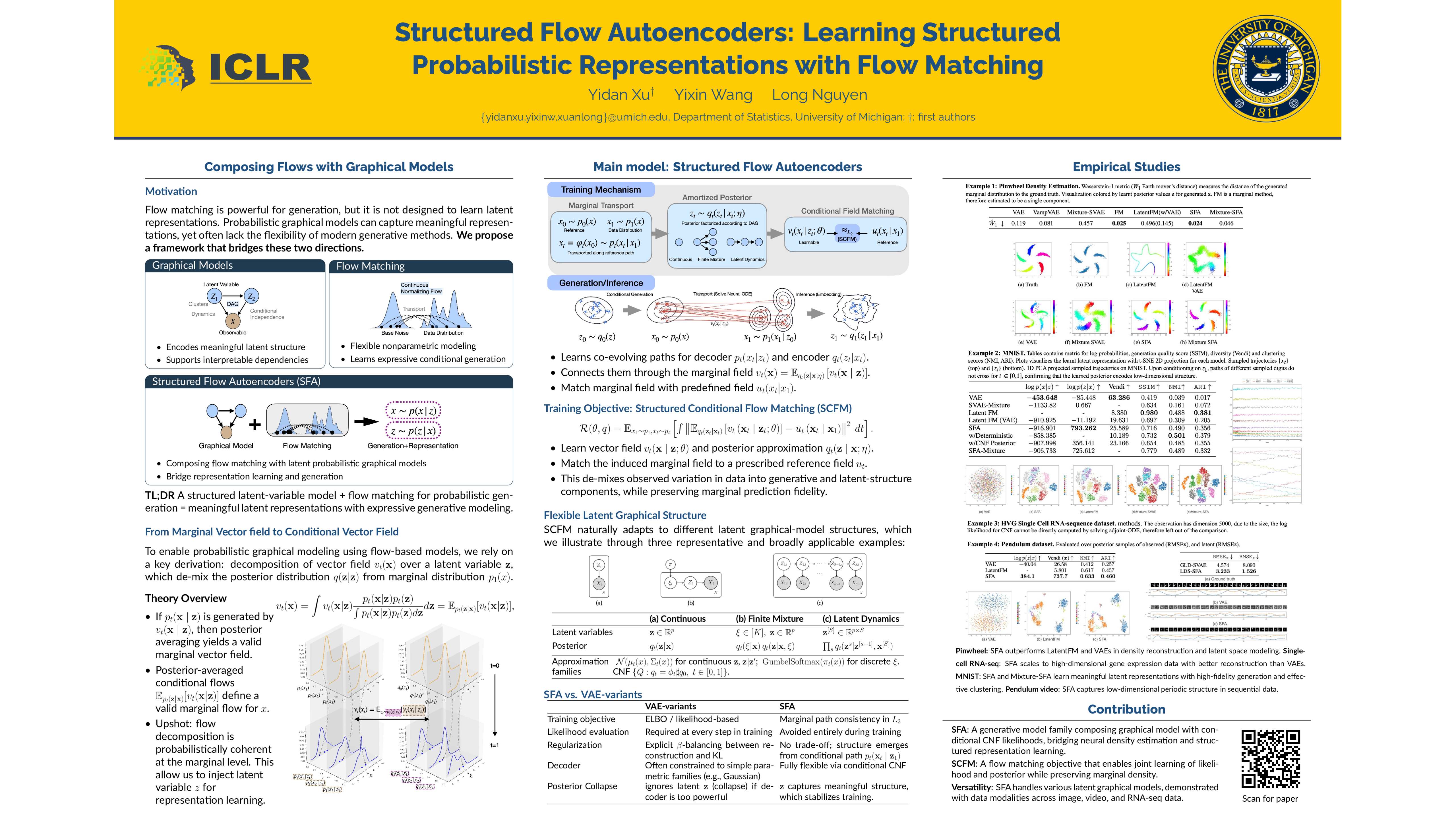
Flow matching is a powerful approach for high-fidelity density estimation, but it often fails to capture the latent structure of complex data. Probabilistic models like variational autoencoders (VAEs), on the other hand, learn structured representations but underperform in sample quality. We propose Structured Flow Autoencoders (SFA), a family of probabilistic models that augments graphical models with conditional continuous normalizing flow (CNF) likelihoods, enabling flow-matching-based structured representation learning. At the core of SFA is a novel flow matching objective that explicitly accounts for latent variables, allowing joint learning of the CNF likelihood and posterior. SFA applies broadly to graphical models with continuous and mixture latents, as well as latent dynamical systems. Empirical studies across image, video, and RNA-seq data show that SFA consistently outperforms VAEs and their structured extensions in generation quality, representation utility, and scalability to large datasets. Compared to generative models like latent flow matching (LatentFM), SFA also produces more diverse samples, suggesting better coverage of the data distribution.