
Nef-Net v2: Adapting Electrocardio Panorama in the wild
Abstract
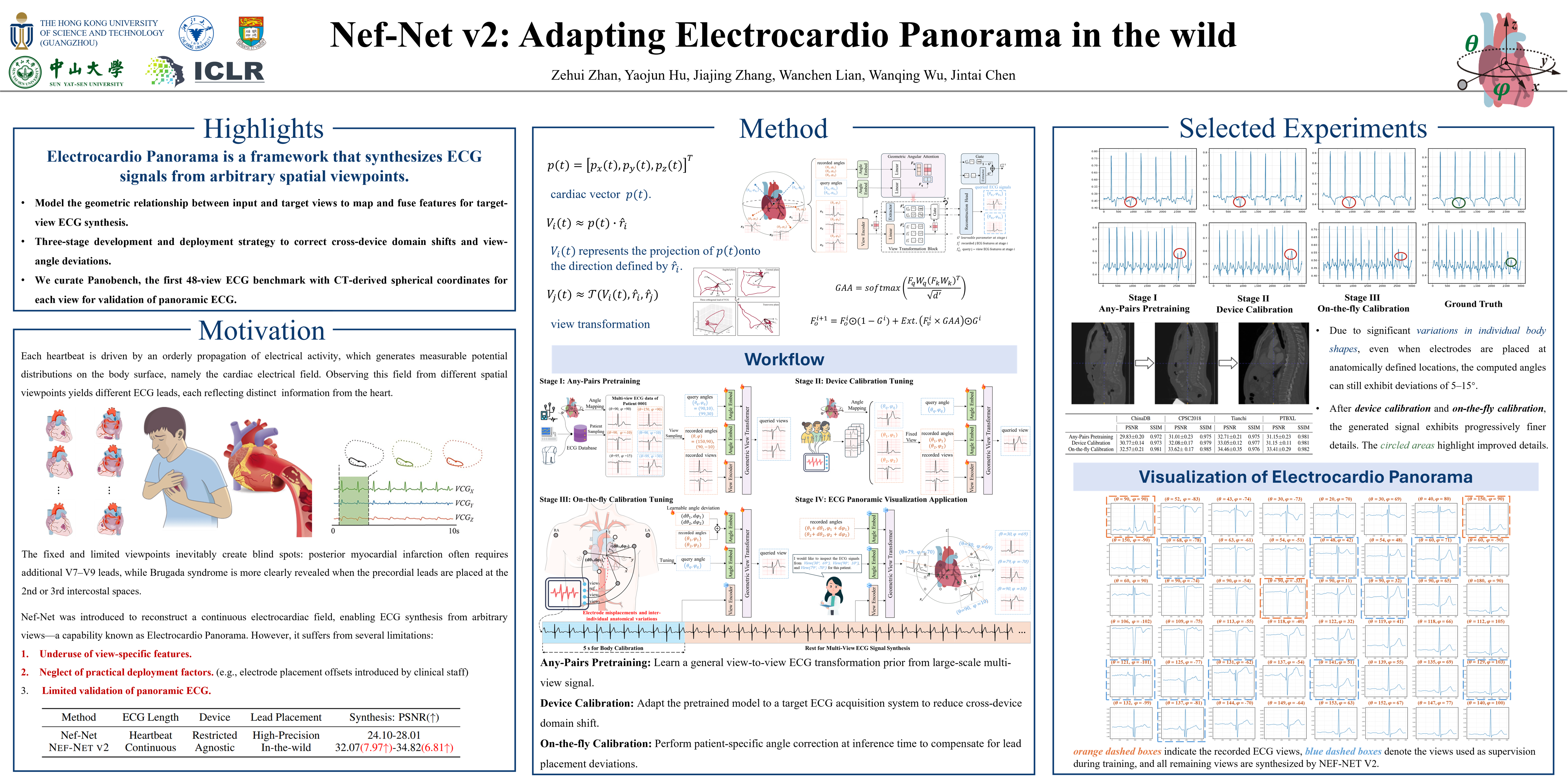
Conventional multi-lead electrocardiogram (ECG) systems capture cardiac signals from a fixed set of anatomical viewpoints defined by lead placement. However, cer- tain cardiac conditions (e.g., Brugada syndrome) require additional, non-standard viewpoints to reveal diagnostically critical patterns that may be absent in standard leads. To systematically overcome this limitation, Nef-Net was recently introduced to reconstruct a continuous electrocardiac field, enabling virtual observation of ECG signals from arbitrary views (termed Electrocardio Panorama). Despite its promise, Nef-Net operates under idealized assumptions and faces in-the-wild challenges, such as long-duration ECG modeling, robustness to device-specific signal artifacts, and suboptimal lead placement calibration. This paper presents NEF-NET V2, an enhanced framework for realistic panoramic ECG synthesis that supports arbitrary-length signal synthesis from any desired view, generalizes across ECG devices, and compensates for operator-induced deviations in electrode place- ment. These capabilities are enabled by a newly designed model architecture that performs direct view transformation, incorporating a workflow comprising offline pretraining, device calibration tuning steps as well as an on-the-fly calibration step for patient-specific adaptation. To rigorously evaluate panoramic ECG synthe- sis, we construct a new Electrocardio Panorama benchmark, called Panobench, comprising 4470 recordings with 48-view per subject, capturing the full spatial variability of cardiac electrical activity. Experimental results show that NEF-NET V2 delivers substantial improvements over Nef-Net, yielding an increase of around 6 dB in PSNR in real-world setting. Our data and code are publicly available at https://github.com/HKUSTGZ-ML4Health-Lab/NEFNET-v2.