
A Study on PAVE Specification for Learnware
Abstract
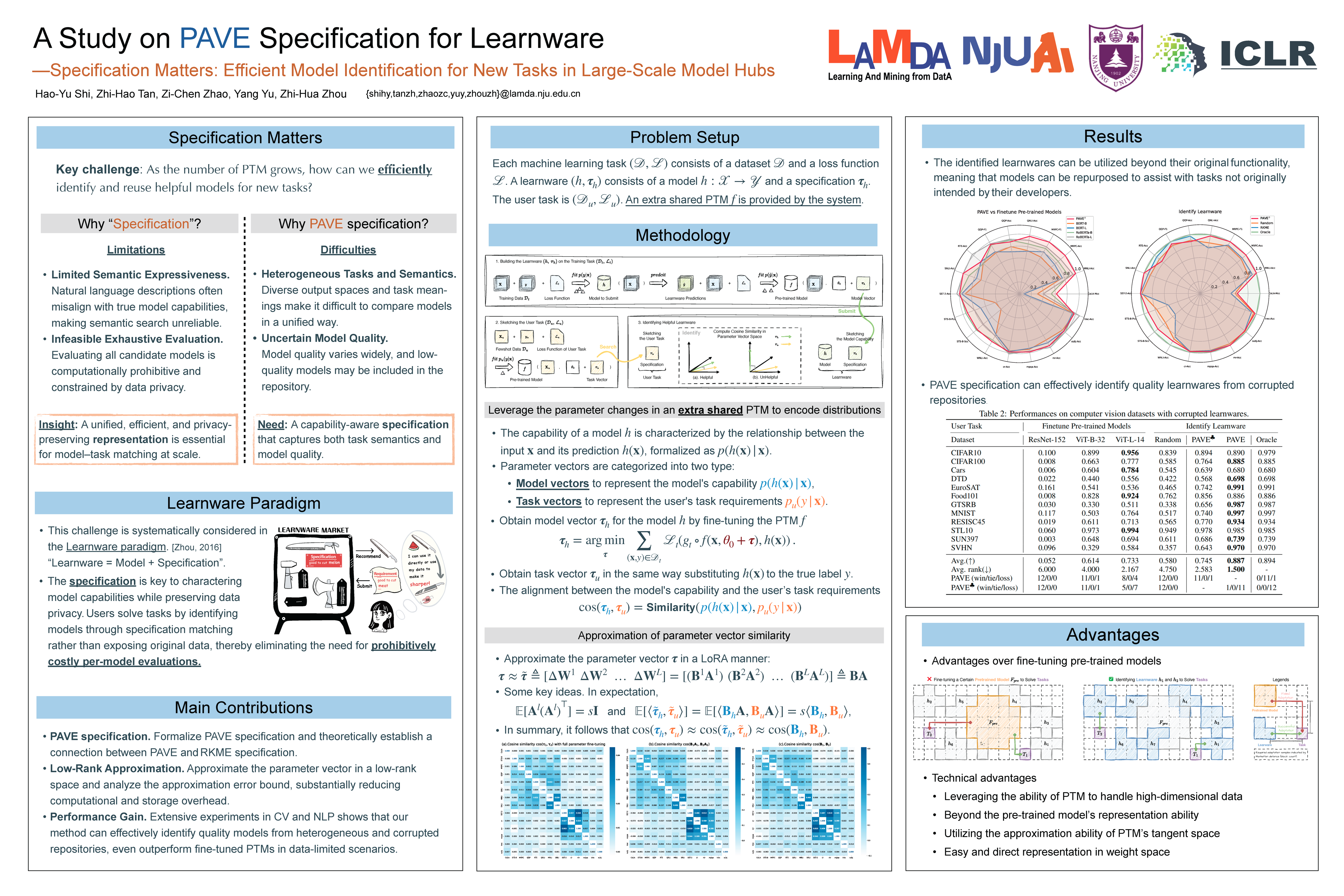
``Learnware = Model + Specification''. A learnware comprises a submitted model paired with a specification sketching its capabilities. For a Learnware Dock System (LDS) which accommodates numerous models, these specifications are essential to enabling users to identify helpful models, eliminating the requirement for prohibitively costly per-model evaluations. Recently, Parameter Vector (PAVE) specification, which utilizes the changes in pre-trained model parameters to inherently encode the model capability and task requirements, shows promising capabilities in enabling identifying useful learnwares for high-dimensional, unstructured text data. In this paper, we present a comprehensive study of PAVE specification for learnware identification. Theoretically, from the neural tangent kernel perspective, we establish a tight connection between PAVE and prior specifications, providing a theoretical explanation for their shared underlying principles. We further approximate PAVE in a low-rank space and analyze the approximation error bound, highly reducing the computational and storage overhead. Extensive empirical studies demonstrate that PAVE specification excels at identifying CV and NLP learnwares even from heterogeneous learnware repository with corrupted model quality. Reusing identified learnware to solve user tasks can even outperform user-fine-tuned pre-trained models in data-limited scenarios.