
Continuously Augmented Discrete Diffusion model for Categorical Generative Modeling
Abstract
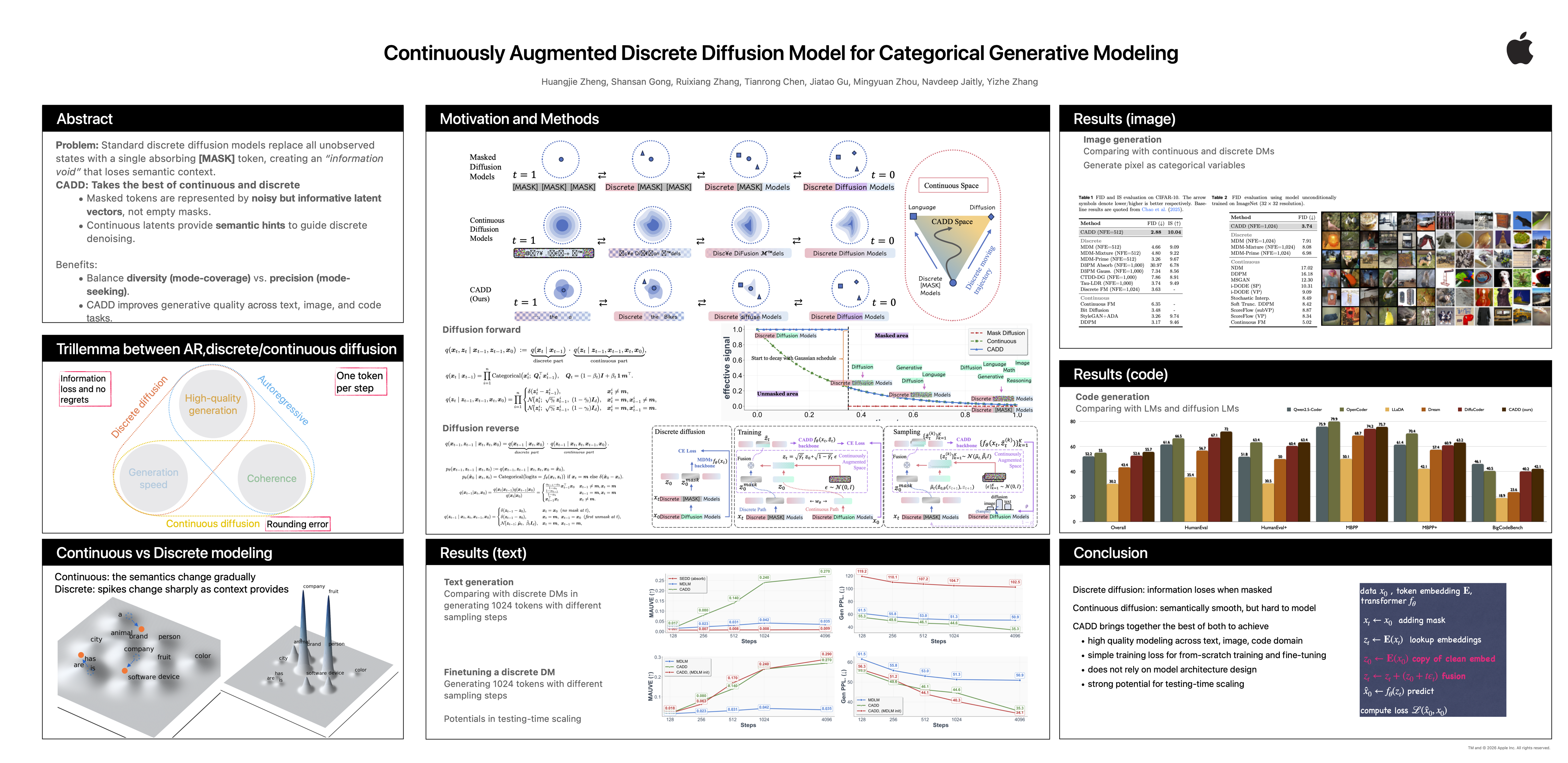
Standard discrete diffusion models treat all unobserved states the same way, typically mapping them to an absorbing [MASK] token. This creates an "information void" where global semantic information that may be inferred for the masked tokens from the unmasked tokens is not directly passed from one denoising step to another. We introduce Continuously Augmented Discrete Diffusion (CADD), a framework that augments the discrete state space with a paired diffusion in a continuous latent space. This yields graded, gradually corrupted states in which masked tokens are represented by noisy yet informative latent vectors rather than information voids. At each reverse step, CADD uses the continuous latent as a semantic hint to guide discrete denoising. The design is clean and compatible with existing discrete diffusion training. At sampling time, the strength and estimator of the continuous latent vector enables a controlled trade-off between mode-coverage (diversity-oriented) and mode-seeking (context-localization-oriented). Empirically, we demonstrate CADD improves generative quality over mask-based diffusion across text generation, image synthesis, and code modeling, with consistent gains on both qualitative and quantitative metrics against strong discrete baselines.