
When Foundation Models are One-Liners: Limitations and Future Directions for Time Series Anomaly Detection
Abstract
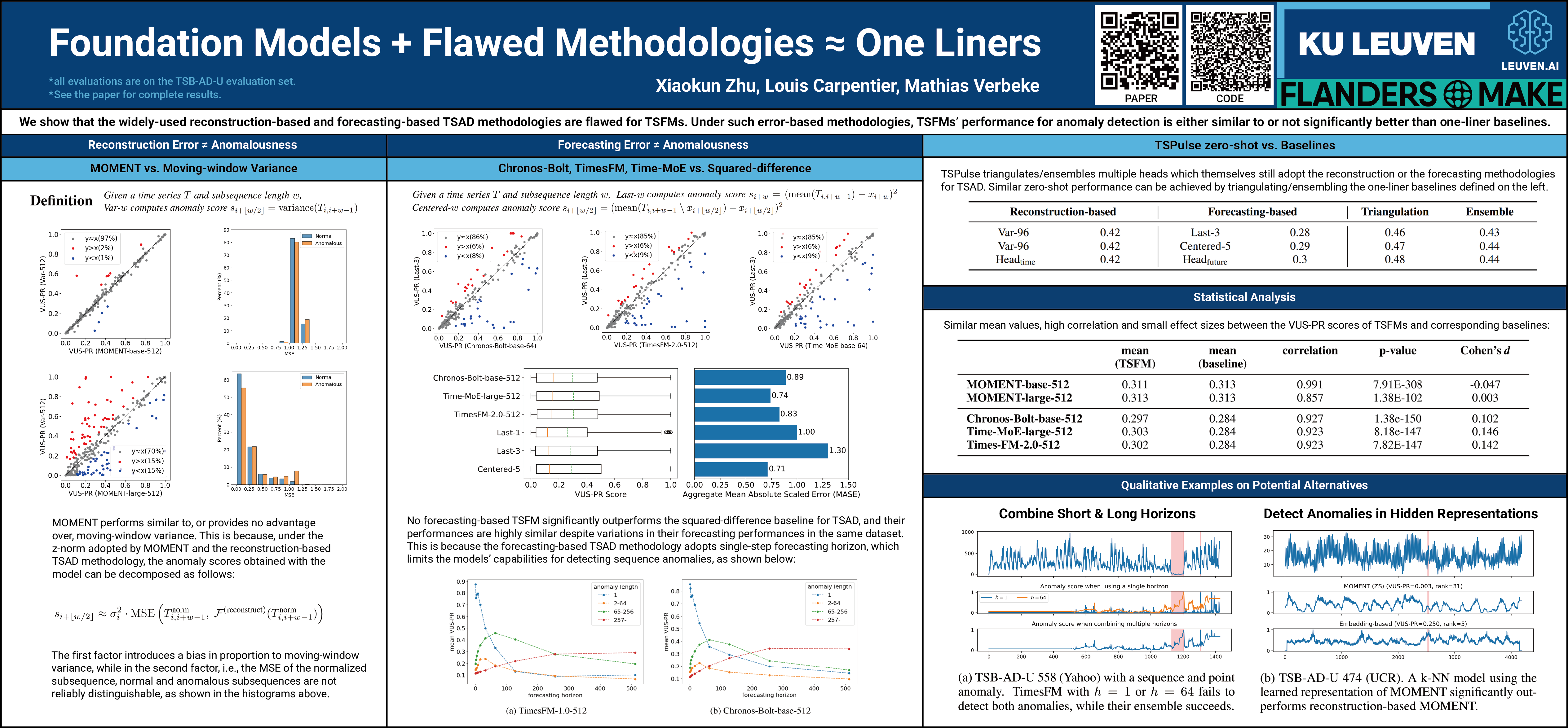
Recent efforts have extended the foundation model paradigm from natural language to time series, raising expectations that pre-trained time-series foundation models generalize well across downstream tasks. In this work, we focus on time-series anomaly detection, in which time-series foundation models detect anomalies based on the reconstruction or forecasting error. Specifically, we critically examine the performance of five popular families of time-series foundation models: MOMENT, Chronos, TimesFM, Time-MoE, and TSPulse. We find that for each model family using varying model sizes and context window lengths, anomaly detection performance does not significantly differ to simple one-liner baselines: moving-window variance and squared-difference. These findings suggest that the key assumptions underlying reconstruction-based and forecasting-based methodologies for time-series anomaly detection are not satisfied for time-series foundation models: anomalies are not consistently harder to reconstruct or forecast. The results suggest that current approaches for leveraging foundation models in anomaly detection are insufficient. Building upon our insights, we propose alternative directions to effectively detect anomalies using foundation models, thereby unlocking their full potential for time-series anomaly detection.