
Latent Planning Emerges with Scale
Abstract
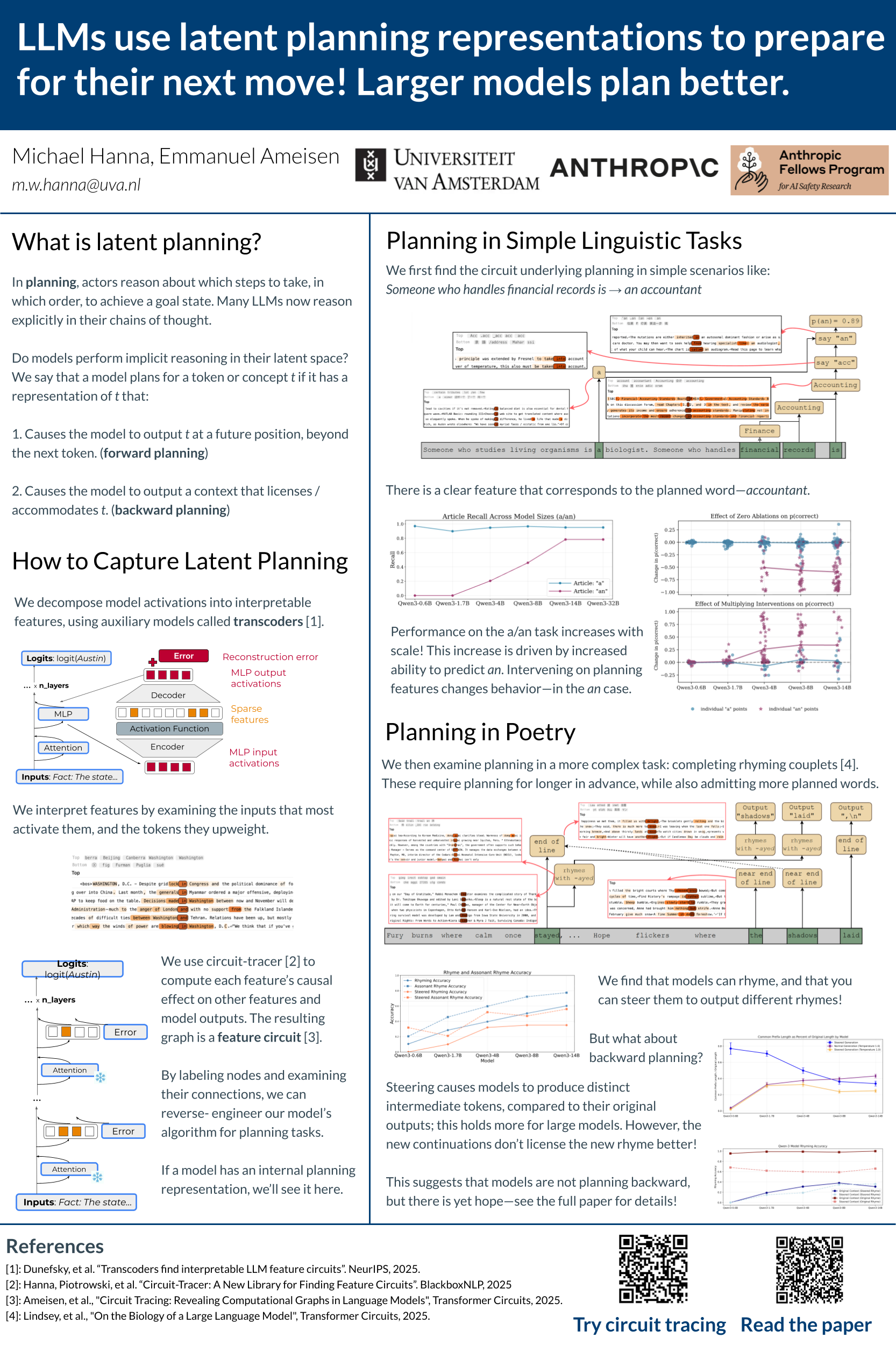
LLMs can perform seemingly planning-intensive tasks, like writing coherent stories or functioning code, without explicitly verbalizing a plan; however, the extent to which they implicitly plan is unknown. In this paper, we define latent planning as occurring when LLMs possess internal planning representations that (1) cause the generation of a specific future token or concept, and (2) shape preceding context to license said future token or concept. We study the Qwen-3 family (0.6B-14B) on simple planning tasks, finding that latent planning ability increases with scale. Models that plan possess features that represent a planned-for word like accountant, and cause them to output an rather than a; moreover, even the less-successful Qwen-3 4B-8B have nascent planning mechanisms. On the more complex task of completing rhyming couplets, we find that models often identify a rhyme ahead of time, but even large models seldom plan far ahead. However, we can elicit some planning that increases with scale when steering models towards planned words in prose. In sum, we offer a framework for measuring planning and mechanistic evidence of how models' planning abilities grow with scale.