
OrthoRF: Exploring Orthogonality in Object-Centric Representations
Abstract
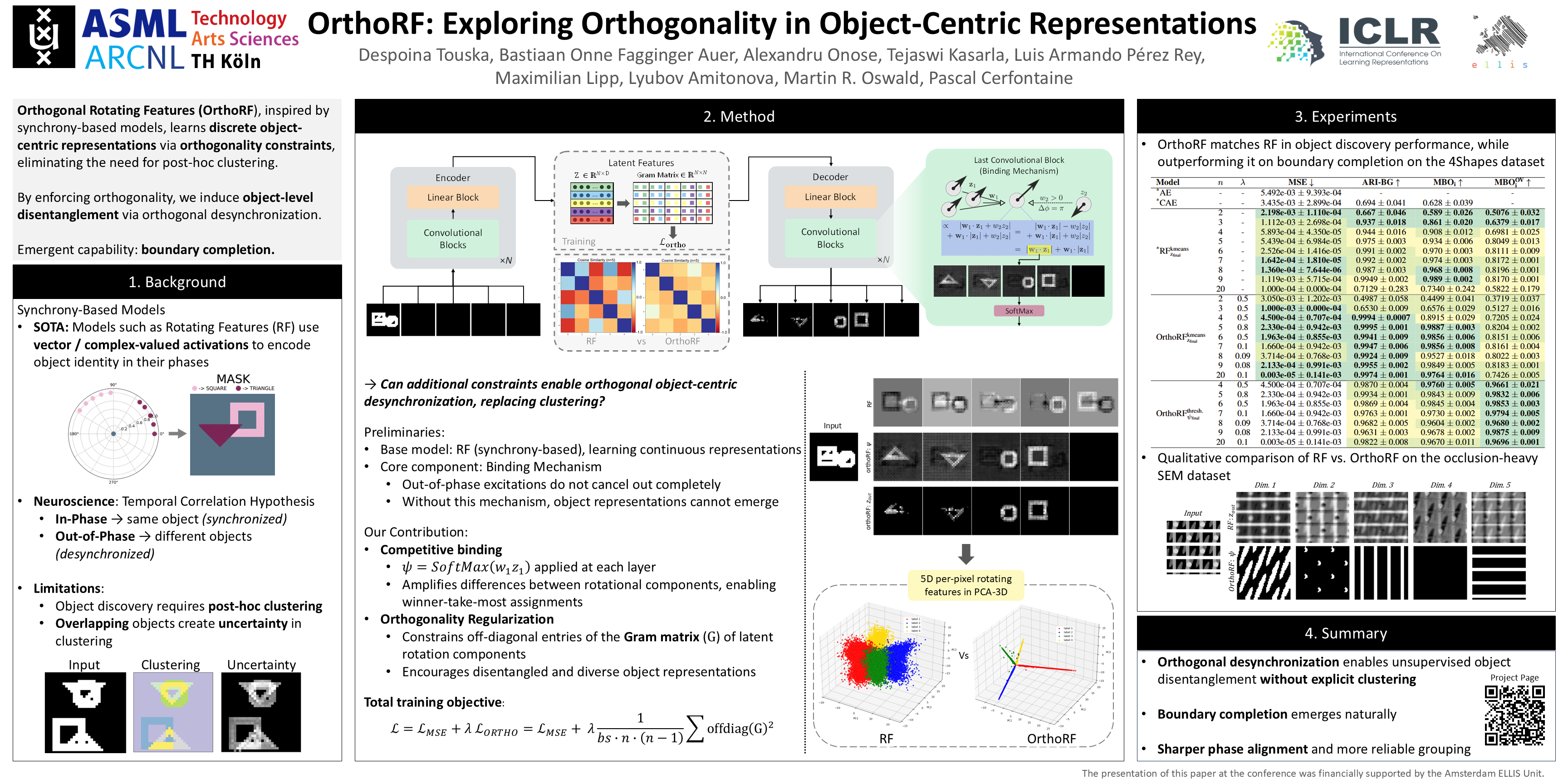
Neural synchrony is hypothesized to help the brain organize visual scenes into structured multi-object representations. In machine learning, synchrony-based models analogously learn object-centric representations by storing binding in the phase of complex-valued features. Rotating Features (RF) instantiate this idea with vector-valued activations, encoding object presence in magnitudes and affiliation in orientations. We propose Orthogonal Rotating Features (OrthoRF), which enforces orthogonality in RF’s orientation space via an inner-product loss and architectural modifications. This yields sharper phase alignment and more reliable grouping. In evaluations of unsupervised object discovery, including settings with overlapping objects, noise, and out-of-distribution tests, OrthoRF matches or outperforms current models while producing more interpretable representations, and it eliminates the post-hoc clustering required by many synchrony-based approaches. Unlike current models, OrthoRF also recovers occluded object parts, indicating stronger grouping under occlusion. Overall, orthogonality emerges as a simple, effective inductive bias for synchrony-based object-centric learning.