
Autoregressive-based Progressive Coding for Ultra-Low Bitrate Image Compression
Abstract
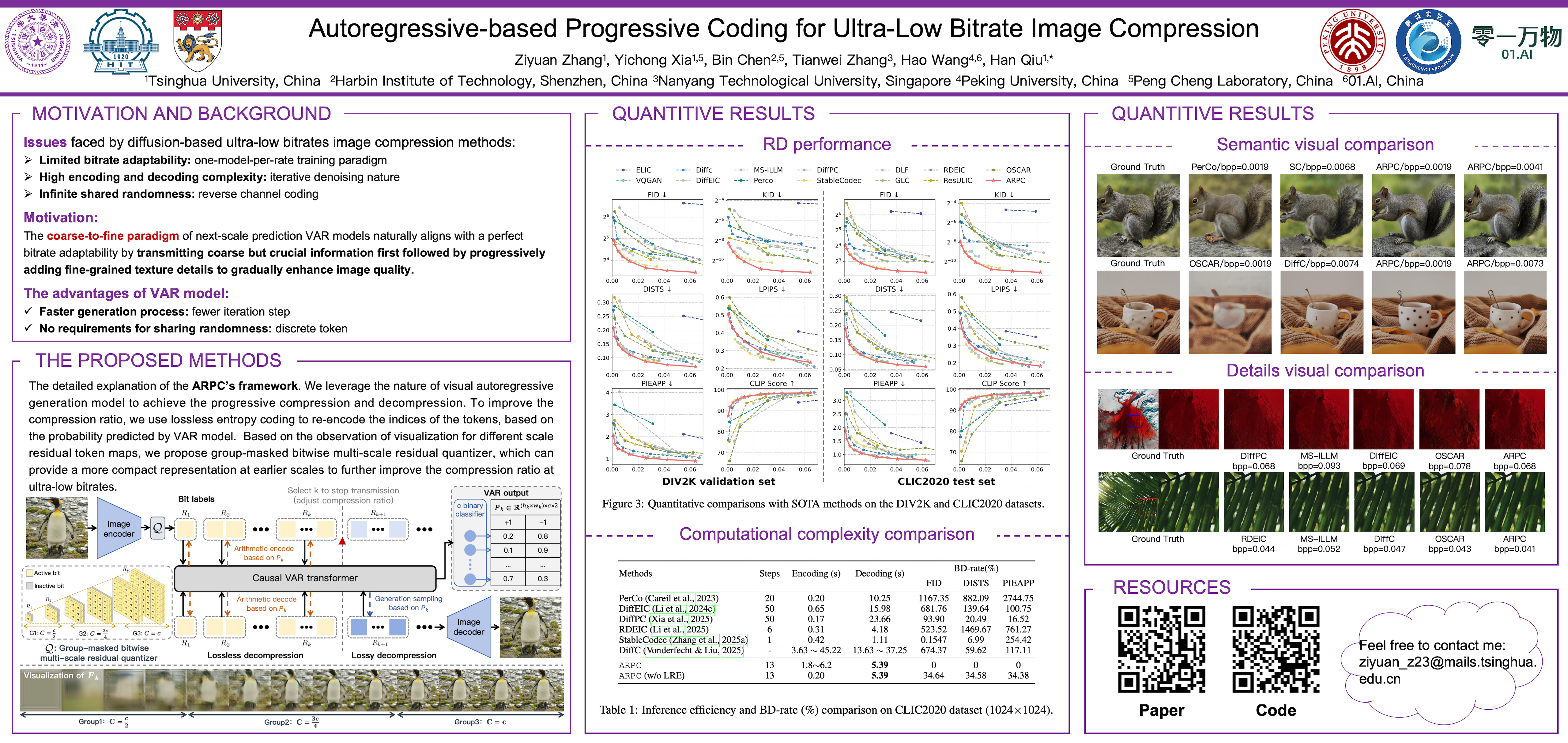
Generative models have demonstrated significant results in ultra-low bitrate image compression, owing to their powerful capabilities for content generation and texture completion. Existing works primarily based on diffusion models still face challenges such as limited bitrate adaptability and high computational complexity for encoding and decoding. Inspired by the success of Visual AutoRegressive model (VAR), we introduce AutoRegressive-based Progressive Coding (ARPC) for ultra-low bitrate image compression, a progressive image compression framework based on next-scale prediction visual autoregressive model. Based on multi-scale residual vector quantizer, ARPC efficiently encodes the image into multi-scale discrete token maps and controls the bitrates by selecting different scales for transmission. For decompression, ARPC leverages the prior knowledge inherent in the visual autoregressive model to predict the unreceived scales, which is naturally the autoregressive generation process. To further increase the compression ratio, we target the VAR as a probability estimator for lossless entropy coding and propose group-masked bitwise multi-scale residual quantizer to adaptively allocate bits for different scales. Extensive experiments show that ARPC achieves state-of-the-art perceptual fidelity at ultra-low bitrates and high decompression efficiency compared with existing diffusion-based methods.