
Functional MRI Time Series Generation via Wavelet-Based Image Transform and Spectral Flow Matching for Brain Disorder Identification
Abstract
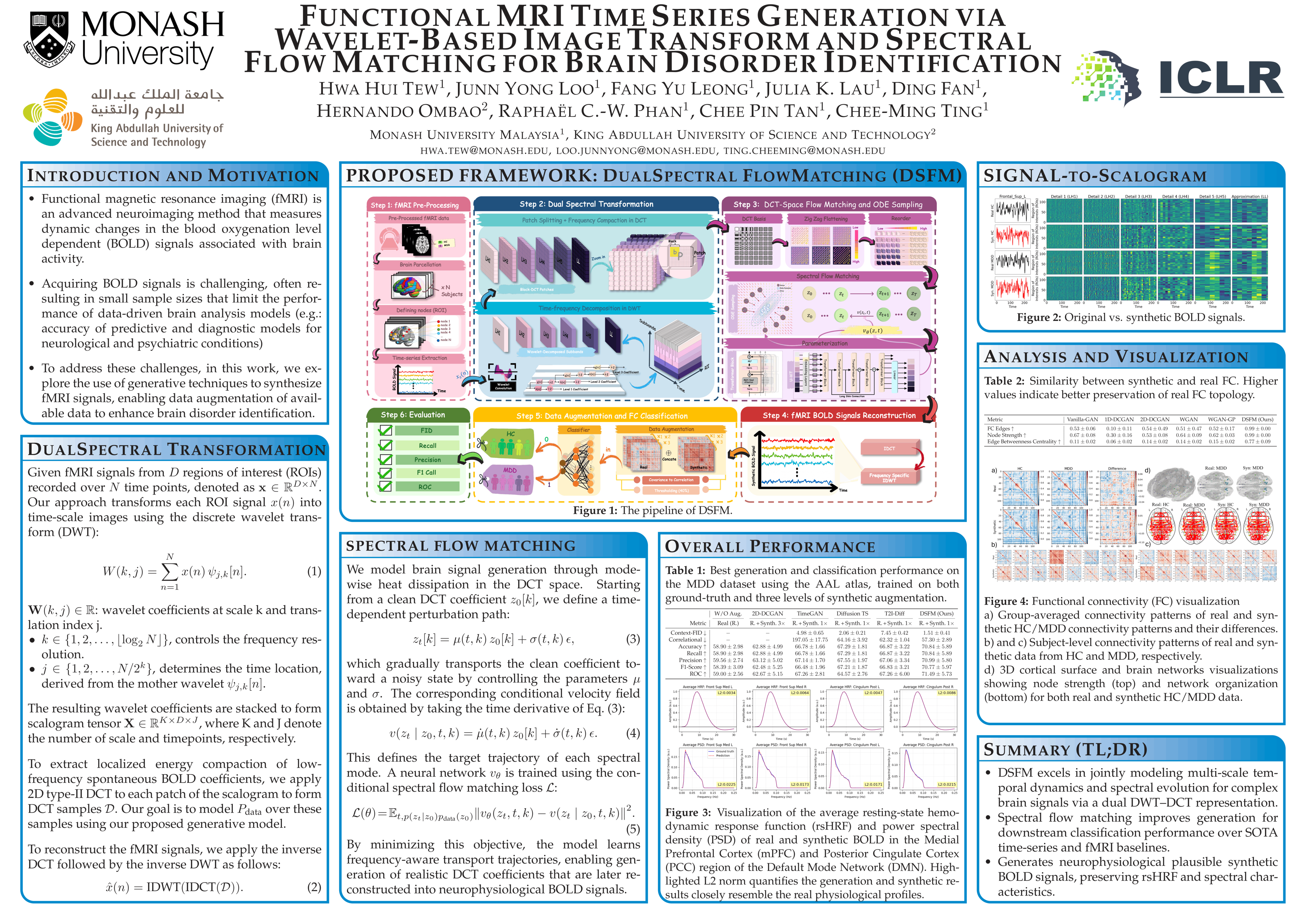
Functional Magnetic Resonance Imaging (fMRI) provides non-invasive access to dynamic brain activity by measuring blood oxygen level-dependent (BOLD) signals over time. However, the resource-intensive nature of fMRI acquisition limits the availability of high-fidelity samples required for data-driven brain analysis models. While modern generative models can synthesize fMRI data, they often remain challenging in replicating their inherent non-stationarity, intricate spatiotemporal dynamics, and physiological variations of raw BOLD signals. To address these challenges, we propose Dual-Spectral Flow Matching (DSFM), a novel fMRI generative framework that cascades dual frequency representation of BOLD signals with spectral flow matching. Specifically, our framework first converts BOLD signals into a wavelet decomposition map via a discrete wavelet transform (DWT) to capture globalized transient and multi-scale variations, and projects into the discrete cosine transform (DCT) space across brain regions and time to exploit localized energy compaction of low-frequency dominant BOLD coefficients. Subsequently, a spectral flow matching model is trained to generate class-conditioned cosine-frequency representation. The generated samples are reconstructed through inverse DCT and inverse DWT operations to recover physiologically plausible time-domain BOLD signals. This dual-transform approach imposes structured frequency priors and preserves key physiological brain dynamics. Ultimately, we demonstrate the efficacy of our approach through improved downstream fMRI-based brain network classification.