
Micro-Macro Retrieval: Reducing Long-Form Hallucination in Large Language Models
Yujie Feng ⋅ Jian Li ⋅ Zhihan Zhou ⋅ Pengfei Xu ⋅ Yujia Zhang ⋅ xiaoyu li ⋅ Xiaohui Zhou ⋅ Alan Zhao ⋅ Xi Chen ⋅ Xiao-Ming Wu
Abstract
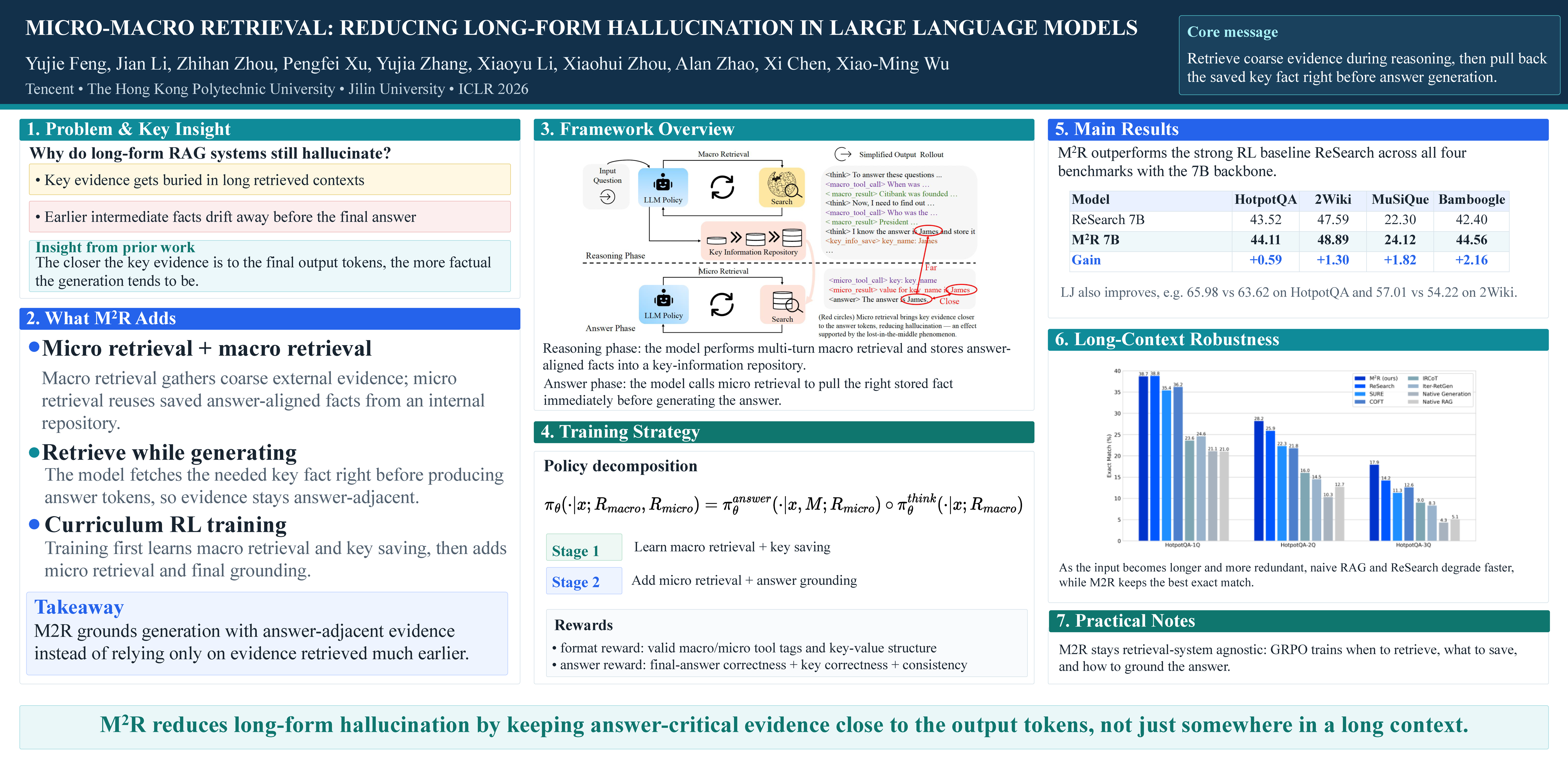
Large Language Models (LLMs) achieve impressive performance across many tasks but remain prone to hallucination, especially in long-form generation where redundant retrieved contexts and lengthy reasoning chains amplify factual errors. Recent studies highlight a critical phenomenon: the closer key information appears to the model outputs, the higher the factual accuracy. However, existing retrieval-augmented language models (RALMs) lack effective mechanisms to ensure this proximity — external evidence is injected into reasoning via multi-turn retrieval, but this cannot ensure key information stays close to the outputs. We propose Micro–Macro Retrieval ($M^2R$), a novel retrieve-while-generate framework to fill this gap. At the macro level, $M^2R$ retrieves coarse-grained evidence from external sources; at the micro level, it extracts essential results from a key information repository built during reasoning and reuses them while generating answers. This design directly addresses the key-information–to-output proximity bottleneck, effectively reducing hallucination in long-form tasks. $M^2R$ is trained with a curriculum learning–based reinforcement learning strategy using customized rule-based rewards, enabling stable acquisition of retrieval and grounding skills. Extensive experiments across different benchmarks demonstrate the effectiveness of $M^2R$, especially in lengthy-context settings.
Video
Chat is not available.
Successful Page Load