
SAFA-SNN: Sparsity-Aware On-Device Few-Shot Class-Incremental Learning with Fast-Adaptive Structure of Spiking Neural Network
Abstract
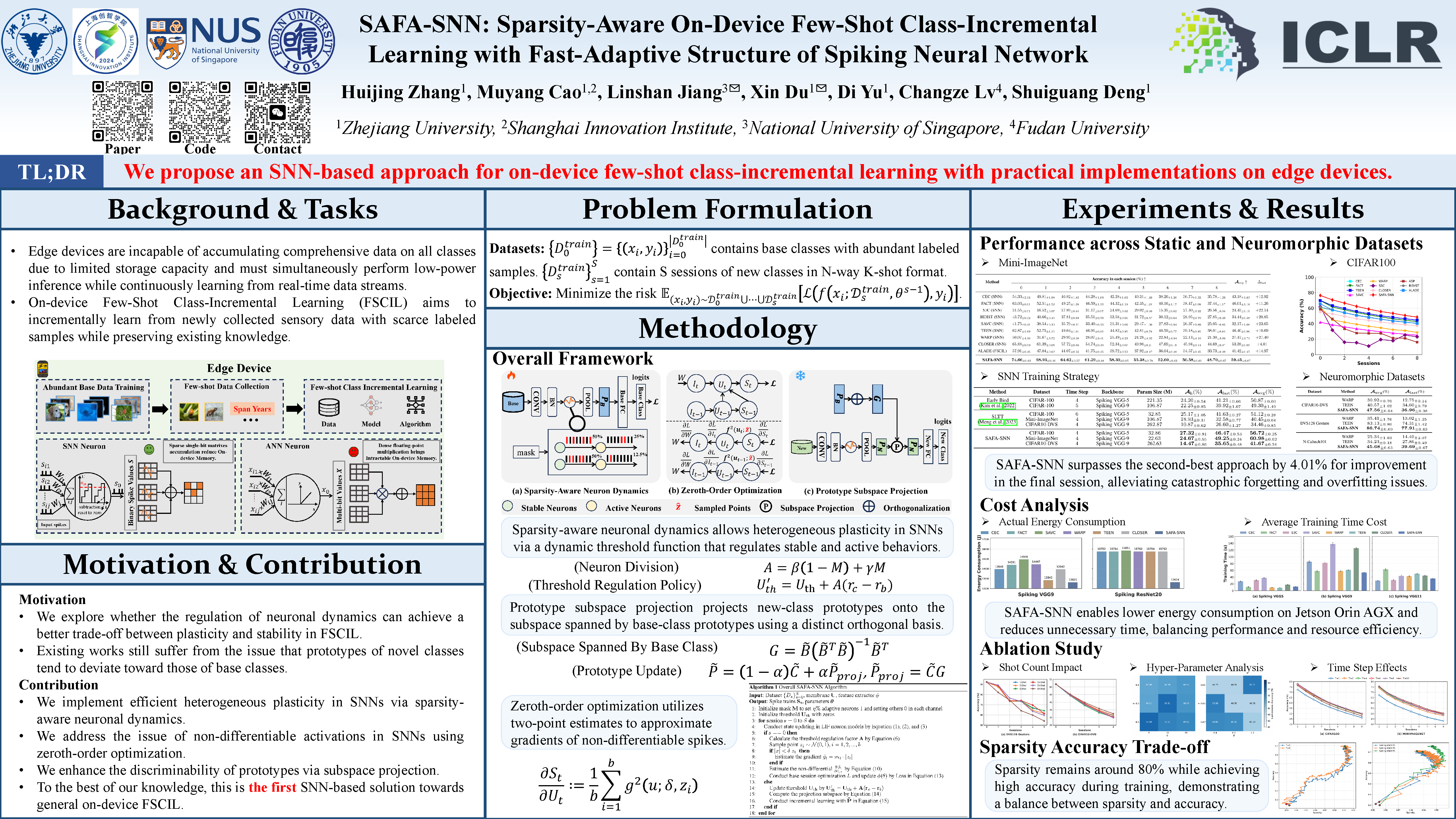
Continuous learning of novel classes is crucial for edge devices to preserve data privacy and maintain reliable performance in dynamic environments. However, the scenario becomes particularly challenging when data samples are insufficient, requiring on-device few-shot class-incremental learning (FSCIL). Although existing work has explored parameter-efficient FSCIL frameworks based on artificial neural networks (ANNs), their deployment is still fundamentally constrained by limited device resources. Spiking neural networks (SNNs) process spatiotemporal information efficiently, offering lower energy consumption, greater biological plausibility, and compatibility with neuromorphic hardware than ANNs. In this work, we propose an SNN-based method containing Sparsity-Aware neuronal dynamics and Fast Adaptive structure (SAFA-SNN) for on-device FSCIL. By threshold regulation, most neurons exhibit stable spikes and others exhibit adaptive spikes. As a result, synaptic traces that encode base-class knowledge are naturally preserved, thereby alleviating catastrophic forgetting. To cope with spike non-differentiability in backpropagation, we employ a gradient-free technique, i.e., zeroth-order optimization. Moreover, class prototypes can limit overfitting on few-shot data but introduce bias. We enhance prototype discriminability by orthogonal subspace projection. Extensive experiments conducted on two standard benchmark datasets (CIFAR-100 and Mini-ImageNet) and three neuromorphic datasets (CIFAR10-DVS, DVS128 Gesture, and N-Caltech101) demonstrate that SAFA-SNN outperforms baselines, specifically achieving at least 4.01\% improvement at the last incremental session on Mini-ImageNet and 20\% lower energy cost on CIFAR-100 over baselines with practical implementation.