
Bridging Explainability and Embeddings: BEE Aware of Spuriousness
Abstract
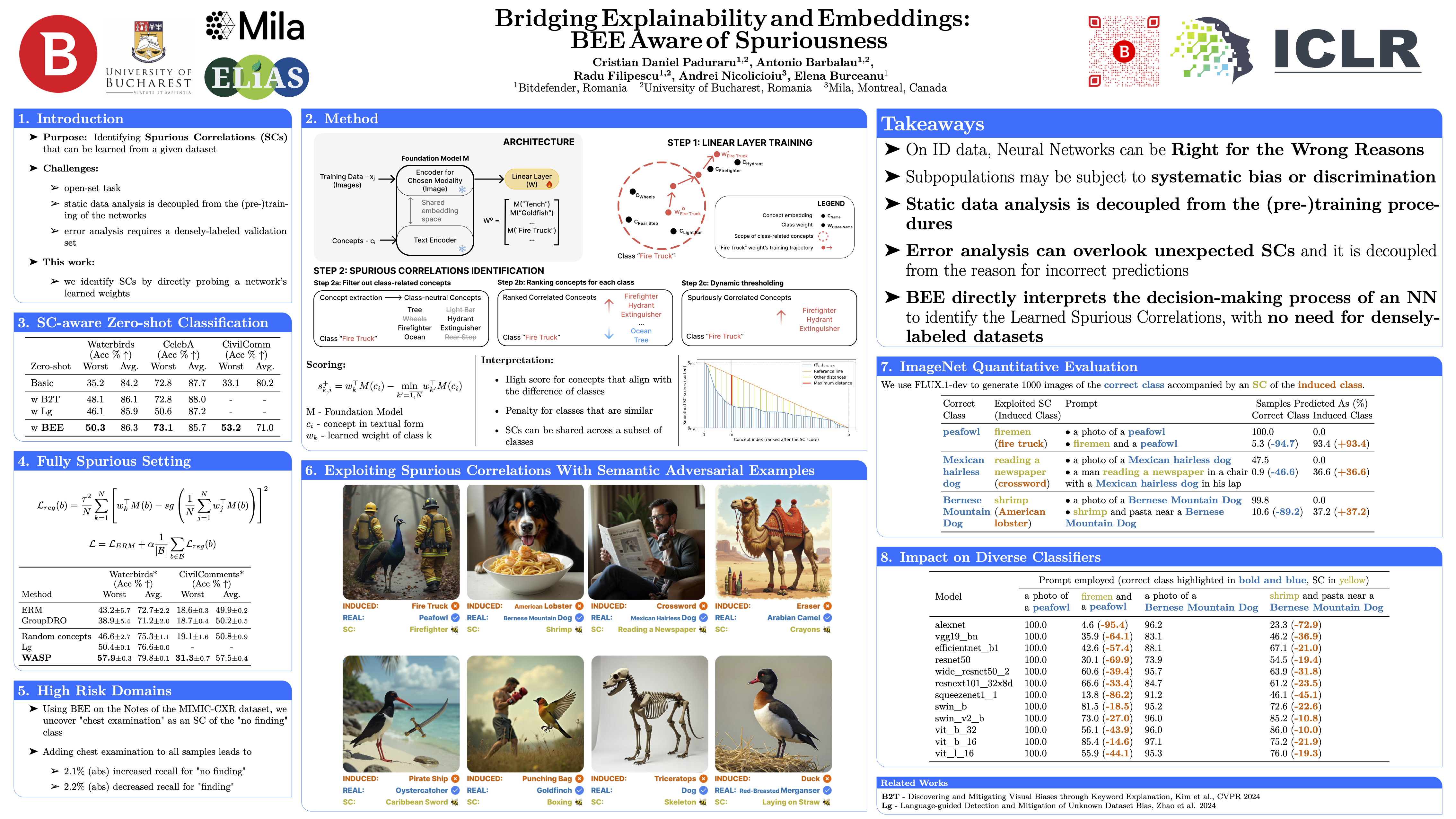
Current methods for detecting spurious correlations rely on data splits or error patterns, leaving many harmful shortcuts invisible when counterexamples are absent. We introduce BEE (Bridging Explainability and Embeddings), a framework that shifts the focus from model predictions to the weight space and embedding geometry underlying decisions. By analyzing how fine-tuning perturbs pretrained representations, BEE uncovers spurious correlations that remain hidden from conventional evaluation pipelines. We use linear probing as a transparent diagnostic lens, revealing spurious features that not only persist after full fine-tuning but also transfer across diverse state-of-the-art models. Our experiments cover numerous datasets and domains: vision (Waterbirds, CelebA, ImageNet-1k), language (CivilComments, MIMIC-CXR medical notes), and multiple embedding families (CLIP, CLIP-DataComp.XL, mGTE, BLIP2, SigLIP2). BEE consistently exposes spurious correlations: from concepts that slash the ImageNet accuracy by up to 95\%, to clinical shortcuts in MIMIC-CXR notes that induce dangerous false negatives. Together, these results position BEE as a general and principled tool for diagnosing spurious correlations in weight space, enabling principled dataset auditing and more trustworthy foundation models. The source code is publicly available at https://github.com/bit-ml/bee.