
Unified Biomolecular Trajectory Generation via Pretrained Variational Bridge
Abstract
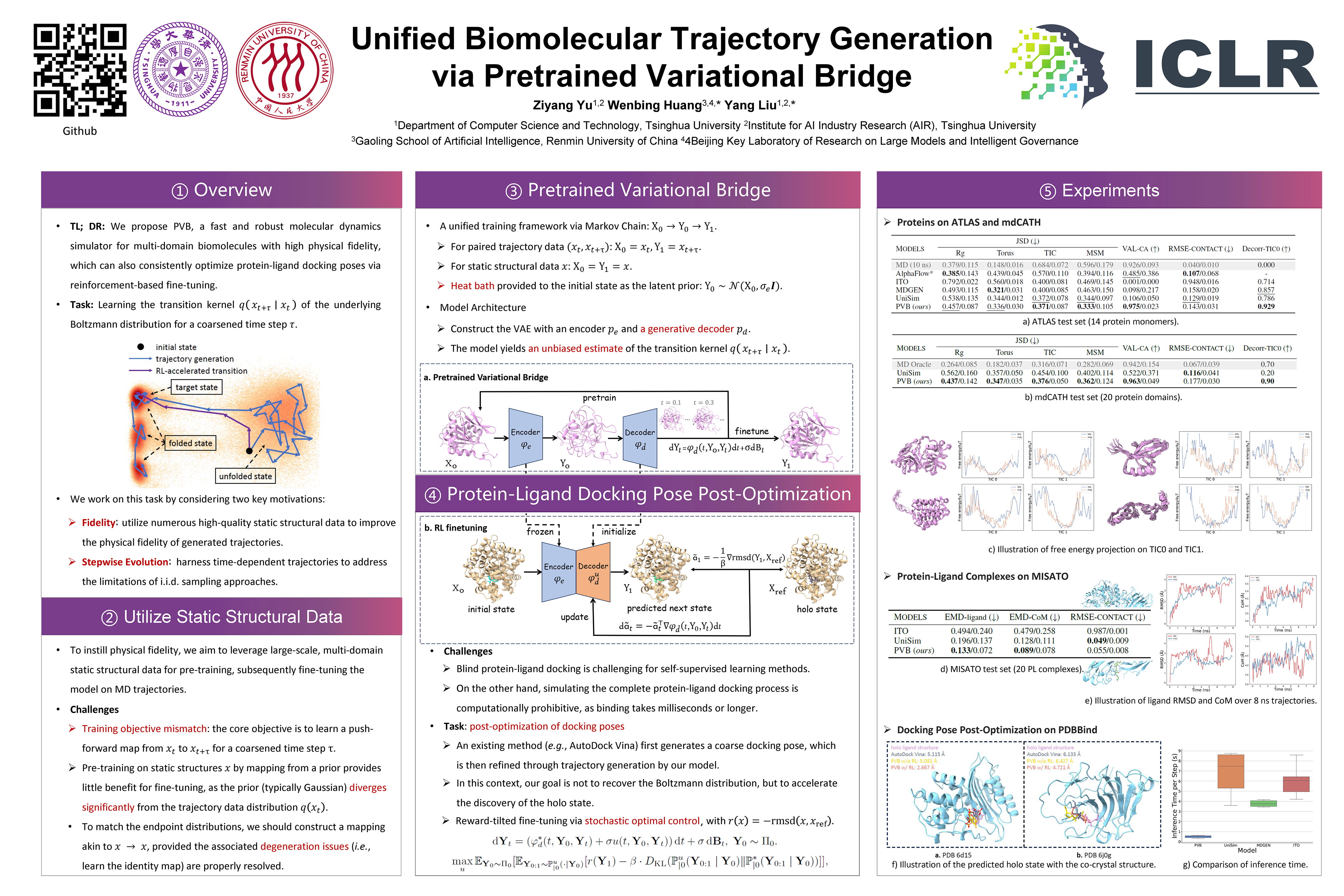
Molecular Dynamics (MD) simulations provide a fundamental tool for characterizing molecular behavior at full atomic resolution, but their applicability is severely constrained by the computational cost. To address this, a surge of deep generative models has recently emerged to learn dynamics at coarsened timesteps for efficient trajectory generation, yet they either generalize poorly across systems or, due to limited molecular diversity of trajectory data, fail to fully exploit structural information to improve generative fidelity. Here, we present the Pretrained Variational Bridge (PVB) in an encoder-decoder fashion, which maps the initial structure into a noised latent space and transports it toward stage-specific targets through augmented bridge matching. This unifies training on both single-structure and paired trajectory data, enabling consistent use of cross-domain structural knowledge across training stages. Moreover, for protein-ligand complexes, we further introduce a reinforcement learning-based optimization via adjoint matching that speeds progression toward the holo state, which supports efficient post-optimization of docking poses. Experiments on proteins and protein-ligand complexes demonstrate that PVB faithfully reproduces thermodynamic and kinetic observables from MD while delivering stable and efficient generative dynamics.