
CP-Agent: Context‑Aware Multimodal Reasoning for Cellular Morphological Profiling under Chemical Perturbations
Abstract
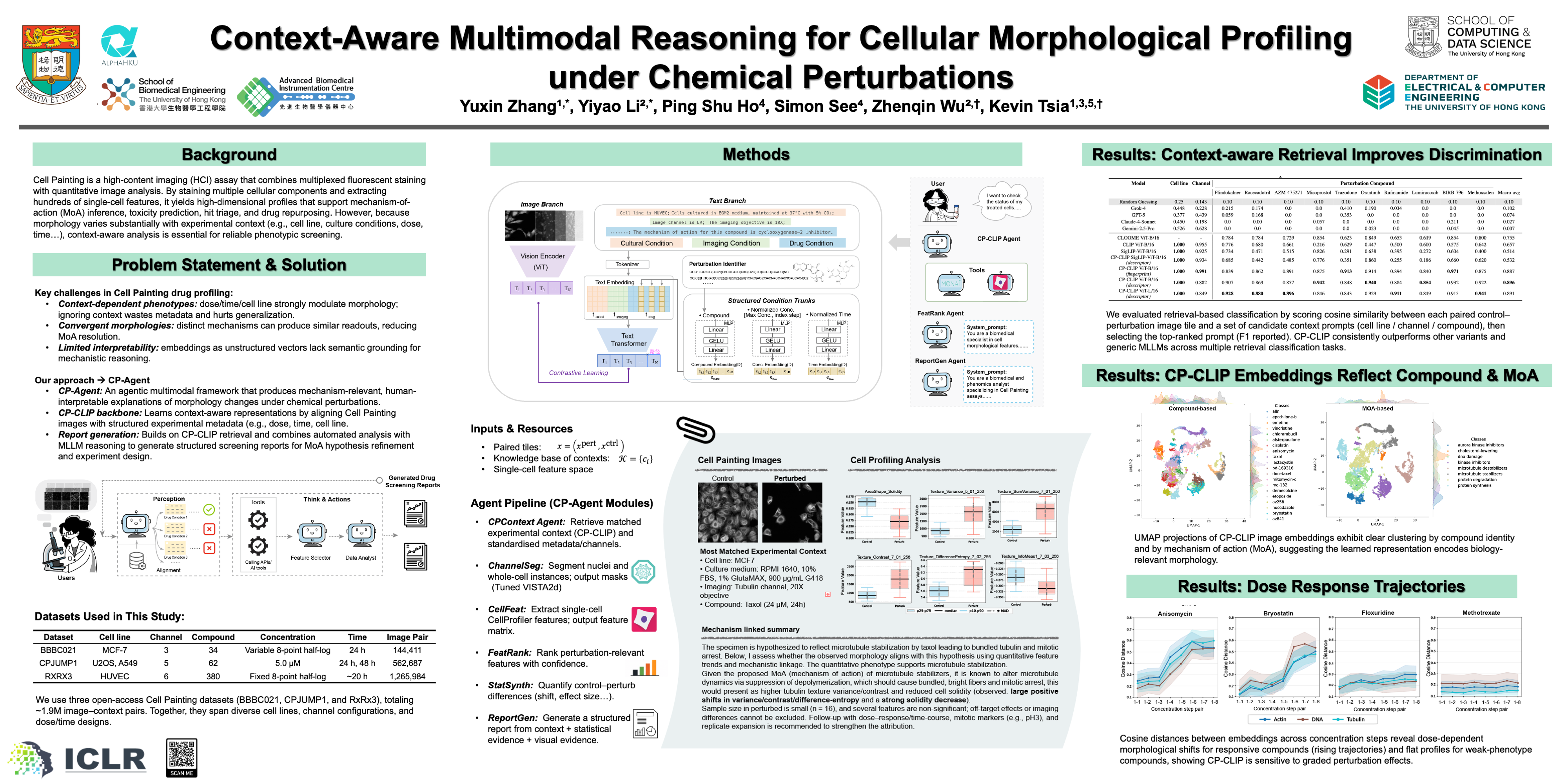
Cell Painting combines multiplexed fluorescent staining, high‑content imaging, and quantitative analysis to generate high-dimensional phenotypic readouts to support diverse downstream tasks such as mechanism-of-action (MoA) inference, toxicity prediction, and construction of drug–disease atlases. However, existing workflows are slow, costly and difficult to interpret. Approaches for drug screening modeling predominantly focus on molecular representation learning, while neglecting actual experimental context (e.g., cell line, dosing schedule, etc.), limiting generalization and MoA resolution. We introduce CP-Agent, an agentic multimodal large language model (MLLM) capable of generating mechanism-relevant, human-interpretable rationales for cell morphological changes under drug perturbations. At its core, CP-Agent leverages a context-aware alignment module, CP-CLIP, that jointly embeds high-content images and experimental metadata to enable robust treatment and MoA discrimination (achieving a maximum F1-score of 0.896). By integrating CP-CLIP outputs with agentic tool usage and reasoning, CP‑Agent compiles rationales into a structured report to guide experimental design and hypothesis refinement. These capabilities highlight CP-Agent’s potential to accelerate drug discovery by enabling more interpretable, scalable, and context-aware phenotypic screening---streamlining iterative cycles of hypothesis generation in drug discovery.