
Understanding the Implicit Biases of Design Choices for Time Series Foundation Models
Abstract
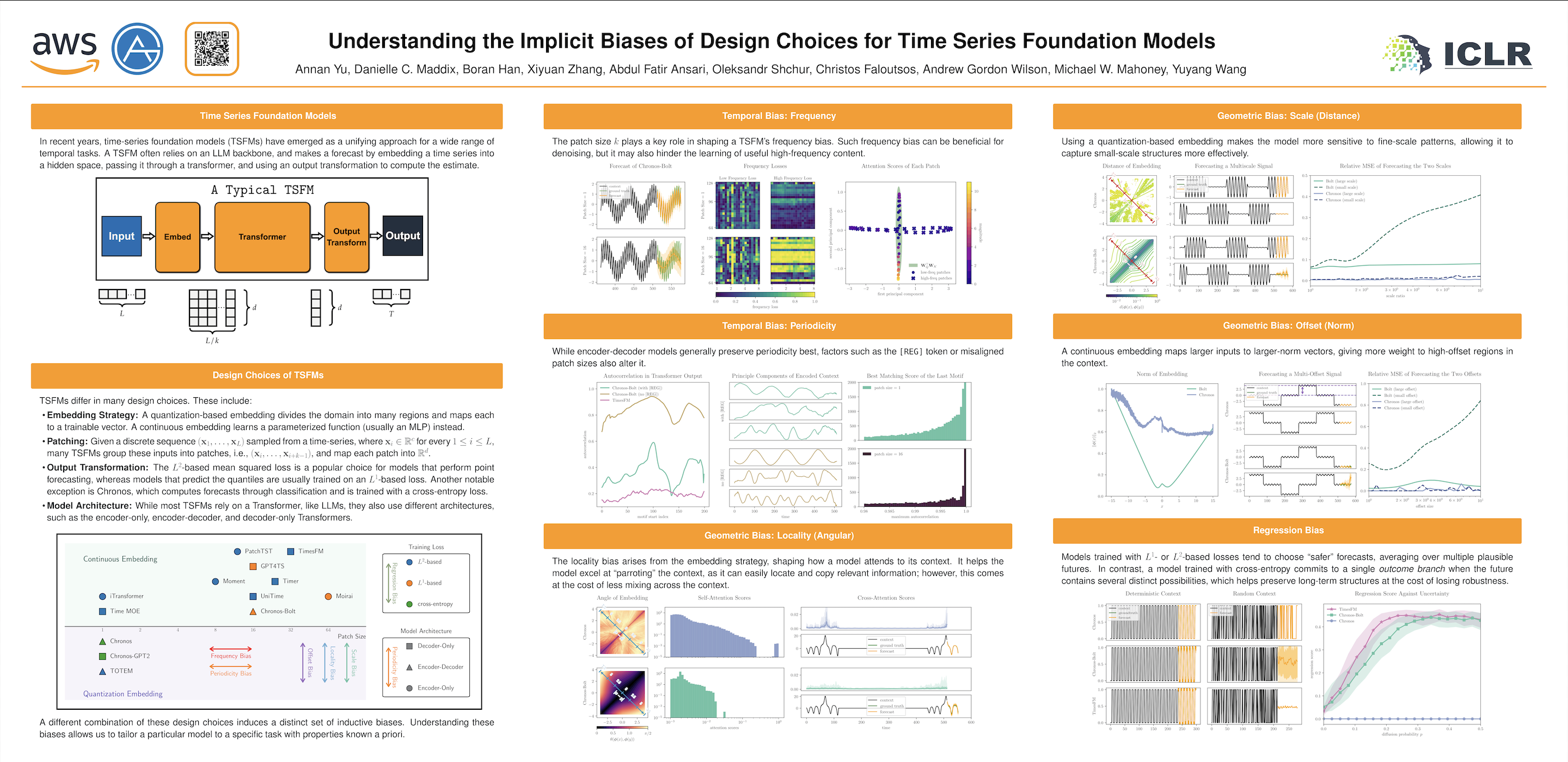
Time series foundation models (TSFMs) are a potential class of powerful, general-purpose tools for forecasting and related temporal tasks, but their behavior is strongly shaped by subtle inductive biases in their design. Rather than developing a new model and claiming that it is better than existing TSFMs, e.g., by winning on existing benchmarks, our objective is to understand how the various "knobs" of the training process affect model quality. Using a mix of theory and controlled empirical evaluation, we identify and show how various design choices (e.g., patch size, embedding choice, training objective, etc.) lead to implicit biases in fundamental model properties (e.g., temporal behavior, geometric structure, how aggressively or not the model regresses to the mean, etc.), and how these biases can be intuitive or counterintuitive, depending on properties of the model and data. We illustrate in a case study on outlier handling how multiple biases interact in complex ways.