
Supporting Multimodal Intermediate Fusion with Informatic Constraint and Distribution Coherence
Yi Li ⋅ Fei Song ⋅ Changwen Zheng ⋅ Jiangmeng Li
Abstract
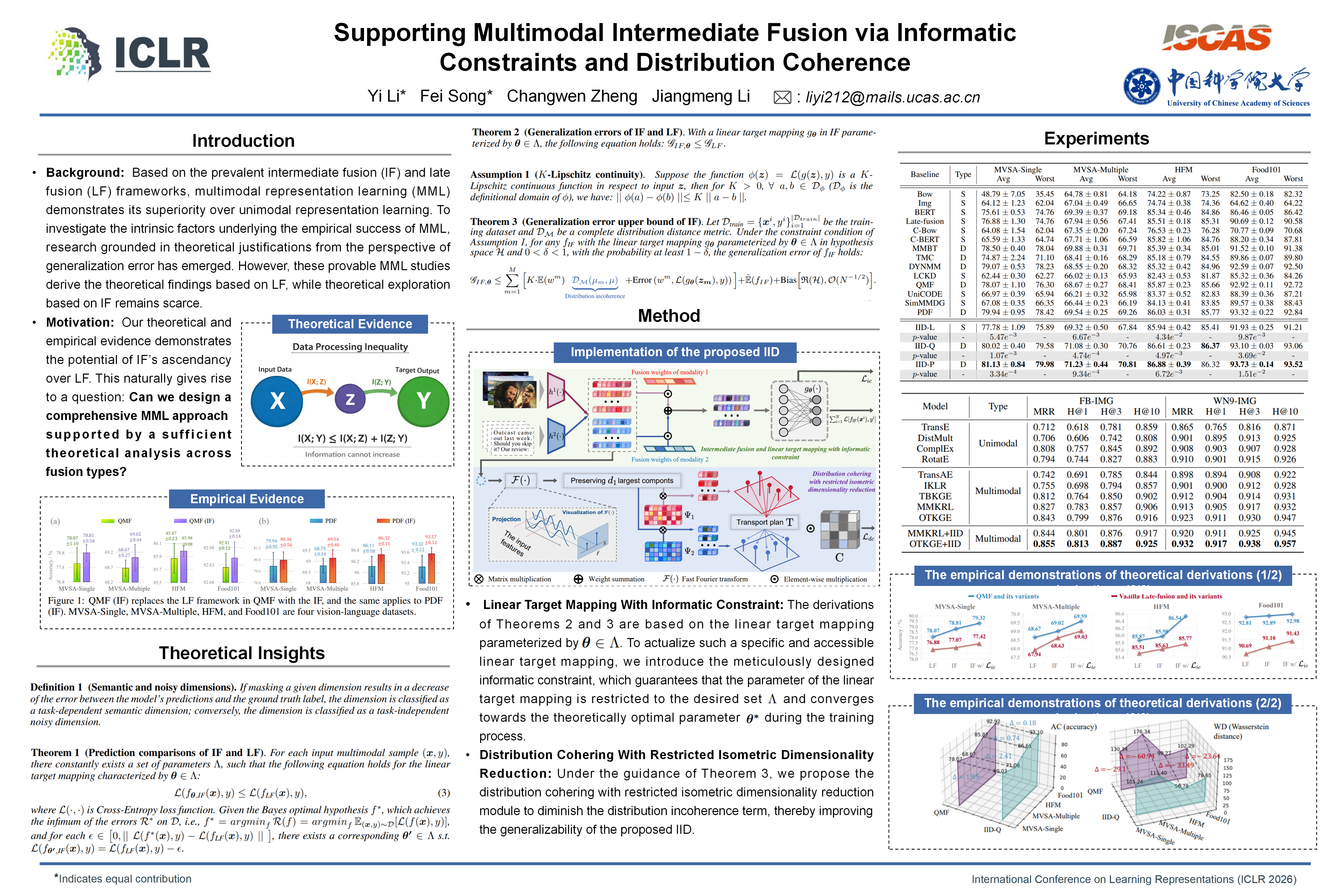
Based on the prevalent intermediate fusion (IF) and late fusion (LF) frameworks, multimodal representation learning (MML) demonstrates its superiority over unimodal representation learning. To investigate the intrinsic factors underlying the empirical success of MML, research grounded in theoretical justifications from the perspective of generalization error has emerged. However, these provable MML studies derive the theoretical findings based on LF, while theoretical exploration based on IF remains scarce. This naturally gives rise to a question: **Can we design a comprehensive MML approach supported by the sufficient theoretical analysis across fusion types?** To this end, we revisit the IF and LF paradigms from a fine-grained dimensional perspective. The derived theoretical evidence sufficiently establishes the superiority of IF over LF under a specific constraint. Based on a general $K$-Lipschitz continuity assumption, we derive the generalization error upper bound of the IF-based methods, indicating that eliminating the distribution incoherence can improve the generalizability of IF-based MML methods. Building upon these theoretical insights, we establish a novel IF-based MML method, which introduces the informatic constraint and performs distribution cohering. Extensive experimental results on multiple widely adopted datasets verify the effectiveness of the proposed method.
Video
Chat is not available.
Successful Page Load