
SNAPHARD CONTRAST LEARNING
Abstract
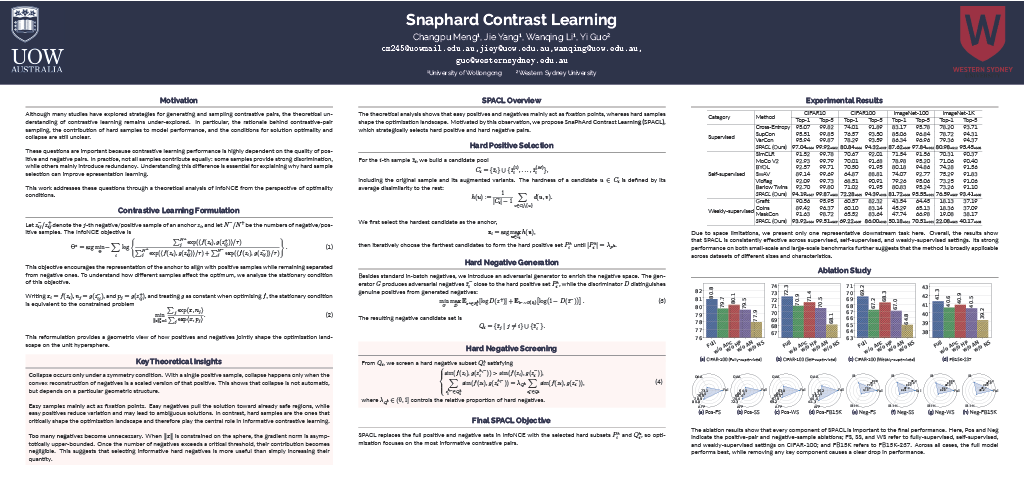
In recent years, Contrastive Learning (CL) has garnered significant attention due to its efficacy across various domains, spanning from visual and textual modalities. A fundamental aspect of CL is aligning the representations of anchor instances with relevant positive samples while simultaneously separating them from negative ones. Prior studies have extensively explored diverse strategies for generating and sampling contrastive (i.e., positive/negative) pairs. Despite the empirical success, the theoretical understanding of the CL approach remains under-explored, leaving questions such as the rationale behind contrastive-pair sampling and its contributions to the model performance unclear. This paper addresses this gap by providing a comprehensive theoretical analysis from the angle of optimality conditions and introducing the SnaPhArd Contrast Learning (SPACL). Specifically, SPACL prioritizes hard positive and hard negative samples during constructing contrastive pairs and computing the contrastive loss, rather than treating all samples equally. Experimental results across two downstream tasks demonstrate that SPACL consistently outperforms or competes favorably with state-of-the-art methods, showcasing its robustness and efficacy. A comprehensive ablation study further examines the effectiveness of SPACL's individual components to verify the theoretic findings.