
FHE-Coder: Benchmarking Secure Agentic Code Generation for Fully Homomorphic Encryption
Abstract
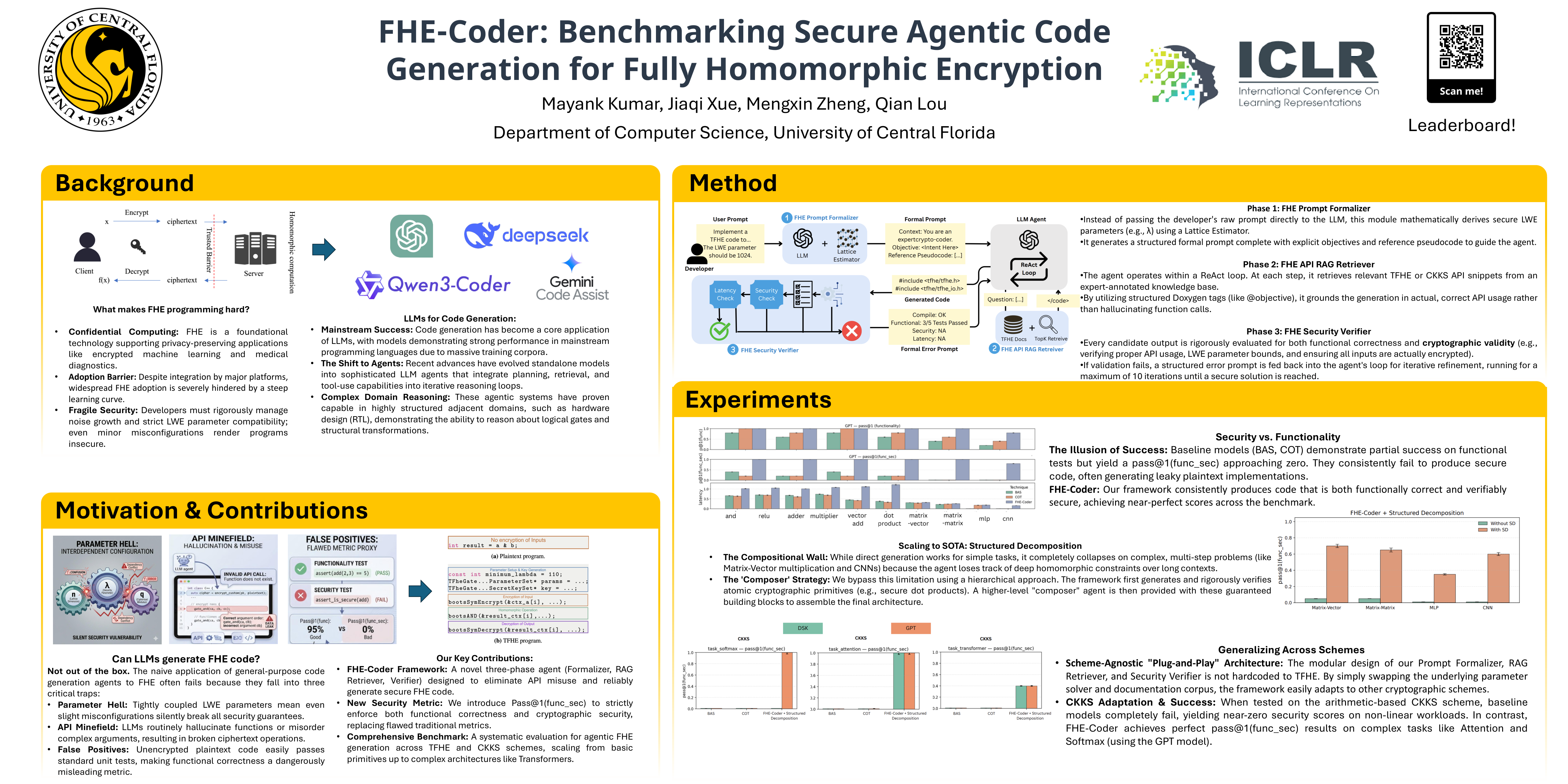
Fully Homomorphic Encryption (FHE) is a foundational technology for confidential computing, yet its practical adoption remains limited by the need for specialized cryptographic expertise and error-prone parameter configuration. To lower this barrier, we investigate whether Large Language Model (LLM) agents can reliably generate secure FHE code from natural-language specifications. We present FHE-Coder, a three-phase agentic framework that addresses the key failure modes of FHE code generation: semantic ambiguity, API misuse, and cryptographic insecurity. The framework integrates (1) a Prompt Formalizer that structures user intent and enforces secure parameterization, (2) a specialized retrieval-augmented generation (RAG) module that supplies scheme-specific API and documentation knowledge, and (3) an automated Security Verifier that performs iterative validation and feedback to detect and correct cryptographic flaws. We evaluate FHE-Coder across four leading LLMs on a benchmark of ten FHE programming tasks spanning increasing functional and security complexity. While baseline agents frequently produce code that compiles and passes functional tests, they often violate security constraints or misuse cryptographic parameters. In contrast, FHE-Coder consistently generates solutions that are compilable, functionally correct, and verifiably secure across schemes including TFHE and CKKS. Our work establishes a systematic methodology and benchmark for agentic FHE code generation, providing a practical step toward democratizing secure computation without compromising cryptographic guarantees.