
RL makes MLLMs see better than SFT
Abstract
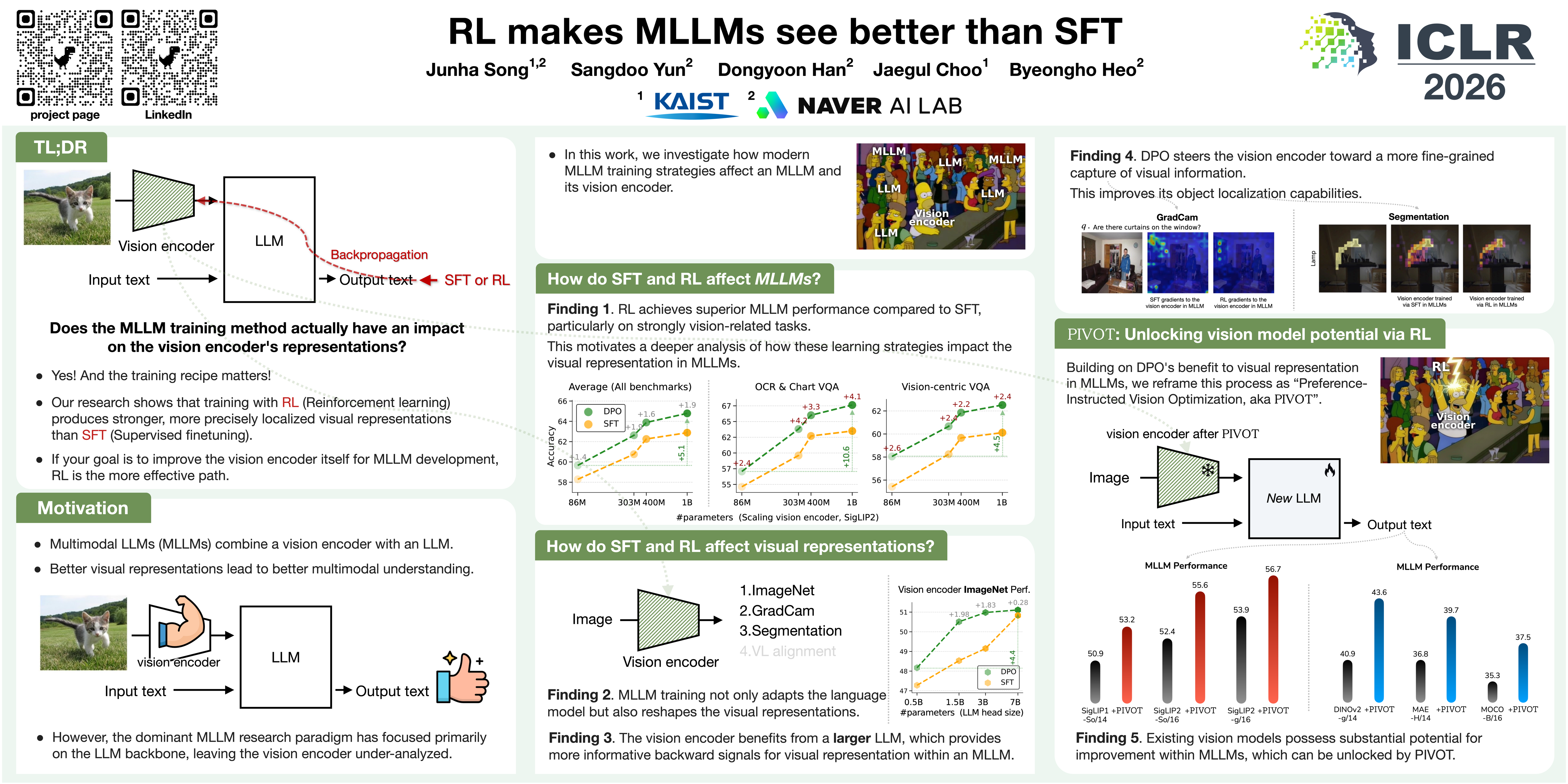
A dominant assumption in Multimodal Language Model (MLLM) research is that its performance is largely inherited from the LLM backbone, given its immense parameter scale and remarkable capabilities. This has created a void in the understanding of the vision encoder, which determines 'how MLLMs perceive images'. The recent shift in MLLM training paradigms, from Supervised Finetuning (SFT) to Reinforcement Learning (RL), magnifies this oversight—namely, the significant lack of analysis on how such training reshapes the vision encoder as well as the MLLM. To address this, we first investigate the impact of training strategies on MLLMs, where RL shows a clear advantage in strongly vision-related VQA benchmarks than SFT. Motivated by this, we conduct a critical yet under-explored analysis of the vision encoder of MLLMs through diverse and in-depth experiments, ranging from ImageNet classification and segmentation to gradient visualization. Our results demonstrate that MLLM's post-training strategy 'i.e, SFT or RL' not only leads to disctinct outcomes on MLLM downstream tasks, but also fundamentally reshapes MLLM's underlying visual representations. Specifically, our main finding is that RL produces stronger and more localized visual representations compared to SFT, boosting the ability of the vision encoder for MLLM. We then reframe our findings into a simple recipe for building strong vision encoders for MLLMs, Preference-Instructed Vision OpTimization (PIVOT). When integrated into MLLMs, a PIVOT-trained vision encoder outperforms even larger and more heavily-trained counterparts, despite requiring less than 1\% of the computational cost of standard vision pretraining. This result opens an effective and efficient path for advancing the vision backbones of MLLMs.