
Scaling with Collapse: Efficient and Predictable Training of LLM Families
Abstract
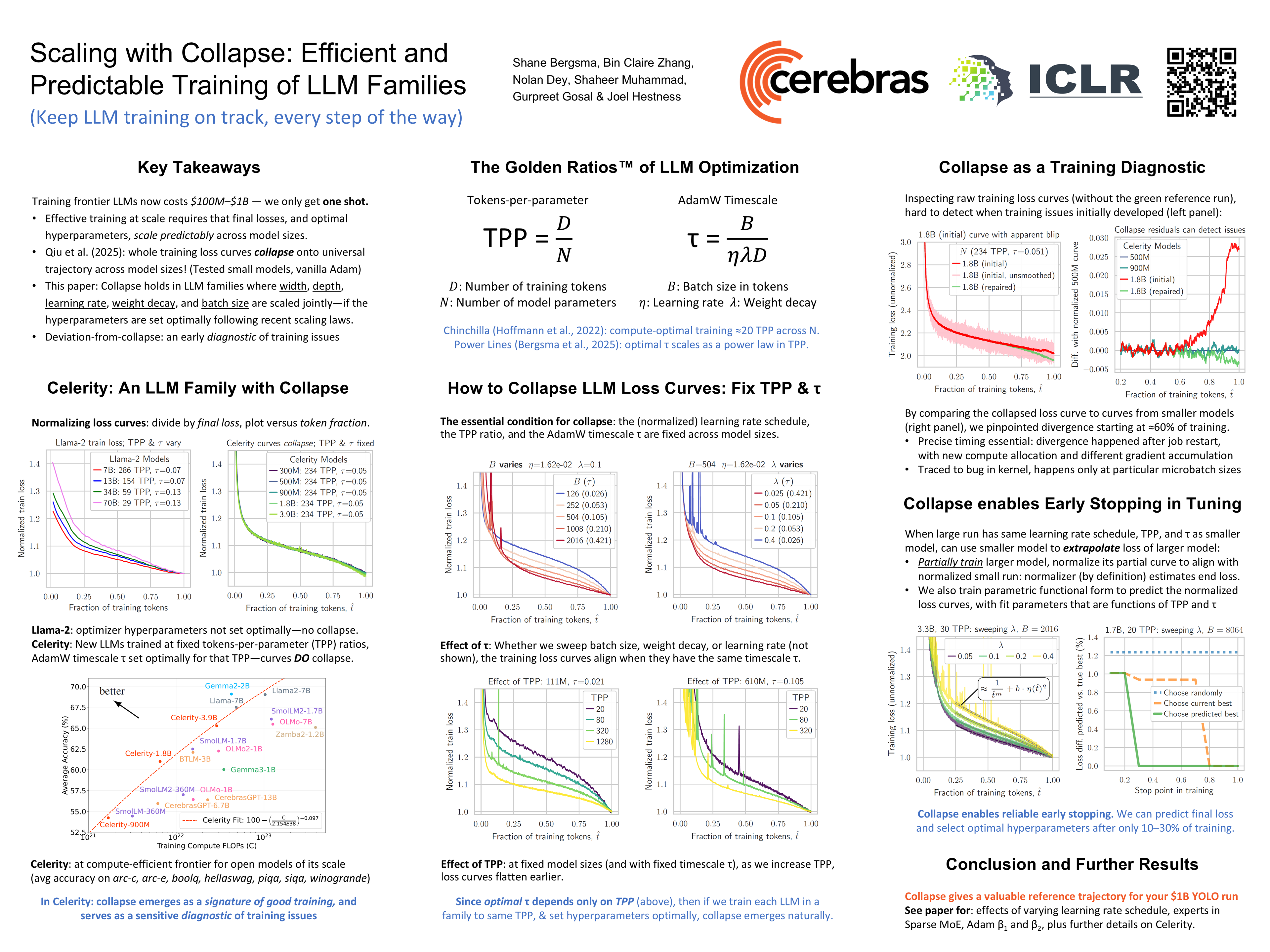
Effective LLM training depends on predictable scaling of key quantities—such as final loss and optimal hyperparameters—with model and dataset size. Qiu et al. (2025) recently showed that this predictability can extend beyond scalars: whole training loss curves can collapse onto a universal trajectory after a simple normalization. What remains unclear is whether this phenomenon persists for LLM families trained under practical scaling recipes, where width, depth, learning rate, batch size, and weight decay are scaled jointly. We show that it does: loss curves collapse across scales precisely when optimization hyperparameters are set optimally for the given data budget, in accordance with recent empirical scaling laws. Collapse therefore emerges as a signature of compute-efficient training. We demonstrate two applications at scale: (1) deviation-from-collapse provides a sensitive, early diagnostic of training pathologies, and (2) predictability of collapsed curves enables early stopping in large-scale hyperparameter tuning. Finally, we train a competitive LLM family, Celerity, using these insights, establishing collapse as an effective tool for developing efficient LLMs.